|
Yes, assimilation is good
Building a unified American culture isn't about bullying people; it's about living together in peace.
|

| |||||||||||||||


 |
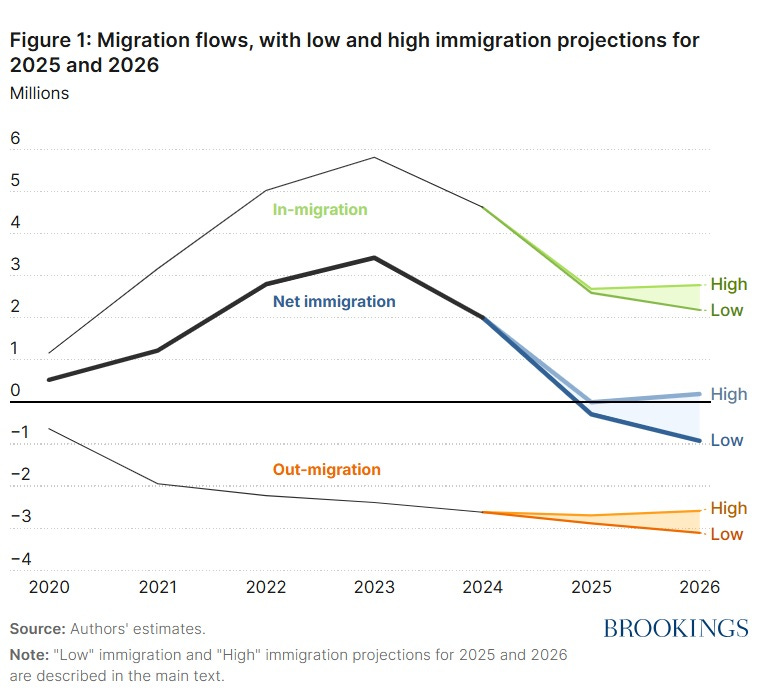
The immigration issue in America isn’t going away. Thanks to Trump’s crackdown, immigration to the U.S. went into reverse in 2025, with more people leaving (voluntarily or involuntarily) than entering the country:
 |
But just like a century ago, shutting the gates isn’t the end of the discussion. The argument has shifted from who gets in to America to who belongs here in the first place.
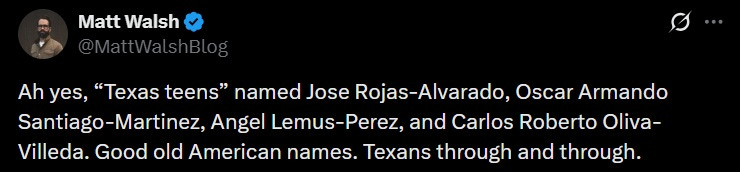
To much of the MAGA right, the answer appears to be that only people of European heritage can become true Americans. For example, here is how right-wing commentator Matt Walsh responded to news about some crimes by some Texan teens:
 |
Anyone who thinks these aren’t Texan names isn’t very familiar with the history of Texas; the Tejanos (Mexican Texans) were there from the beginning, and were a core part of the Texas Revolution. Most Mexican Texans today aren’t descended from the original Tejanos, but from more recent immigrants. But the fact that the Tejanos were there from the start is probably why Hispanics, and Mexicans in particular, have always been deeply integrated into Texan culture. It was at the behest of Texan businessmen that America didn’t put any cap on Mexican immigration in 1924, when it passed a law effectively barring immigration from most other countries.
Matt Walsh is unaware of most of that; to him, anyone without an Anglo-sounding name is presumptively non-American. This leaves little doubt as to what Walsh views as the marker of true American-ness. It’s likely that many others in the MAGA movement feel similarly, even if many would feel uncomfortable stating it out loud in simple terms. Anti-Indian sentiment has also risen to prominence on the right.
And many in the MAGA movement view Muslim immigration as an invasion, bent on imposing Sharia law on Westerners. They believe this “invasion” has already overtaken Europe, which explains their antipathy toward the EU and NATO. A “Sharia Free Caucus” is growing in popularity in Congress, and Ron DeSantis has signed anti-Sharia legislation in Florida. Various Republican politicians have explicitly stated that Muslims don’t belong in America.
If you’re Hispanic, Muslim, or Indian, there’s just not much you can do about this. In the past, showing that you were a good American — waving the flag, joining the army, speaking perfect English, and so on — was good enough to reassure most conservatives that you weren’t an invader bent on overthrowing America’s culture and replacing it with something alien. Nowadays, that’s not enough.
So perhaps it’s unsurprising that some nonwhite Americans are choosing to simply throw in the towel and reject the whole notion of assimilation. This is the essence of Shadi Hamid’s article in the Washington Post yesterday. He writes:
The assimilation defense — look how well we’ve integrated — is satisfying to make. But it concedes a premise I no longer accept: that a minority community’s right to be in the United States depends on its willingness to converge with the cultural mainstream. It shouldn’t depend on that. It shouldn’t depend on anything.
Whereas in the past, Hamid saw assimilation as synonymous with patriotism, now he sees it as a requirement to give up the religion of Islam itself:
The country is becoming less religious. Muslims, by and large, are not…This is a community that has increasingly integrated into American civic life, but it has done so while holding on to its religious commitments in a way that most other groups haven’t. Whether you think that's admirable or worrying probably says more about you than it does about them. The question I keep returning to is: Why do Muslims need to be like everyone else?…[A]ssimilation tends to mean secularization.
Whether Hamid is right that “assimilation tends to mean secularization” is an open question. Assimilation certainly didn’t require Catholic or Jewish Americans to give up their religion when they immigrated en masse in the 19th and early 20th centuries. Religious liberty is a fundamental part of the Constitution and of American tradition. On the other hand, even some immigration advocates do use conversion away from Islam as a measure of assimilation, and a growing number of Republicans — heavily influenced by their view of events in Europe — sees the religion as incompatible with American-ness.
Hamid is no blue-haired progressive — in fact, he’s explicitly anti-woke and fairly conservative. But his call to reject assimilation will be music to the ears of progressives, who have loudly and vehemently rejected assimilation for many years. A recent example of this is Bianca Mabute-Louie, whose new book Unassimilable: An Asian Diasporic Manifesto for the Twenty-First Century is a call for Asian Americans to resist assimilation by building communities and culture apart from White Americans. In a recent interview, NPR’s Alisa Chang gently pu