Hi! Bankers, assemble: After Anthropic warned that its new AI model is too dangerous to release, Scott Bessent and Jerome Powell “summoned” the leaders of the biggest US banks for an “urgent meeting” to discuss cybersecurity risks, per Bloomberg. Today we’re exploring:
|
- Family ties: America’s fertility rate just hit another record low.
- Record sums: How much does Universal Music Group actually pay its artists?
|
More babies are now born to parents over 40 than under 20 in the US |
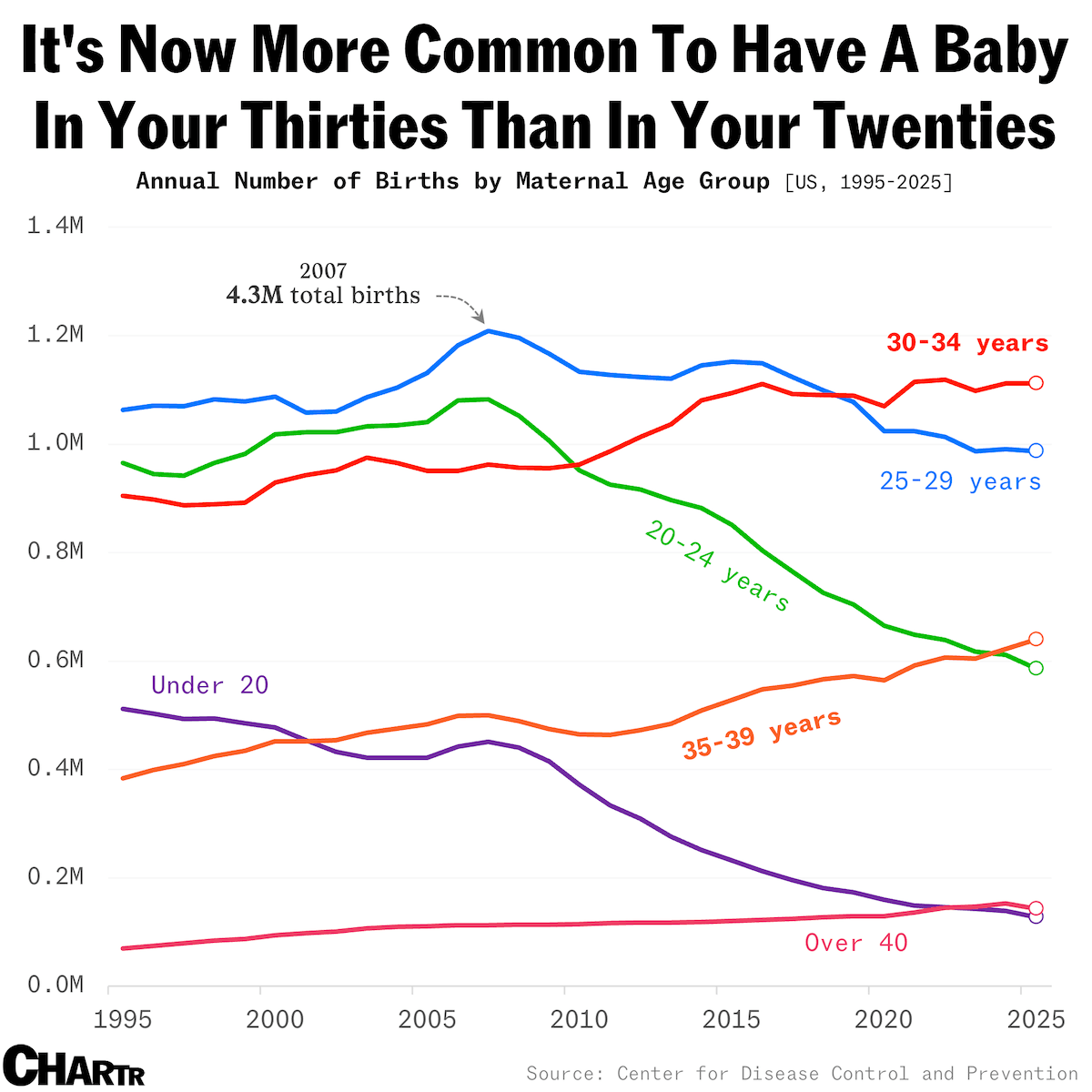
In what will come as a surprise to very few demographers, the US fertility rate slumped to another all-time low last year, per data from the Centers for Disease Control and Prevention released Thursday. Continuing almost two decades of decline and compounding one of the most consequential long-term trends of our age, America’s general fertility rate — the number of births per 1,000 women aged 15 to 44 years old — fell slightly from 53.8 in 2024 to 53.1 in 2025, marking yet another record low. At the same time, the number of births in the US hovered at ~3.6 million for a sixth straight year, some 700,000 less than in 2007.
So, despite a growing pronatalist movement and a spate of government-proposed fertility incentives, including discussions for a $5,000 “baby bonus,” fewer children are being born in America. But while this contraction has been driven in part by those rejecting having kids altogether, much of it can also be explained by more people delaying starting a family until later in life.
|
Looking at the CDC data, the total number of births in the US last year was highest for women aged 30 to 34 years, at 1.1 million, extending the cohort’s lead over women aged 25 to 29 (~990,000 births). Adjusting for population size, fertility rates for US women in their late 30s surpassed those for women in their early 20s for the first time last year.
Zooming into extremes at both ends, a similar phenomenon is observed: in each of the last three years, there were more babies born to American women over 40 years old (~147,000 on average) than to women aged under 20 (~136,000). As recently as 1995, those aged under 20 were having more than 7x as many babies as the over-40 cohort, per CDC figures.
|
Though the veracity of economist Mike Konczal’s “later, not less” fertility theory has been debated, what the CDC data does point to is adolescent births decreasing with improved contraceptive access; births in advanced age groups increasing with reproductive medical advancements; and a total fertility rate that’s sinking further from the replacement level of 2.1.
What does this tell us? Well, for one, that American women appear to be exercising more control over their fertility, whether that be due to financial worries, personal relationships, education, employment, or just general uncertainty about the future (or, most likely, all of the above). |
As “artist-centric” Universal mulls a merger deal, how much does it actually pay out to artists? |
The music industry has come a long way in the last 20 years, and billionaire investor Bill Ackman’s latest big bet — a $64 billion merger proposal for Universal Music Group — is a testament to that, particularly considering that the offer is at a whopping 78% premium to the company’s closing price on Monday.
According to Pershing Square, the move reflects its view that the stock has “languished” from “a combination of issues that are unrelated to the performance of its music business.” It also continues Ackman’s long-standing belief that Universal’s copyright ownership offers “forever” cash flows for the company, since it owns the rights to roughly one-third of the world’s recorded music, including records by The Beatles.
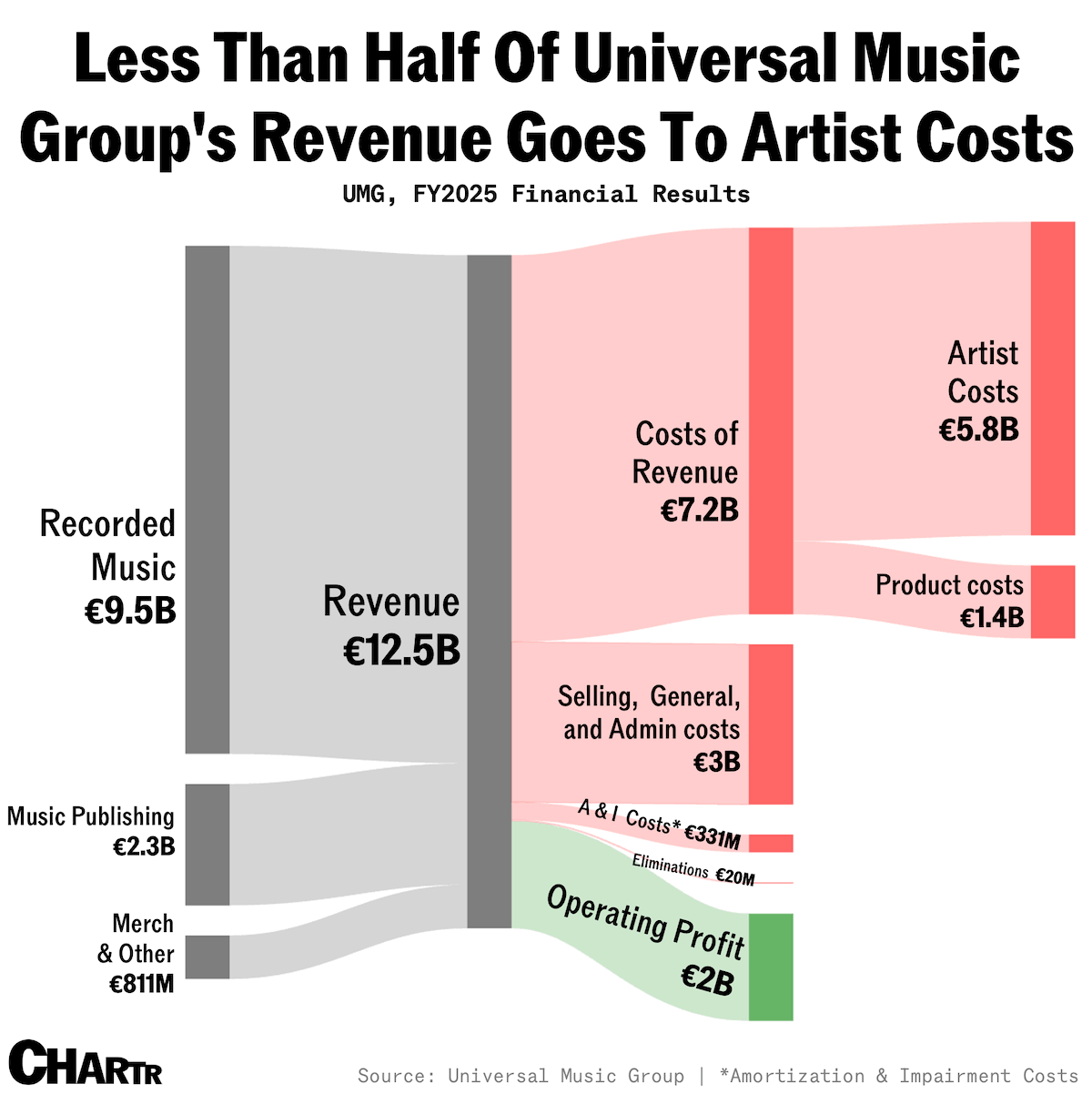
Indeed, even as Universal doubled down on being “artist-centric,” it continued to grow its bottom line (up 13%) faster than its artist costs (up 7%). All told, the company reported $5.8 billion in artist payments on total revenues of $12.5 billion. |
To grow its profits, UMG has been doubling down on direct-to-consumer channels to squeeze sales from “superfans,” noting that its D2C business — which includes sales from physical music, merchandise, and fan platforms — has been growing more than 30% each year.
While only 47% of its revenue was paid towards artist costs, that was still higher than peer Warner Music, which reported that just 35% of its revenue went explicitly towards artists in FY2025. Even so, these payouts don’t necessarily reflect the number that artists see in their bank accounts: those payments are split among managing agencies, performing rights organizations, songwriters, and more.
|
|
|
-
Amazon yesterday disclosed that its cloud unit’s AI revenue run rate topped $15 billion in Q1 2026, which is 260x what its web services division made at a similar time in its maturity.
-
Closed d’Or? The lineup for the Cannes Film Festival was announced Thursday, and 65% of the Competition films come from just 3 countries, with only one film heralding from the US.
-
Gallup’s latest State of the Global Workplace report found that global employee engagement declined to 20% last year — the lowest level seen since 2020.
-
TSMC posted a 35% sales jump in the first quarter as demand for its advanced AI chips remained strong.
-
Gloves on, gloves off… Boxer Tyson Fury is officially returning to the ring on Saturday, marking his fifth ‘un-retirement’ since 2016.
|
|
|
-
This Artemis II tracker puts live NASA data into a mission control-style dashboard, including wake-up songs and whether the space toilet is working.
-
Big Bluey: Stat Significant breaks down how a kids’ cartoon became streaming’s biggest show.
|
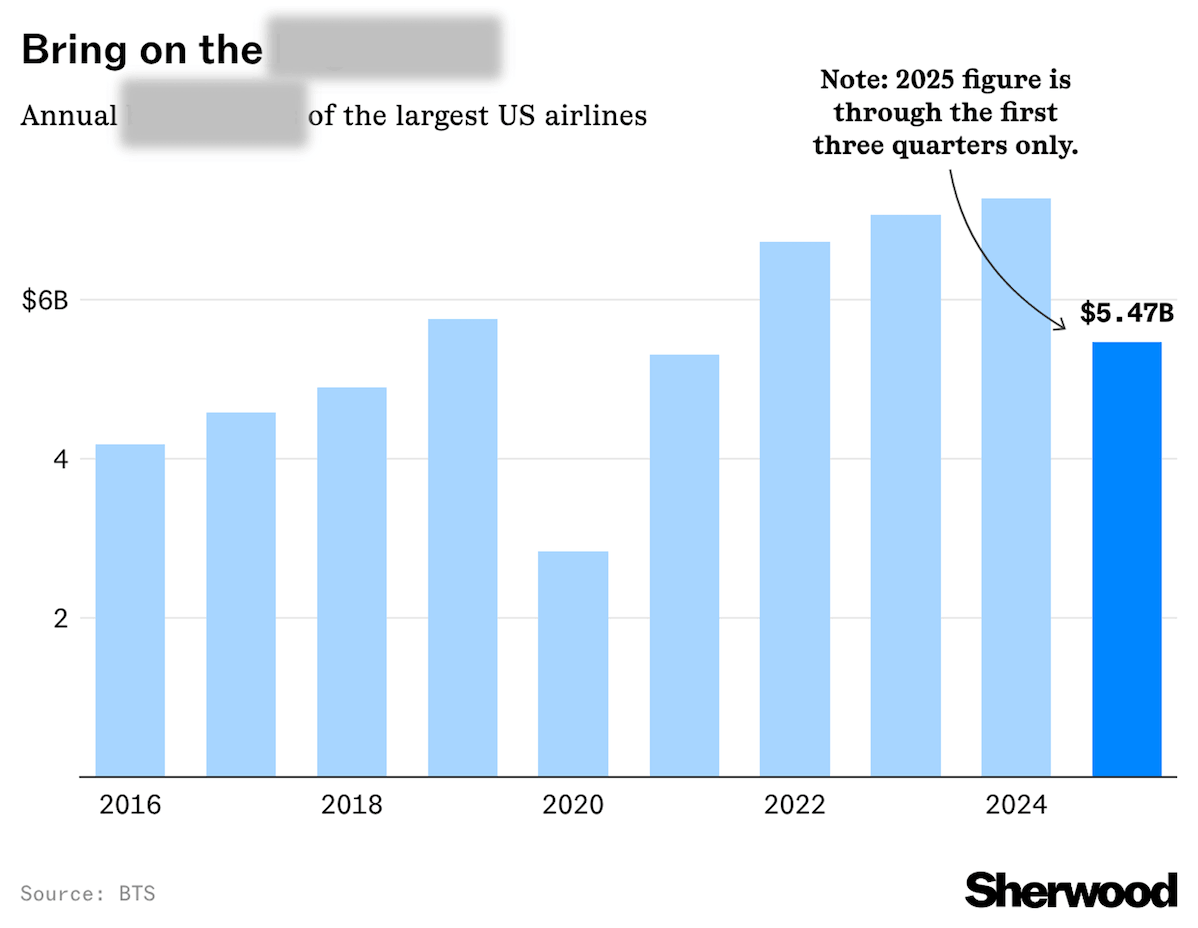
Off the charts: Which booming part of the business have US airlines been relying on more lately in light of rising fuel costs? [Answer below]. |
Not a subscriber? Sign up for free below. |
Sherwood Media, LLC produces fresh and unique perspectives on topical financial news and is a fully owned subsidiary of Robinhood Markets, Inc., and any views expressed here do not necessarily reflect the views of any other Robinhood affiliate... See more |
|
|
SHERWOOD MEDIA, LLC, 85 Willow Road, Menlo Park, CA 94025 |
|
|
|