I paused. As an investigative reporter at ProPublica, I’m reaching out to a lot of people all the time. But as I racked my brain, I couldn’t think of any Canadians I had recently tried to develop as sources.
It seems as though someone is impersonating you, the man warned.
I was at a loss. What was Fake Me asking about? Were they just using my name or my picture too? How could I be sure the person warning me about this impostor wasn’t actually an impostor himself?
The Canadian official assured me he’d send a message from his government email to confirm his identity, and he’d include screenshots of his conversation with Fake Me. I thanked him, and we exchanged some pleasantries. Before saying goodbye, I asked him if there was anything he’d like to get on the radar of an investigative reporter. (Without even realizing it, I was working him for information. Maybe Fake Me and Real Me aren’t so different.)
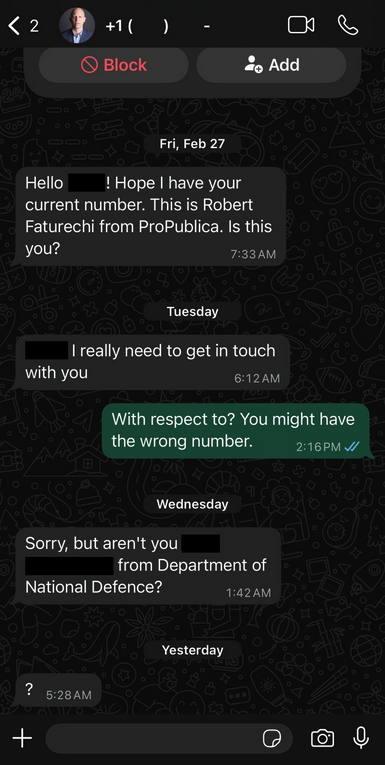
The screenshots the Canadian sent over later showed someone with a Miami number using my ProPublica headshot as their profile pic. I’ve never lived in Florida.
“This is Robert Faturechi from ProPublica,” Fake Me wrote. “I really need to get in touch with you.”
The Canadian asked me not to publicly reveal too many details about his work, but it involves dealing with other countries, including Ukraine.
I alerted our security team at ProPublica. They told me that there was little we could do aside from reporting the fake account to WhatsApp.
We did, and I put the matter behind me — until two weeks later, when I got another warning.
This time it was a Latvian businessman who said he runs an organization providing equipment to the Ukrainian military and is involved in a drone development project with Ukrainian forces.
“Hey!” the Latvian wrote to me on LinkedIn. “Was good to chat on Signal! Let’s connect here as well!”
The only problem was I had never chatted with him on Signal, the encrypted messaging app.
The Latvian reached out to me on LinkedIn because he was concerned he wasn’t talking to Real Me on Signal. He sent over screenshots of someone using my headshot and claiming to be me.
“Am I right in understanding that you are an expert in the field of UAVs?” Fake Me had messaged the Latvian, referring to unmanned aerial vehicles, a fancy term for drones.
“My clients,” the impostor explained, “are particularly interested in the application of UAVs in Ukraine.”
The Latvian had offered to discuss the topic in a phone call, but Fake Me (who could be a man or woman) declined, saying they weren’t “comfortable” talking on the phone. They asked to continue the “conversation in written format” or if the Latvian could “record a voice message on this topic.”
The Latvian, growing suspicious, insisted on a video call. Fake Me relented, sending him step-by-step instructions they said would result in a secure video chat, but that actually appeared to have been an attempt to trick the Latvian into giving up access to his email account.
The Latvian ultimately blocked Fake Me.
The impersonations were disquieting. Investigative reporting is hard enough with public trust in media so low and those in power stepping up attacks against journalists. Scammers giving potential sources another thing to worry about just makes our work more difficult.
I can’t be certain what Fake Me is up to, but posing as a journalist in this way seems to be the latest evolution in online deception. ProPublica has chronicled the dark world of pig butchering, in which human traffickers in Asia force their victims to scam people by posing as friends or potential romantic interests. In those cases, the goal is cash.
But sometimes the objective is stealing sensitive information. And even sophisticated actors can fall victim to so-called phishing attacks, in which scammers impersonate legitimate entities. One of the most notable and perhaps consequential instances was when John Podesta, chair of Hillary Clinton’s 2016 presidential campaign, fell victim to an email purporting to be a Google security alert, giving hackers access to his personal Gmail account. Thousands of his emails, some of them quite damaging to Clinton and the Democratic Party, were published online.