| | In today’s edition: Business leaders remain cautiously optimistic about post-war recovery, while the͏ ͏ ͏ ͏ ͏ ͏ |
| |  Washington Washington | Dubai | Kuwait City |
 | Gulf |  |
| |
|
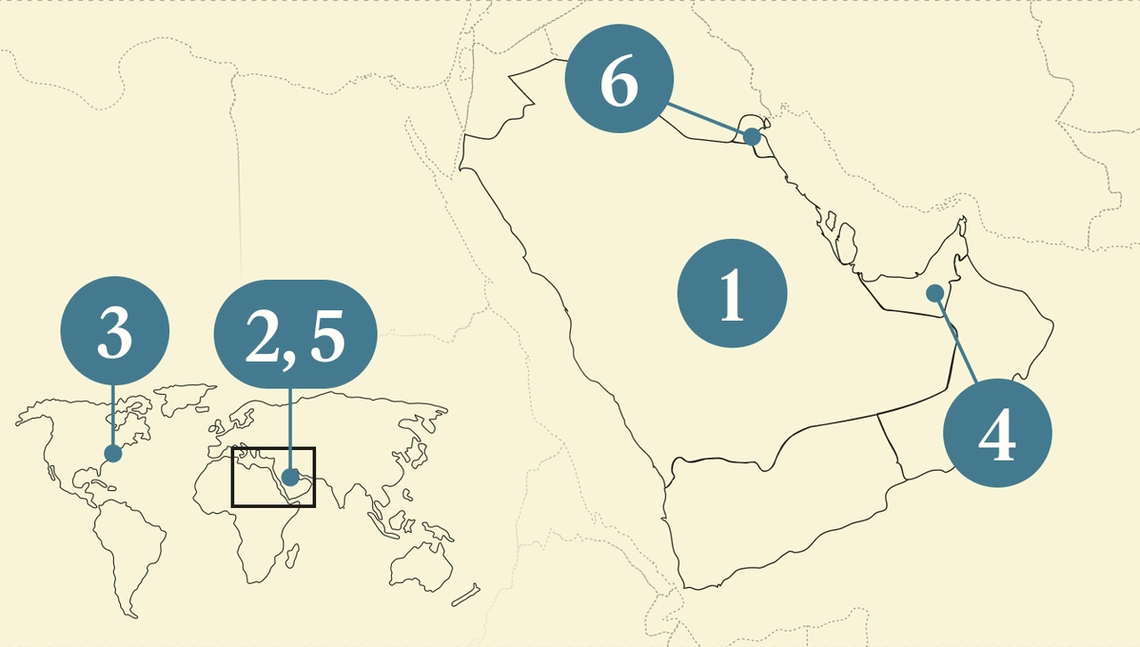 - PIF sets new course
- IMF expects sharp dip
- Gulf shows deal resilience
- Dubai spending recovers
- Reviving oil output
- Citizen changes in Kuwait
 Abu Dhabi’s crown prince secures investment deal with China. |
|
 Stringer/Reuters Stringer/ReutersSaudi Arabia’s Public Investment Fund will focus on improving the efficiency and impact of its investments as part of a new five-year strategy announced today, after being forced to cut some of its most ambitious plans. The sovereign wealth fund said it would also look to increase private sector activity in the kingdom, a recognition of criticism that its activities had crowded out other investors in the past. Under the new strategy, PIF has structured its investments into three portfolios: vision, strategic, and financial. The plan will take it up to 2030, a key milestone in the kingdom’s economic transformation under Crown Prince Mohammed Bin Salman. PIF had already started to pivot in recent years, as a combination of lower oil prices, weaker-than-expected foreign investment levels, and runaway spending on so-called giga projects like NEOM led the fund to curtail some of its ambitions. In 2024, the fund took an $8 billion writedown on the value of its giga projects. — Matthew Martin |
|
IMF outlines extent of pain |
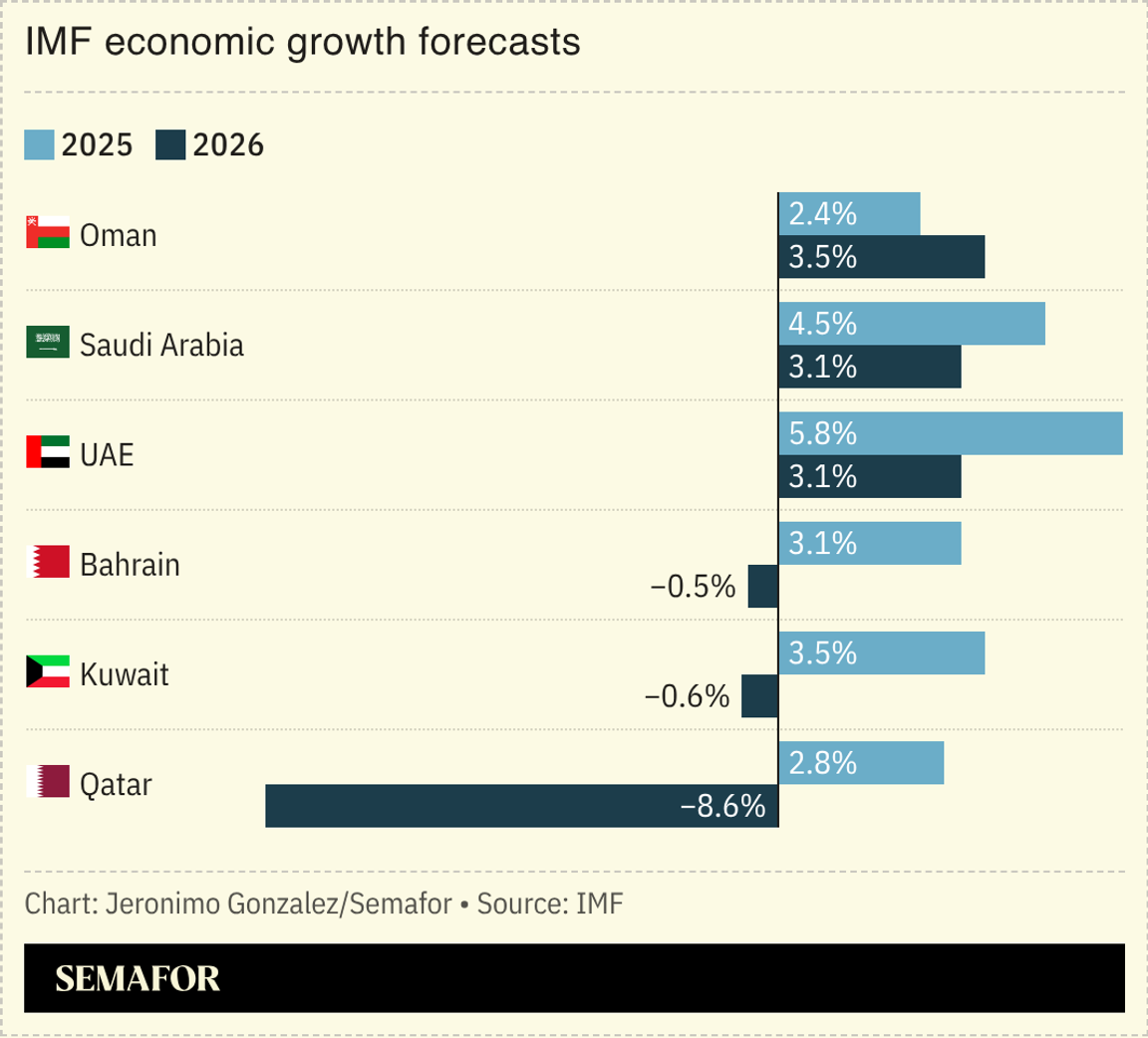 The costs of the war from damaged infrastructure, lost export revenues, and weaker business activity continue to mount — and are translating into a sharp slowdown for most Gulf economies, according to the International Monetary Fund. Growth across the Middle East is expected to be just 1.9% this year, compared to the 3.9% the IMF had predicted before the Iran war began. “The impact of the war will be uneven,” said Pierre-Olivier Gourinchas, the IMF’s chief economist. “But the damage is most severe for countries in the Gulf.” The region’s biggest economy, Saudi Arabia, should grow more quickly than the region as a whole, but still far more slowly than the IMF had previously anticipated. Qatar’s economy is expected to contract sharply, after its LNG export capacity was severely damaged. War is not the only concern. The IMF also pointed to the risk of renewed trade tensions and the chance that AI will not provide the productivity boost its advocates claim. Even those downbeat predictions might be too rosy: UK-based Oxford Economics said the IMF’s forecast of 3.1% global growth was “still too optimistic,” warning that oil prices will likely stay higher for longer than the Washington-based lender expects. — Dominic Dudley |
|
  Dina Powell McCormick. Annabelle Gordon/Semafor Dina Powell McCormick. Annabelle Gordon/SemaforBusiness leaders with Gulf ties, speaking at Semafor World Economy, cautiously forecast a comeback for the region. Meta President and Vice Chair Dina Powell McCormick said she didn’t see state-backed investors “waiting” on deals because of the conflict, and that she expected Saudi Arabia, the UAE, and Qatar — where diversification strategies have led to big long-term bets on technology — to stay on course with their ambitious plans. Sovereign wealth funds may make more inward investments to replace damaged infrastructure and stanch losses from a fall in expat residents and tourism that are “going to take a little bit longer to get back,” according to John Toomey, the CEO of Harbourvest Partners, which has an office in Abu Dhabi. Still, Toomey said his firm remains committed to the region. In another signal of confidence in the UAE, Bain Capital said it is opening an office in Abu Dhabi initially staffed with five to 10 employees. Hotel developments in tourist-hungry places like the UAE and Saudi Arabia are proceeding, according to Hilton CEO Chris Nassetta, though he acknowledged the tourists may be slow to return: “People have a long memory.” MetLife CEO Michel Khalaf was similarly circumspect: “The UAE built its economy, its brand on stability … I wouldn’t say that’s shattered today, but certainly that’s a bit in question.” — Kelsey Warner |
|
| More from Semafor World Economy |
|
| Gulf connections today at Semafor World Economy |
  - David Rubenstein, Co-Founder, Carlyle Group
- Sean Cairncross, Director, White House Cyber
- John Waldron, President, Goldman Sachs
- Orlando Bravo, Founder & Managing Partner, Thoma Bravo
- Rene Haas, CEO, Arm Holdings
- Reem Al Hashimy, Minister of State for International Cooperation, UAE
 - Majid Al Suwaidi, CEO, ALTÉRRA
- Divesh Makan, Founder, ICONIQ Capital
- Christian Ulbrich, CEO, JLL
- Alexander Wynaendts, Chairman, Deutsche Bank AG
|
|
Dubai bills itself comeback city |
 Hadi Badri. Kris Tripplaar/Semafor Hadi Badri. Kris Tripplaar/SemaforDomestic spending in Dubai is nearly back to prewar levels because the majority of the city’s residents stuck around despite being under heavy bombardment from Iran, according to the CEO of the Dubai Economic Development Corporation. Hadi Badri said at Semafor World Economy that the impact of the conflict on residents of the UAE’s largest city had been “more psychological than anything.” Around 500 flights are coming in and out of the city every day, with Emirates operating about two-thirds of its normal schedule, according to Badri. He noted that domestic spending had largely recovered from an initial shock after the first missiles and drones were launched by Iran, and was now “only a few percentage points shy” of pre-conflict levels, as a fragile ceasefire between the US and Iran holds. But numbers are shakier at the top-end of Dubai’s economy. The city had been a key destination for the ultra-wealthy to set up residency post-pandemic, but it is expected to draw fewer millionaires and billionaires this year, Enterprise News reported, citing New World Wealth. And luxury brands in March reported sales drops of up to 50% at the Mall of the Emirates, compared to the same month last year, according to Reuters. — Kelsey Warner |
|
Reviving oil output could take months |
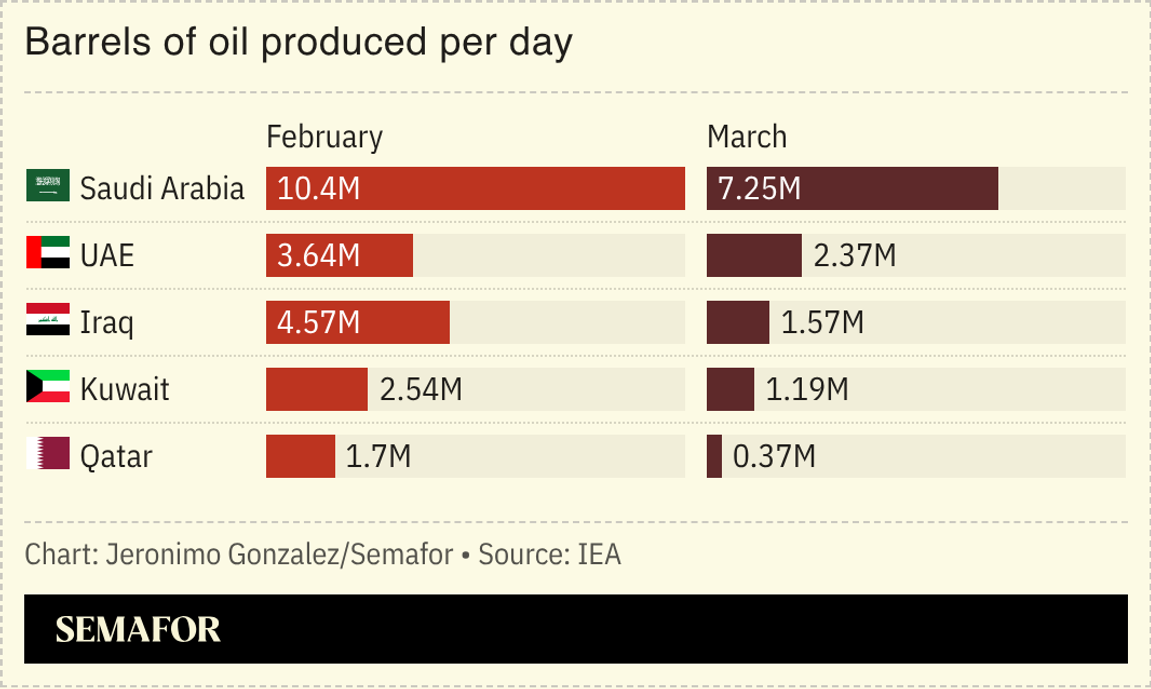 It will take around two months for Gulf countries to resume a steady flow of oil exports once the war ends, according to the International Energy Agency. In its latest report on the oil market, the Paris-based organization said exports were down by 13 million barrels a day and global demand was set to be 810,000 barrels a day lower this year than had been expected before the war. Reviving Gulf production presents numerous challenges, including the need for oil-laden tankers to move out of Gulf waters and full storage facilities to be drawn down before more ships can come into port. Fatih Birol, the IEA’s executive director, predicted at Semafor World Economy that “we are not going back to where we were” after the Strait of Hormuz reopens. Tankers that usually carry Gulf exports have been redeployed elsewhere, adding to the logistical difficulties. Some oil fields will be hard to restart because of technical issues such as low reservoir pressure. “Ultimately, some pre-conflict production may not return,” the IEA said in its report. The conflict has underlined the need for Gulf countries to expand their logistics operations to improve resilience. In line with that, Abu Dhabi’s AD Ports Group has approached the Egyptian government about leasing oil storage facilities there, according to the Arabic-language Al-Sharq Business. AD Ports is also eyeing a potential investment in Romania’s Port of Constanța, the largest port of the Black Sea. |
|
Kuwait tightens routes to citizenship |
 Kuwait City. Stephanie McGehee/Reuters Kuwait City. Stephanie McGehee/ReutersKuwait has tightened its citizenship rules, the latest step in a campaign that has already seen tens of thousands lose their passports. Under a law published this week, which takes effect immediately, the government has been given greater authority to withdraw citizenship in cases involving fraud, false information, or national security issues, and decisions are not subject to judicial appeal. Among the other provisions, foreign women are no longer able to obtain Kuwaiti citizenship by marrying a local man; previously they could do so after five years of marriage. A woman who has previously gained citizenship through marriage may lose it if the marriage ends and she has no children. A further 146 people had their citizenship revoked this week, in the latest decisions by the Higher Committee for Kuwaiti Citizenship. The more repressive atmosphere in the country was underlined by the arrest in March of journalist Ahmed Shihab-Eldin, who was born in the US and is a Kuwaiti citizen. (His father is a prominent energy executive who represented Kuwait at OPEC.) |
|
 Semafor World Economy is well underway with more than 500 CEOs and government leaders — including US Cabinet secretaries, central bank governors, finance ministers, and Fortune 500 executives — joining us for on-the-record conversations about the forces shaping the global economy. Today’s sessions include discussions on Building Human-Centered Business, |
|
|


