| | In this edition: Why tokens are now central to AI conversations, and Mark Zuckerberg makes a big mov͏ ͏ ͏ ͏ ͏ ͏ |
| |  | Technology |  |
| |
|
 - Semafor World Economy
- Dell on AI bubble
- Quantum opportunity
- Where Zuck stands
- EV sales rise
 Anthropic’s Mythos model offers a glimpse of the future, and vibe coding leads to an explosion in new apps. |
|
 One of the nice things about being at Semafor World Economy in DC all week is that it takes me outside the Silicon Valley bubble and I get to hear what non-tech CEOs and leaders are talking about. One of the big topics is Anthropic’s Mythos AI model, which has clearly struck fear into a segment of the population out here. After a handful of discussions with people who know what they’re talking about and some who don’t, here’s how I think the world should be processing this. Mythos, and now OpenAI’s GPT 5.4-cyber, represent a step up in AI capability that could allow hackers to find more exploits in software. Part of what makes these models powerful is the high number of tokens they require to operate. In that sense, they’re a glimpse into an AI future, when the cost of tokens inevitably comes down. But the change might not be as dramatic as some people think. Imagine a bunch of bike racks in a public place. Some of the bikes have big, powerful locks. Some have puny cable locks that can be broken with pliers. And a lot of them have no locks at all. AI is like giving bike thieves better lock cutters. But the bigger problem is that there’s already an endless supply of unlocked or poorly locked bikes. More bikes will be stolen, but only marginally so. Mythos, hopefully, is a wake-up call for the entire industry that everybody needs to start investing more in cybersecurity. We need better ways to help people use basic security. Password managers and passkeys just aren’t user friendly. Companies need to work on new, innovative methods of authentication that preserve privacy and anonymity. Companies need to empower teams of software engineers who fix bugs, one area of notorious underinvestment. All of this should have already happened. Perhaps fear will be the motivator the world needs. |
|
Highlights from the stage |
|
Token demand eases bubble fears |
  Michael Dell. Tasos Katopodis/Getty Images for Semafor Michael Dell. Tasos Katopodis/Getty Images for SemaforToken cost and availability are becoming central to AI conversations, so much so that according to Michael Dell, the issue answers one of the big questions about the technology of the past year: Are we in a bubble? “The demand [for tokens] is in excess of the supply, by a lot,” the Dell CEO said Tuesday at Semafor World Economy. “It would be hard for there to be a bubble right now, just because there’s not enough supply.” He anticipated some level of market correction, but not anytime soon: “At some point, the markets always overcorrect and there will be too much, but I don’t see it at any time in the next couple of years,” he added later at a dinner hosted by Semafor. Dell expects its server business to reach $50 billion in revenue this year, roughly double what it made last year. Since updating its sales outlook in February, its stock price has increased by 50%, valuing the 40-year-old computer-maker at $120 billion. |
|
A major US quantum opportunity |
 Pete Shadbolt. Annabelle Gordon/Getty Images for Semafor Pete Shadbolt. Annabelle Gordon/Getty Images for SemaforThe US’ quantum opportunity isn’t just in developing the first large-scale, usable quantum computer, but in building the supply chain behind it, according to Pete Shadbolt, co-founder and chief scientific officer at quantum company PsiQuantum. “That’s a thrilling opportunity that comes with the novelty of the technology, but also I think it’s really important to treat it seriously,” Shadbolt said at Semafor World Economy. The tech was drawing lots of buzz (and investors) on Tuesday, World Quantum Day. As Nvidia announced new AI models intended to advance quantum error correction, quantum hardware and software company D-Wave said Nvidia is building chips increasingly difficult to power. “If I was Nvidia, I’d be shaking in my boots,” D-Wave CEO Alan Baratz said at Semafor World Economy, touting his company’s own efficient approach. |
|
Zuckerberg is back to the basics |
 Dina Powell McCormick. Annabelle Gordon/Semafor Dina Powell McCormick. Annabelle Gordon/SemaforThe old office adage goes: “Where you stand depends on where you sit.” By those standards, Mark Zuckerberg is going back to the basics. The Meta CEO has “actually moved his desk and is seated in the AI lab … and he’s coding all day long,” said Dina Powell McCormick, president and vice chairman at the company. “I think he feels so strongly that he has to understand it at that level to really think about how to make our model the strongest it can be,” she said at Semafor World Economy on Tuesday. Meta has fallen behind on capabilities, with its Llama family of models unable to generate the kind of hype that has accompanied releases from its competitors. Earlier this month, the company announced a new model — the first under chief AI officer Alexandr Wang — that will plug into Instagram, Facebook, WhatsApp, and Meta’s smart glasses. |
|
Hyundai’s US EV sales up 40% |
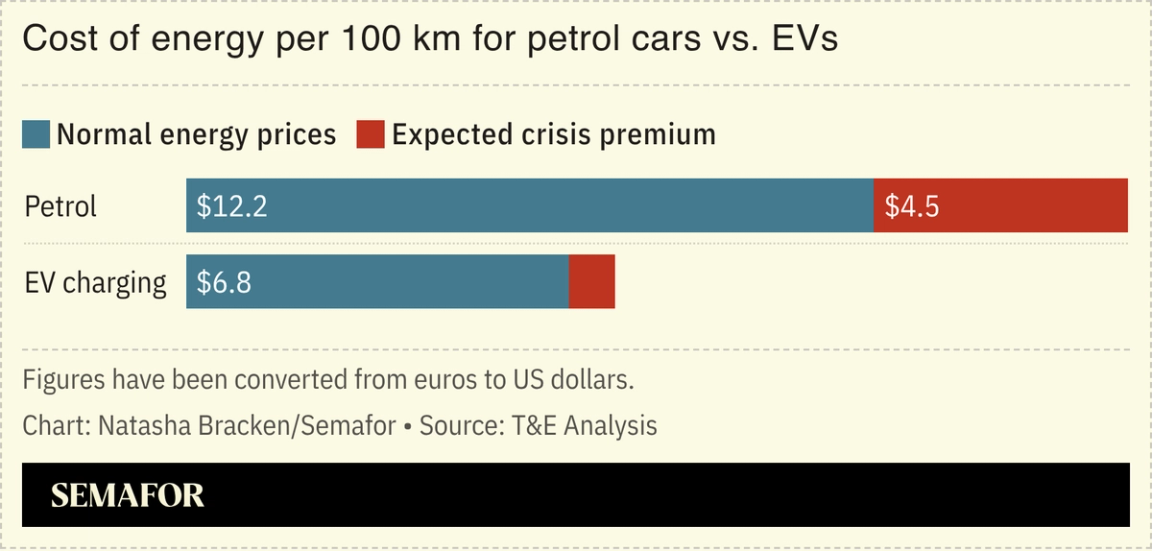 While the Iran war has disrupted global supply chains, it has also created opportunities for companies making clean energy technology and electric vehicles. Hyundai’s EV sales in the US increased by 40% from February to March, as fuel prices rose due to supply shortages, CEO José Muñoz said at a Semafor dinner Tuesday. The situation has highlighted the back-and-forth nature of EV demand that has plagued car companies in recent years. “One day, [dealers] call you and they say, ‘please stop producing EVs,’” he said. “The day after, they call you and say, ‘why [are you] not producing more?’” EV sales have fallen since the $7,500 tax credit to Americans buying the cars ended last year, Business Insider reported. But it doesn’t represent a retreat from EVs. In March, Hyundai saw its sales mix return to the same level as before the tax credits, Muñoz said. “So we’re happy with that, but we would like to sell even more.” |
|
 Yves Herman/Reuters Yves Herman/ReutersApple’s App Store has seen a staggering increase in new apps as vibe coding lowers the barriers to programming. The number of new apps declined between 2016 and 2024, but then shot up 30% in 2025. The momentum has increased too, with Q1 2026 having 84% more than the same period last year. AI coding tools have driven the increase, an analyst told The Information; one Semafor writer, whose children are using Claude to build a zombie survival game, can confirm. Vibecoding is having other, less positive impacts: Tech workers are now producing more code than their companies can check, The New York Times reported, leaving it at risk of crashes or security vulnerabilities. Recruiters are seeking senior engineers who can spot errors. — Tom Chivers |
|
|


