Opening Hormuz is the easy part

Global news you can trust.

Download the Reuters App.


Power Up

Power Up

A Reuters Open Interest newsletter


By Ron Bousso, ROI Energy Columnist


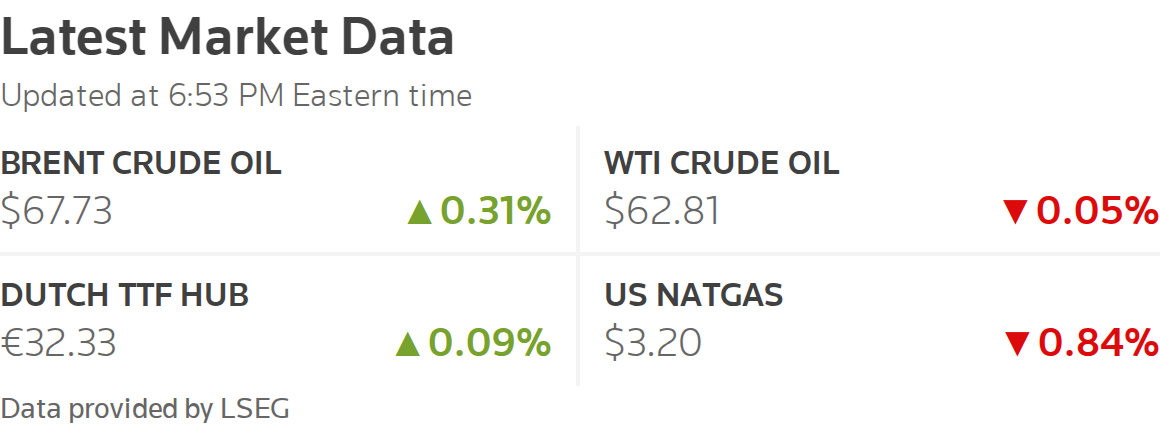
Data refreshes every time you open this email. For more energy news, click here. Please send any feedback to powerup@thomsonreuters.com.

Hello Power Up readers,

The Strait of Hormuz is once again closed for business, after hopes briefly rose last week that traffic through the narrow waterway between Iran and Oman would resume. Today, concerns are mounting that the ceasefire between the United States and Iran might collapse after the U.S. Navy seized an Iranian cargo ship that tried to run its blockade and Iran vowed to retaliate.

Oil prices whipsawed accordingly, with Brent crude rising over 5% to above $95 a barrel on Monday after tumbling 9% on Friday.

The recent days’ events in the Mideast highlight just how complicated to will be to truly end the Iran war. Since the start of the conflict on February 28, futures oil prices have reflected the belief that the war – and the closure of the Strait of Hormuz – would be short-lived as would the disruption to the supply of crude and refined products.

In effect, since the bombing started, the paper crude market has mostly appeared to believe U.S. President Donald Trump's social media posts arguing that the conflict will be short and the economic pain will be temporary.

The problem, ROI Asia Commodities Columnist Clyde Russell wrote today is that the reality on the ground doesn't match President Trump’s claims. The energy crisis is real, and the longer the strait remains closed, the more severe it will become.

While uncertainty regarding the transit through Hormuz remains sky high, one thing is already clear: even if the guns fall silent, flows through the narrow waterway will take months – and possibly years – to recover to pre-war levels. More on this below.

Here are some more headlines:

  • The world has lost over $50 billion worth of crude oil that has not been produced since the Iran war began nearly 50 days ago, and the aftershock of the crisis will be felt for months and even years to come, according to analysts and Reuters calculations
  • The trading desks of Europe's top three oil majors have reaped billions of dollars from the energy supply crunch caused by the Iran war, eclipsing their more cautious U.S. rivals and helping offset the conflict's impact on their production operations.
  • Norway's $2.2 trillion sovereign wealth fund, the world's largest, said on Saturday it will vote in favour of the election of BP Chair Albert Manifold and other board-supported resolutions at the April 23 annual general meeting.

As always, don’t hesitate to contact me at ron.bousso@thomsonreuters.com or follow me on LinkedIn with any questions or thoughts.


Top energy headlines

  • Brazil's Novonor signs deal to sell controlling stake in Braskem to IG4
  • Oil prices rise 5% on fears of US-Iran ceasefire collapse
  • China curtailing, not banning fuel exports, shipping data shows
  • Oil tanker exits Hormuz, heading to South Korea's HD Hyundai Oilbank, data shows
  • Eni says talking with Repsol on Venezuelan gas exports, no deal yet


The relief rush

Tehran effectively shut down the strait after the joint U.S.-Israeli aerial bombing campaign on Iranbegan on February 28. Since then, traffic through the strait – a passage that normally carries around a fifth of global oil and gas supplies – has slowed to a trickle.

The immediate impact has been severe. Around 13 million barrels per day (bpd) of oil supply and roughly 300 million cubic metres per day of liquefied natural gas (LNG) have been trapped inside the Gulf, forcing producers to shut in oil fields, refineries and LNG plants and battering economies from Asia to Europe.

The fighting has also caused lasting damage to energy infrastructure – and diplomatic relationships – across the region.

So how will a recovery play out, and when can the industry reasonably expect to approach pre-war ⁠operating levels?

The pace of recovery will depend not just on diplomacy between Washington and Tehran, but also on logistics, tanker insurance availability, freight rates and the willingness of shipowners to risk the passage.

Read the full column
 

Get full access to Reuters.com for just $1/week. Subscribe now.


Sponsors are not involved in the creation of newsletters or other Reuters news content. Advertise in this newsletter or on Reuters' website

LiveIntent Logo
AdChoices Logo