[Author’s Note: This essay is free for all subscribers.]
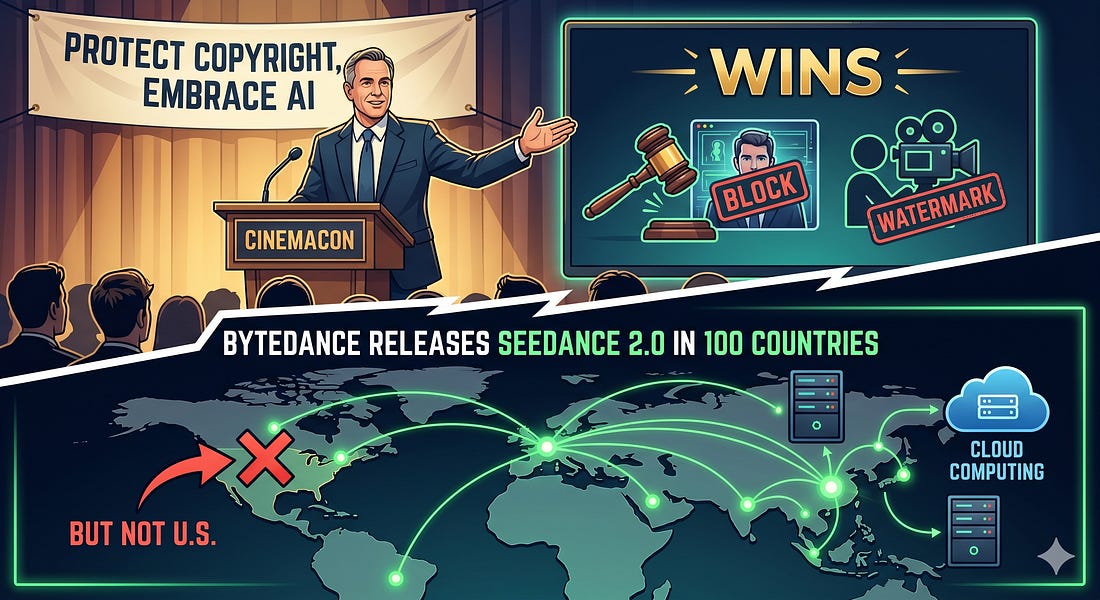
Last week had another fun coincidence: On the same day Motion Picture Association (MPA) Chairman and CEO Charles Rivkin delivered his annual State of the Industry address at CinemaCon, BytePlus—ByteDance’s cloud computing unit—released Seedance 2.0 globally to enterprise customers on three platforms: Runway and ByteDance-owned Dreamina and CapCut.
Rivkin told the crowd, “At our best, what sets our industry, and our country, apart is our fidelity to the rule of law, matched by our openness to change. We can and must do both.”
His framing is that the rule of law can coexist with rapid technological change. In one example, he described the MPA holding ByteDance’s “feet to the fire to ensure their guardrails [for Seedance 2.0] are effective” and studios’ intellectual property is “protected.”
Over the past month, Bollywood, ByteDance and Hailuo AI (Disney v. MiniMax lawsuit) are pushing change faster than the rule of law can adapt via legislation or lawsuits. Rivkin’s job requires this framing—the studios need him to ensure customers and partners remain confident in the model. However, the trajectories of Hollywood and the rest of the world are like opposing personas of LLM tests—the same inputs with opposite legal parameters.
The commercial incentives that force ByteDance to be a compliant partner—TikTok, advertising, U.S. market access—do not exist in India or in the Asian markets (China, Singapore) where Hailuo AI is available. That is the bigger disconnect that IP law cannot solve and which Rivkin cannot speak to.