| |  | | | | | | Not a subscriber? Sign up here to get this newsletter in your inbox. In today’s issue: - With inconsistent rules, SNAP bans on soda and candy are creating confusion for retailers and recipients
- Sen. Susan Collins (R-Maine), a top appropriator, told hospital executives Monday she wants to push back on the Trump administration’s proposed cuts to federal health agencies
- President Donald Trump moves to increase research and access to psychedelics, bolstering biotech stocks
Good Monday afternoon, all. Welcome to Health Brief. And happy Lobbying Disclosure Act Day for all those who celebrate. Companies, groups and associations all must report the amount they spent on lobbying during the first three months of the year by Monday at midnight. I’m recording said info in my big ol’ spreadsheet, and I’ll have important Q1 data and takeaways later this week. I’ve been reporting from the American Hospital Association’s annual membership meeting in Washington this week — and I’ll also have more to share from that in the days ahead. But first, let’s take a dive into the states and examine the Trump administration’s efforts to overhaul the nation’s food assistance program. Do you have any health policy tips or scoops? What’s flying under the radar? Don’t hesitate to reach out. I’m at megan.wilson@washpost.com. Or, if you’d prefer to message me securely, I’m also on Signal at megan.434. This newsletter is published by WP Intelligence, The Washington Post’s subscription service for professionals that provides business, policy and thought leaders with actionable insights. WP Intelligence operates independently from The Washington Post newsroom. Learn more about WP Intelligence. | 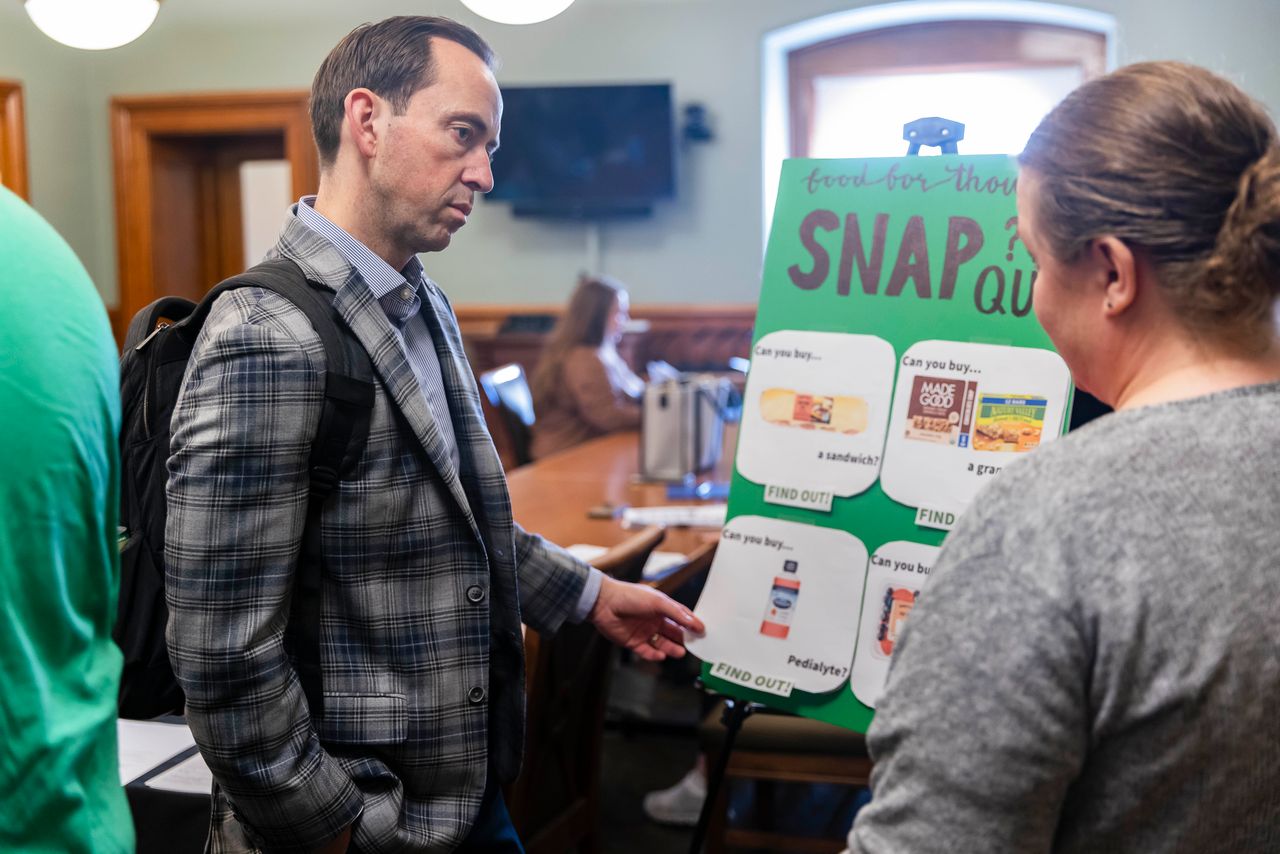 | | Iowa state Rep. Ryan Weldon (R) takes a quiz about SNAP benefits during the Iowa Hunger Coalition’s Day of Action at the Iowa State Capitol. (Kathryn Gamble/Kathryn Gamble for The Washington Post) | | | |  | The Lead Brief | States are moving to block soda and candy purchases with food stamps, creating a patchwork of new rules that retailers and low-income Americans say is increasingly difficult to navigate, reports Rachel Roubein in The Post’s newsroom. The push, backed by Health Secretary Robert F. Kennedy Jr. and his allies, is part of a broader effort to combat chronic disease by steering federal nutrition dollars away from products linked to obesity and poor health. Under the initiative, nearly two dozen states, most of which lean Republican, have secured waivers allowing them to restrict certain items under the Supplemental Nutrition Assistance Program, also known as SNAP. → Rachel tracked how individual states are rolling out the changes to the nation’s largest food assistance program. She spoke to more than two dozen people, including those in trade groups for independent grocers and convenience stores, store owners, anti-hunger advocates, and SNAP participants. - Ten states have already implemented restrictions. But the rollout has been uneven and, at times, confusing. What qualifies as ineligible can vary not just by state but even store by store.
- In practice, that has led to counterintuitive outcomes. Some candy — such as Twix bars — remain eligible in some states because they contain flour, while eligibility for certain granola bars is mixed. In Iowa, whether cold sandwiches sold in stores can be purchased with food stamps depends on varying factors. And in some states, sports drinks, flavored sparkling waters and even electrolyte drinks — such as Pedialyte in Iowa — are excluded.
- Other ultra-processed foods are often still eligible. Some states may not permit recipients to purchase semisweet chocolate chips for baking but do allow SNAP benefits to be used to buy packaged chips and cookies.
Why it matters: This uneven rollout reveals the tensions over how to define healthy foods, provide a nutritious and affordable diet, and still enact systemic change. It comes as Kennedy is focusing his messaging on food and nutrition ahead of the midterms instead of his controversial vaccine overhaul. “Secretary Kennedy has been clear that we will support efforts by states to pursue SNAP waivers that prioritize healthier food options,” Andrew Nixon, a spokesman for the Department of Health and Human Services, told Rachel in a statement. “The goal is to empower families with better access to nutritious foods and support a healthier future.” → But, in one example, lawmakers in Utah abandoned an attempt to define “candy” altogether and instead focused on banning soft drinks — defined as a flavored carbonated drink sweetened with sugar or artificial sweetener — highlighting the difficulty of drawing clear lines. The state legislature is now studying how to expand the pilot program to also include ultra-processed foods. OFW Law Principal Stewart Fried, who represents retailers on SNAP-related issues, faulted the U.S. Department of Agriculture (USDA) for not establishing uniform definitions for candy and soda. “This has created massive confusion across the entire country,” he told The Post. - Retailers face high stakes in getting it right: Violating SNAP rules can mean losing the ability to accept benefits, which can account for a significant share of sales depending on the location. As a result, some stores are taking a more restrictive approach than required, while others are trying to apply the rules more precisely — further stoking inconsistency.
The waivers, issued by the USDA, are temporary. States have two years to run these pilots and report data back to federal officials on a quarterly basis. Brian Elbel, a professor of population health at NYU Grossman School of Medicine, noted that for most SNAP participants, the program doesn’t even cover all of their monthly groceries. He told Rachel that he hopes states analyze whether recipients instead pay for restricted items with their own money or whether they switch to healthier foods — as well as how individual stores implement the changes. What to watch: Some SNAP participants have sued the Trump administration, seeking to halt the changes to the food assistance program in five states. Read the full story: “KitKat, Gatorade or granola bars? What’s banned under new SNAP rules is mixed.” | | | | | | Health on the Hill | Kennedy is again making the rounds on Capitol Hill to field questions from lawmakers about the Trump administration’s health policy priority — and is likely to face bipartisan questions regarding his efforts to overhaul federal vaccine policy during virtually every congressional appearance. He’s set to appear before a key Senate appropriations panel Tuesday, which had previously rejected last year’s budget request from the administration calling for a 41 percent reduction in funds to the National Institutes of Health. Sen. Susan Collins (R-Maine), who leads the Senate Appropriations Committee, told an audience of hospital executives on Monday morning that she was “alarmed” by the requested cuts to medical research and the Centers for Disease Control and Prevention. Collins helped beat back those requested reductions — and actually increased NIH funding — in the last congressional spending law. “This year, the president’s budget did a little bit better,” Collins said at the American Hospital Association’s annual conference at the Marriott Marquis in Washington, D.C., though she lamented this year’s request to cut 12 percent from the HHS budget. “I still don’t want that.” “We need to make sure that America continues to be the global leader in biomedical research, and that’s my goal,” Collins said. “I don’t want to lose our young scientists and researchers to other countries, like China in particular. But also, we’re seeing Europe make a real effort to recruit our young researchers, and we just can’t let that happen.” | _tstmp_1776717952-1280-0.png) | | | | | | Executive Health Brief | President Donald Trump over the weekend signed an executive order that directs federal regulators to speed the review of psychedelic treatments and increase investments into psychedelic research to help treat major depression, reports WaPo’s Dan Diamond. In a signing ceremony in the Oval Office, Trump called the move a “decisive step to confront one of the most urgent public health challenges facing our nation, the mental health crisis.” - The Food and Drug Administration will support new clinical trials for ibogaine, psilocybin and other drugs that are known as serotonin agonist receptors, and move swiftly to approve drugs deemed to be safe and effective. The drugs, which also include LSD and MDMA, can cause hallucinogenic effects and are currently illegal in the United States.
- The executive order also directs regulators to expand “right to try” access to psychedelic medications, including ibogaine, that are still under investigation. The federal “right to try” law allows patients with certain conditions to receive experimental medications when other treatments have failed.
- The executive order commits $50 million in additional funding for psychedelics research through the Advanced Research Projects for Health, also known as ARPA-H.
Although ibogaine, a plant-based psychoactive compound, has been linked to heart risks, it has garnered support from influential figures and military veterans who argue it has helped alleviate severe mental health symptoms. During the signing ceremony, Trump was flanked by veterans, top federal health officials and Joe Rogan, a popular podcaster who had urged Trump to increase access to psychedelics. Rogan said at the White House that he’d sent a text to Trump about the benefits of ibogaine. “The text message came back, ‘Sounds great. Do you want FDA approval? Let’s do it,’” Rogan explained. “It was literally that quick.” Former high-level policymakers — including former Texas governor Rick Perry (R) and former senator Kyrsten Sinema (I-Arizona) — have been advocating for more research into the benefits of ibogaine and broader availability of the drug. Those seeking treatment must travel to places such as Mexico to receive it. What to watch: FDA Commissioner Marty Makary said during the briefing that the agency would soon issue priority vouchers to accelerate federal reviews of several psychedelic drugs and potentially approve them this summer. It’s unclear which drugs are being selected for the expedited review. Some drug policy experts criticized Trump’s plan, warning that expanding access to the substances could have unintended public health consequences. Kevin Sabet, who was a White House drug policy adviser across three presidential administrations, told Dan that the order will “send the wrong message” by encouraging hasty, potentially dangerous research. Read the full story: “Trump orders more access to psychedelics like LSD, psilocybin and ibogaine.” | | | | | | Market Moves | The stock price of several psychedelic biotech companies jumped Monday following the White House moves. - Enveric BioSciences surged 115 percent
- Compass Pathways climbed 43 percent
- AtaiBeckley jumped 24 percent
- GH Research increased 17 percent
- Stock prices for Definium Therapeutics, formerly known as MindMed, initially increased but later dropped back to opening levels
But not all is flowery in the land of psychedelic biopharma: → Shares in Cybin, which does business as Helus Pharma, are up by about 4 percent. However, its CEO, Michael Cola, stepped down Monday at the request of the board, according to a press release. A press representative for the company did not respond to an inquiry asking for the reason behind the request. Co-founder Eric So will serve as CEO while the company searches for a successor. | | | | | | | | | | |


_tstmp_1756933376-1920-1080.png)






