
|
 |



As he said he would on Sunday morning, FBI Director Kash Patel filed a defamation case against The Atlantic and reporter Sarah Fitzpatrick this morning over a story that characterizes him as an incompetent drunk who is jeopardizing national security. We talked about the contents of the article and Patel’s reaction here.
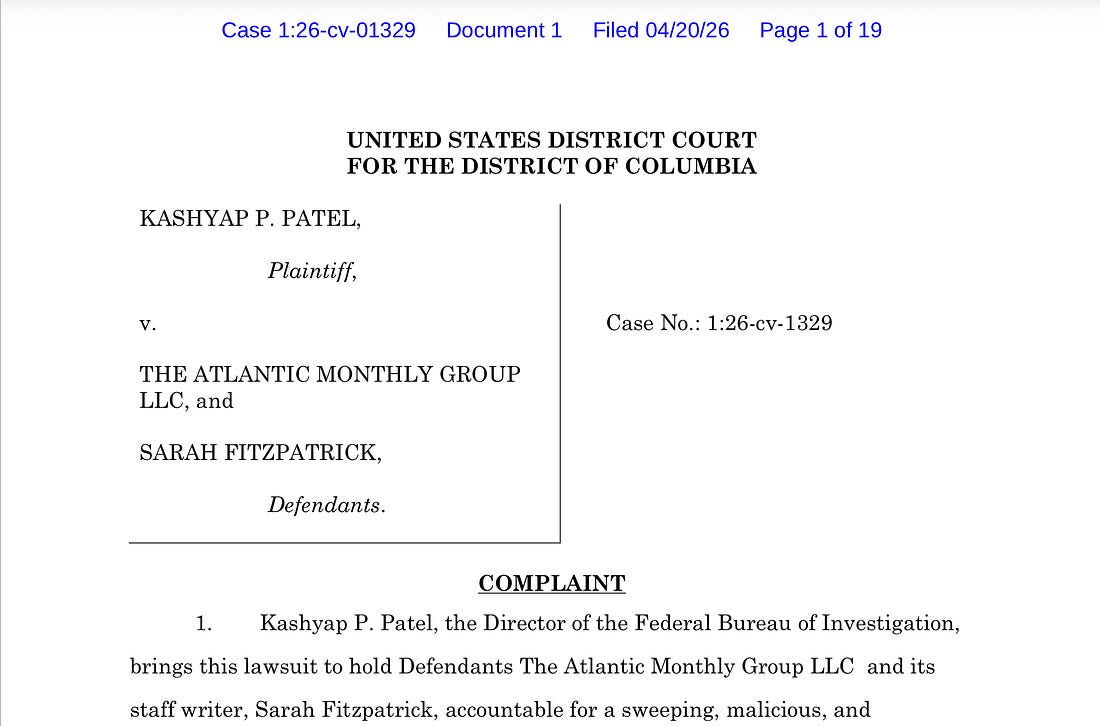 |
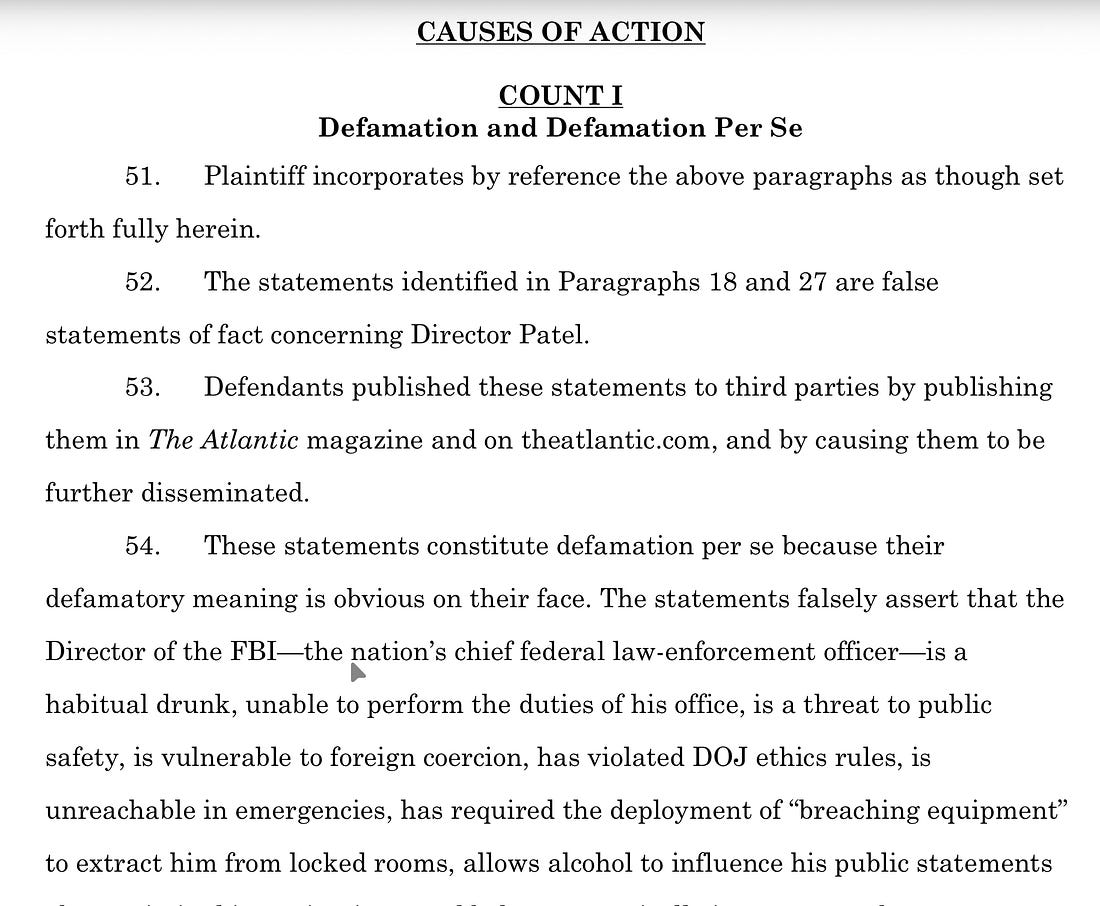
The civil lawsuit alleges just one count of defamation over publication of the article. To prevail, Patel would have to prove that false statements were made about him with “reckless disregard” for their truth. In a normal defamation case, the plaintiff need only show negligence, but because Patel is a public figure, he must meet the higher burden of showing that the defendants published the article either with knowledge it contained false statements, or with reckless disregard for their truthfulness.
 |
The complaint starts by touting Patel’s virtues as director, including claims that he has overseen the capture of eight of the FBI’s 10 Most Wanted fugitives and more than 40,000 violent crime arrests, which the complaint says reflects a 112% increase in violent crime arrests. The 40,000 number seems quite high, and of course arrests aren’t the same as the number of people subsequently indicted and convicted. But this complaint seems designed for the audience of one that controls whether Patel stays on as FBI director. So we get a full recitation of work Patel claims as his own, like locating 6,300 child victims and arresting more than 2,200 child predators, a claim that might be more compelling if he’d investigated outstanding leads in the Jeffrey Epstein matter, including the 10 people identified as potential coconspirators in a memo written by Southern District of New York prosecutors in one of the documents released as part of the Epstein Files.
All of that to say, the recitation of Patel’s accomplishments has more to do with PR than it does with a lawsuit about specific claims about his drinking and job performance, which have little to do with how the FBI as a whole has performed its work since he came to the Bureau. But Patel alleges that The Atlantic had “preexisting animus” toward him, because it reported stories that said he was on the “chopping block” and in line to be fired by the president. Although Trump ultimately backed Patel when those rumors surfaced last November, there were reports from multiple sources that the White House was unhappy with some of the headlines about his personal life. It’s difficult to characterize The Atlantic, one of many news outlets that reported that information, as having special animus toward Patel.
The complaint continues by discussing the article in The Atlantic, whose intent, it claims, was telegraphed by the headline: “it was not journalism about a subject; it was advocacy against Director Patel. Defendants made no effort to disguise their aim.” The headline read, “Kash Patel’s Erratic Behavior Could Cost Him His Job.”
The next step in a civil case is for the defendants to respond to these allegations within 21 days of being served with the complaint. This is usually done, going through the complaint line by line, to indicate, for each allegation, whether a defendant admits, denies, or lacks knowledge about the truth of each of its allegations—here that means we can expect to see them deny that the contents of the story were false and deny that that they published the story with reckless disregard for its truth.
The Atlantic undoubtedly understood that this lawsuit was coming when they published the story–Patel’s lawyers wrote to them in advance. But the story says there are about two dozen sources, who were permitted to remain anonymous because of the nature of the information they provided.
Patel lays out the key claims in the article and says, as he must, that they are all false. So the core of the defendants’ response will be their explanation of why they had a reasonable belief they were true when they ran the story. Patel’s complaint provides a nice summary of the key points in The Atlantic article:
That Director Patel “is known to drink to the point of obvious
intoxication, in many cases at the private club Ned’s in
Washington, D.C., while in the presence of White House and other
administration staff.”
That Director Patel “is also known to drink to excess at the Poodle Room in Las Vegas, where he frequently spends parts of his weekends”.
That “[e]arly in his tenure, meetings and briefings had to be rescheduled for later in the day as a result of his alcohol-fueled nights.”
That “[o]n multiple occasions in the past year, members of his Security detail had difficulty waking Patel because he was seemingly intoxicated, according to information supplied to Justice Department and White House officials.”
That “[a] request for ‘breaching equipment’—normally used by SWAT and hostage-rescue teams to quickly gain entry into buildings—was made last year because Patel had been unreachable behind locked doors.”
That Director Patel’s alleged alcohol consumption has negatively impacted various law-enforcement investigations, including the Charlie Kirk murder investigation.
That Director Patel “recently expressed frustration with the look of FBI merchandise, complaining that it isn’t intimidating enough.”
That on April 10, 2026, Director Patel “panicked, frantically calling aides and allies to announce that he had been fired by the White House,” and that his behavior was a “freak-out.”
That Director Patel is “often away or unreachable, delaying time-sensitive decisions needed to advance investigations,” and that on several occasions, Director Patel’s “delays resulted in normally unflappable agents ‘losing their shit.’”
That Director Patel’s “drinking has been a recurring source of concern across the government.”
The false implication that Director Patel violated DOJ’s ethics rules prohibiting “habitually using alcohol or other intoxicants to excess.”
That Director Patel has used his position to improperly “target political or personal adversaries of the president.”
The false implication that Director Patel abuses alcohol, thereby making him vulnerable to exploitation or coercion by foreign adversaries.
The false implication that this alleged alcohol abuse “has become a threat to public safety,” including in the context of “a domestic terrorist attack,” and constitutes a national-security vulnerability.
That Director Patel “is deeply concerned that his job is in jeopardy.”
That Director Patel has had a problem with “unexplained absences,” and “spotty attendance at the office,” thereby falsely implying that Director Patel has been derelict in his duties.
That Director Patel left the country vulnerable because “Days be