
|


 |
Historian Thomas Kidd is right to recall our country’s dark history even as we observe its founding. As we celebrate our independence from British rule, our religious freedom, and our freedom from unjust taxation, we must also remember that our country boasted about human equality while suppressing the rights of others—mostly, enslaved men, women, and children. Kidd recommends several books that we would do right to read solemnly as we mark our country’s 250th anniversary.
Happy Reading,
Kara Bettis Carvalho
Senior Features Editor, Christianity Today
P.S. A portion of this newsletter appeared as a column at Christianity Today. Join CT for full access to all our journalism.

 |
Three History Books on the US Slave Trade
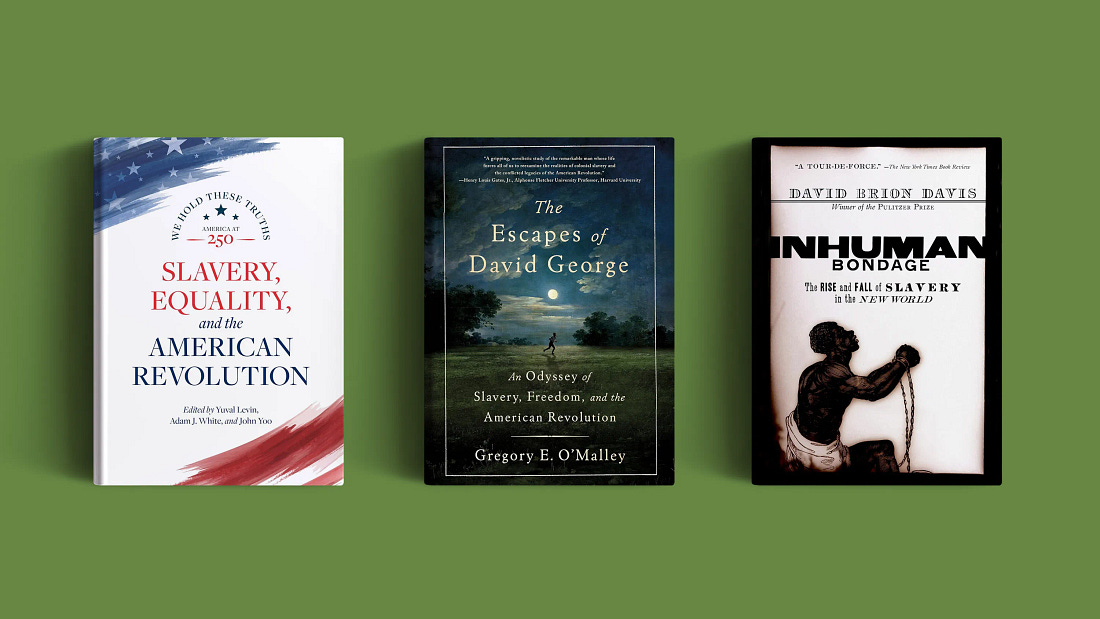
Gregory E. O’Malley, The Escapes of David George: An Odyssey of Slavery, Freedom, and the American Revolution (St. Martin’s Press, 2026)
In this anniversary year of American independence, the problem of slavery introduces a minor chord into our national celebrations. The United States proclaimed that all men are created equal, but it also permitted the enslavement of millions of people. Gregory O’Malley’s The Escapes of David George brilliantly evokes the founding’s moral tensions by reconstructing the amazing life of the runaway slave and Baptist preacher.
George’s improbable escapes took him away from the Virginia plantation where he was born into slavery, to stopovers in Native American villages, and then to a South Carolina plantation where he heard the gospel of salvation through Christ. Around 1773, George became the pastor of the Silver Bluff Baptist Church, likely the oldest enduring African American–pastored congregation.
Then, during the Revolutionary War, he escaped again, going to British-occupied Savannah and Charleston before evacuating to Nova Scotia at the war’s end. He became one of Nova Scotia’s key evangelical pastors before leaving one more time, resettling in Sierra Leone in West Africa.
O’Malley has little direct source material with which to reconstruct George’s extraordinary story, but he makes the most of what exists to depict slavery’s grim realities in the Atlantic world. However, O’Malley might have done more to understand George not just as a former slave escaping bondage’s shadow but also as a sinner saved by God’s grace. The sources suggest this was how George primarily viewed himself.
Edited by Yuval Levin, Adam J. White, and John Yoo, Slavery, Equality, and the American Revolution (AEI Press, 2025)
The American Enterprise Institute (AEI) has produced a terrific series of thematic volumes about the American founding in anticipation of the anniversary of the Declaration of Independence. One of these collections is Slavery, Equality, and the American Revolution. Available in print and for free online, this book features five essays by scholars of law and politics, all considering the relationship of America’s founding documents to slavery.
As AEI’s Yuval Levin notes, the dilemma regarding slavery and America dates back to the founding itself. Jefferson initially included a critical section on the slave trade in the Declaration, but the Continental Congress removed it from the final version.