
|


 |
PN is supported by paid subscribers. Become one ⬇️
Elon Musk and Sam Altman are currently kicking the shit out of each other in a federal courthouse in Oakland. Two of the most destructive men on earth are each claiming to be principled humanitarians, and Musk’s customary chaos monkey litigation strategy is on full display.
The short version: Musk funded OpenAI in 2015 as a nonprofit dedicated to developing artificial intelligence safely, for humanity's benefit. Then Altman turned it into an $850 billion juggernaut for his own enrichment. Musk is suing to get “his” share of OpenAI back, or, as of three weeks before trial, to return the money to the charity — a share which he now values at $134 billion. And he’d also like to unwind the conversion of OpenAI to a for-profit company, for the good of humanity.
By sheer coincidence, this would massively benefit Musk’s own company xAI, whose chatbot Grok is prone to calling itself MechaHitler and will helpfully answer questions like “what are the good races?”
It’s only a shame they can’t both lose.
For the good of all mankind
In 2015, tech leaders sounded the alarm about the societal impacts and potential misuse of artificial general intelligence. Musk was one of the signatories to an open letter advocating thoughtful research “to reap its benefits while avoiding potential pitfalls” before unleashing this powerfully technology.
Altman, who was running the tech incubator Y Combinator (later rebranded YC), wrote that “development of superhuman machine intelligence is probably the greatest threat to the continued existence of humanity.”
Altman pitched Musk on a nonprofit research lab which would develop AI responsibly and deliberately, serving as a counterweight to Google, which had just acquired the British company Deepmind. They conceived of OpenAI as a charitable foundation which would nurture AI as an open-source, safety-focused project, with no pressure to maximize shareholder returns.
 |
|
On December 8, 2015, OpenAI filed a certificate of incorporation in Delaware stating the organization’s charitable function: “The resulting technology will benefit the public and the corporation will seek to open source technology for the public benefit when applicable. The corporation is not organized for the private gain of any person.”
Musk lent his name, his connections, his recruiting power, and approximately $44 million to the project. In a 2016 email to Altman and OpenAI’s CEO Greg Brockman, he wrote, “whatever it takes to bring on ace talent is fine by me. Deepmind is causing me extreme mental stress. If they win, it will be really bad news with their one mind to rule the world philosophy.”
By 2017 the parties were locked in conflict. In part, this is because Musk was pushing to take control of the project, assume the title of CEO, and bring OpenAI into Tesla’s ambit. But Musk also suspected that Altman and Brockman were secretly plotting to convert OpenAI to a for-profit company with a major assist from Microsoft. And he was right.
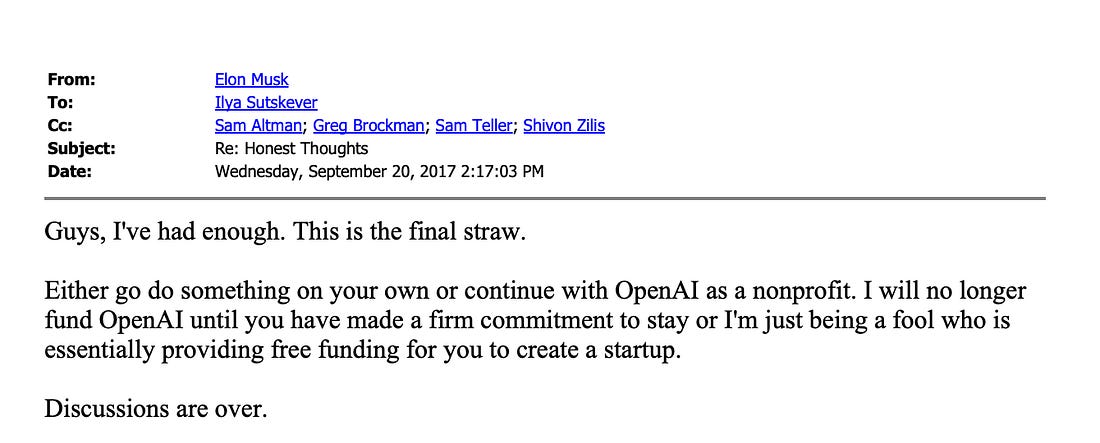
“Either go do something on your own or continue with OpenAI as a nonprofit,” Musk wrote in a September email. “I will no longer fund OpenAI until you have made a firm commitment to stay or I'm just being a fool who is essentially providing free funding for you to create a startup.”
 |