
|
 |


A few months ago I sat in the audience for a PhD student’s talk that was, well, not great. The student was clear and articulate. They were prepared. The talk was not great because the ideas weren’t fully worked through, had internal inconsistencies, and failed to account for obvious alternative explanations.
Several professors in the audience shared my concerns and asked tough but respectful questions that gave the student pause. The student’s advisor probably should have pushed them harder before the talk, but in the room itself, other professors did what academia is supposed to do: they productively challenged a student to think more carefully about their work. A normal day at a university. And I’m glad to see normal days again, because for a while there, they weren’t.
In recent years, a strange norm took hold. Critical feedback from someone with more power directed at someone with less became suspect, an example of punching down. Critiquing student work was a professor’s job, sure, but doing it publicly, especially online, became fraught.
Thankfully the worst of this has receded, and most of us seem willing again to evaluate ideas on their merits regardless of who’s offering them. But plenty of folks still treat punching down as immoral, and I want to defend the practice. Scratch that. I want to defend the practice of punching, full stop. Up, down, sideways.
I wrote about this last year as a paid post. Below is an edited version of that essay, now free for all. Punch back in the comments.
The principle of “not punching down” has become sacrosanct in academic spaces, holding them together like a rug ties a room together (sorry, couldn't resist). The idea seems noble enough: those with more power shouldn't attack those with less. The privileged shouldn't criticize the marginalized, white people shouldn't challenge people of colour, the wealthy shouldn’t mock the poor. You get the picture; it's about protecting the vulnerable. But like many well-intentioned principles, this one deserves unpacking.
I recently learned that sports writers coined the term “punching down” in the mid-20th century to describe boxers fighting above or below their weight class. It wasn't until the early 2000s that the term morphed into what we know today, a metaphor about power dynamics and protecting marginalized groups from abuse by the powerful.
 |
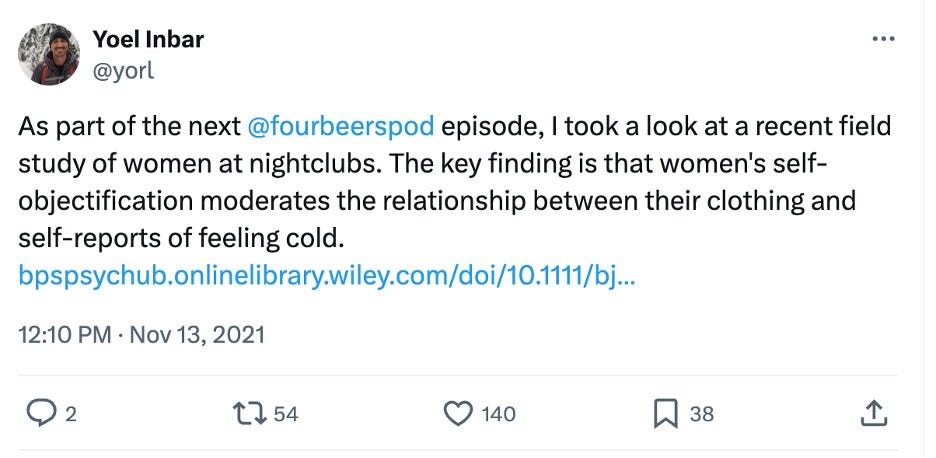
A few years ago, my friend, UofT colleague, and podcast co-host Yoel Inbar found himself in hot water for criticizing a psychology paper on Twitter and on our Two Psychologists Four Beers podcast. The paper claimed that attractive women don't feel cold outside of nightclubs on cold winter nights even when they're barely dressed. Some hot women, apparently, don't get cold. Yes, you read that right. And, yes, this was a real published article.
Yoel did what scientists are supposed to do: he scrutinized the methods and raised concerns about the analysis and conclusions. But instead of sparking a healthy scientific debate, something else happened instead. Because the paper's lead author was a graduate student and a woman, the response was a swift: "How dare you punch down!"
 |
I saw very little engagement with what Yoel actually said. Instead, there was a rush of condemnation that Yoel’s criticism was inappropriate, even immoral. I even saw one histrionic post from someone who not only defended the paper but then accused the entire open science community of bad faith, questioning the motives of a group he previously identified with. He might as well have said: Shameless little bullies.
Here's another example from academic Twitter. A Latino postdoc published a qualitative study about Black and Latino people's experiences with policing and discovered that even without handcuffs or sirens, the police leaves behind trauma, paranoia, and the constant feeling of being watched. A white professor, doing what professors are supposed to do, pointed out something pretty basic: every single person interviewed for this study came from an organization dedicated to police abolition and political activism. In other words, maybe, just maybe, the findings tell us more about how police abolitionists experience the police than about how the average young person of colour does.
Instead of engaging with this pretty reasonable point, though, the postdoc played the power dynamics card, complaining about a senior scholar publicly criticizing a junior scholar. Before long, the whole thing devolved into a mess of accusations about white tenured professors attacking scholars of colour. The actual scientific question—you know, the one about selection bias—got buried under an avalanche of takes about power, privilege, and who has the right to criticize whom. The Dude would not abide.
 |