
| Forwarded this email? Subscribe for more |



 |
| By Caitlin Flanagan |
It is my great honor to announce that Caitlin Flanagan is joining The Free Press. Finally.
Caitlin, a great American writer, until recently at The Atlantic magazine, has been a mentor and friend since before this whole thing was a glimmer in our eyes. During long days at her house in Pasadena, we hammered out the details of The Free Press. We complained; we brainstormed; we rehearsed hard conversations. Her husband Rob coached Bari in how to, you know, be a boss. Which is all to say, we adore Caitlin Flanagan. And now, finally, we get Caitlin Flanagan as a writer. And what is she like as a writer?
She’s sharp, smart, lyrical, honest, poignant, and funny, surprising and contrarian in her thinking but not just to be contrarian for its own sake, and she’s equal parts kind and ruthless. Deeply Californian and deeply American (two different things), she’s everything you want in a writer. For a sense, read Caitlin Flanagan on the abortion debate—or listen to her talk about it on Honestly. Read her Atlantic archive here. Buy her books here and here. If I had to pick two of her pieces, I would say to read Caitlin’s article on Bill Clinton and #MeToo and her story on the college admissions scandal, which I’ll excerpt a little taste of:
Down, down, down she went in the FBI car, in her handcuffs and athleisure, down below Outpost, down below Lake Hollywood, down below the Dolby Theatre where she had been so many times—in a beautiful gown, with her famous husband, William H. Macy, beside her—to watch the Academy Awards, once as a nominee. All the way down to—my God!—the downest place of all: Spring Street. The federal courthouse! This was where Donald Trump was supposed to go, not Felicity Huffman. Cool your heels, defender of the downtrodden: There is no rushing through all this—the mug shot, the phone call, the hearing. And this can’t even be grist for the mill of a new devotion to the plight of American mass incarceration. You’re now Exhibit A of law enforcement finally treating rich, white Americans as unsparingly as it treats poor, black ones.
In a shallow and nasty era, Caitlin Flanagan is a complex, humane, deep writer. You don’t need me to sell you on her (all this doesn’t even count; this is just how I introduce her at dinner). You’ll start finding her words in your inbox, and you’ll see for yourself. She’ll usually be behind a paywall, but there’s none today—as a special treat.
Caitlin Flanagan is a Free Press columnist. Caitlin! Flanagan! We couldn’t be prouder.
—Nellie Bowles
 |
I was born in the era of assassinations. I was two, almost to the day, when John Kennedy was shot dead, and by the time I was eight the same thing had happened to Malcolm X, Martin Luther King Jr., and Bobby Kennedy. These were the most famous of the killings, but there were many more: Medgar Evers, Fred Hampton, three civil rights workers who had traveled to Mississippi and been murdered by Ku Klux Klan members.
The ’60s dissolved into the ’70s and political violence rolled on, often in the form of acts committed by what seemed like endlessly proliferating radical groups who tied the possibility of enormous political change to limited acts of great violence. I grew up in two places, mostly in Berkeley but also in Ireland, and spent the Irish equivalent of first, fifth, and 10th grades there as well as most summers. In June 1968 Bobby Kennedy was shot dead in Los Angeles, and on October 5 of that year Northern Irish Catholics marched in protest of discrimination and were set upon not just by Protestants but by agents of the British state; most people believe that the Troubles began with this event.
We’ve once again crossed the river where we may not countenance violence of this kind, but we understand it as an aspect of the known world.
During those years I saw many things I should not have seen, even though I lived in Dublin, which was almost untouched by this violence. My family was in Derry on the first anniversary of internment—a policy of the British government whereby Irish Catholics could be imprisoned without charges or trials—and we got caught in some street fighting. Soldiers of the British Army were firing rubber bullets, and some people were so furious that they set their own houses on fire. My internal threat assessment is permanently stuck on high alert, and I think that experience had something to do with it.
The Black Panther Party was a presence in the Berkeley of my youth, as were a number of less disciplined radical organizations dedicated to the overthrow of the United States government by force or violence. I was 12 when the far-left Symbionese Liberation Army kidnapped Patty Hearst from her apartment off Telegraph Avenue, a significant event in the lives of many Berkeley kids. It was followed three months later by the worst after-school special in history, when the gang was tracked to a small house in Compton and the Los Angeles Police fired over 5,000 rounds of ammunition into it as well as tear gas that started a massive fire that killed most of the six people inside; others died of gunshot wounds. It wasn’t until the next day that police announced that Patty Hearst hadn’t been in the house, all of us glued to the television thought we were watching her burn.
 If you value journalism like this, and want to support The Free Press, consider becoming a paid subscriber today. |
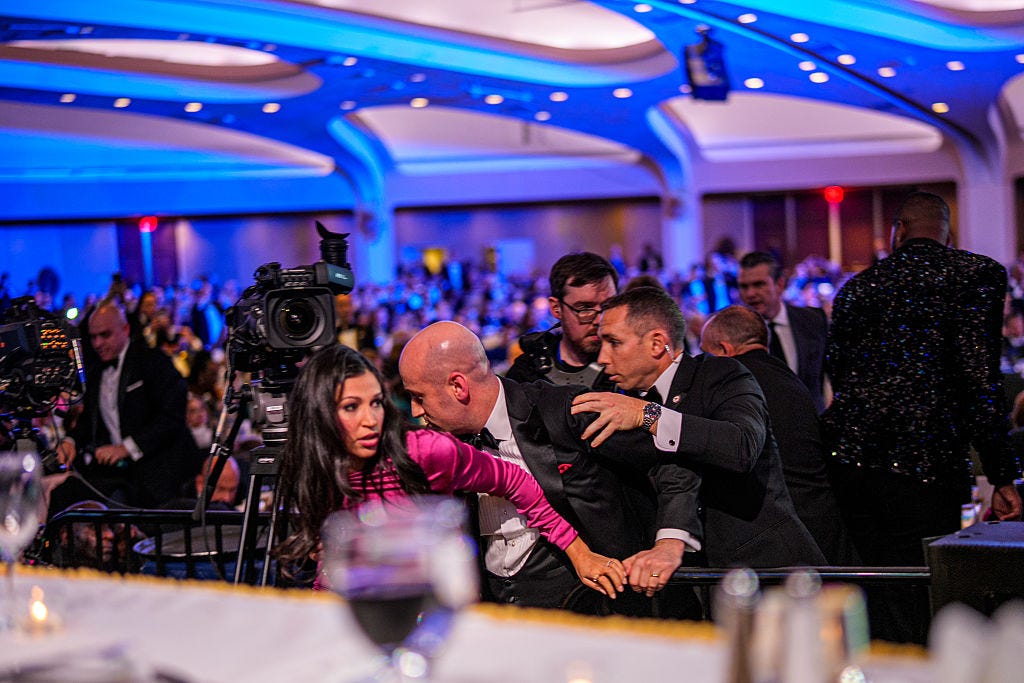
My hatred of political violence makes me bewildered by my own response to the news of a shooting at the White House Correspondents’ Dinner. I glanced at my phone, took in the essential facts, and didn’t really feel anything at all. It just seemed like one more event that hovered on the edge of the real and the unreal. I was at a dinner party and when I got back to the table and told the other people sitting there what had happened, they all seemed to have the same response I’d had. Nobody reached for a phone to learn more, no one wondered about a motive; we had all absorbed the essential fact that nobody had been injured and we went on to other things.
That’s when I realized that political violence is truly back, that an attempt to assassinate the American president is within the realm not just of possibility but of the unremarkable, and that we’ve once again crossed the river where we may not countenance violence of this kind, but we understand it as an aspect of the known world.
 |
Now that we’ve reentered the cycle, here are two things to know about political violence. The first is that young people are the most attracted to it, for the same reason so many young people enlisted in the military after 9/11: because they were aware of and angry about an intolerable situation, and because the condition of youth includes an awareness of one’s own physical power. It also involves a bravery that trembles on the edge of foolishness. That’s why old people don’t fight wars; they declare them. The second thing to know about political violence is that it produces romantic heroes faster than MGM in the 1940s.
The photograph of Huey Newton in a peacock chair, flanked by a gun and a spear, still occasionally appears in dorm rooms now, and the 1960 photograph of Che Guevara is as much a part of move-in day as the Starbucks logo. It’s also why even Luigi: The Musical can’t stop an infatuation with Luigi Mangione, the young man who allegedly murdered Brian Thompson, the CEO of UnitedHealthcare, 17 months ago. All these men represent the romantic ideal of standing up against a seemingly intractable force—respectively, white supremacy, capitalism, and the profiteering of the American healthcare industry—risking their lives at the barricades and accepting whatever happens to them. When I saw a photograph of Cole Tomas Allen and learned that he, like the other three, is handsome, I knew that soon enough he would join their ranks.
I was 20 years old the day I walked through a student commons and heard that Ronald Reagan had been shot. The first thing I did was find a payphone and call my parents. I was young and callow and—because my parents were extremely opposed to Ronald Reagan, hated Ronald Reagan—I made a flip remark. My father cut me off at the knees: “This is very serious.” It was a different time.