
|
 |
Hi, y’all. Welcome back to The Opposition. As I’ve mentioned in previous editions, one of my goals for this newsletter is to bring you on-the-ground reporting from states and House districts that could be the majority-makers in the next Congress. Today’s newsletter takes us to a part of the country that is rarely thought of as competitive: the Deep South. I’ve been hearing for weeks from Democratic strategists that this year’s Mississippi Senate race could be surprisingly close. This corresponds with something Sen. Chuck Schumer has been saying for years: that Mississippi could be a place where Democrats can expand the map. So last week I drove down to the Magnolia State to see what the hype was all about.
Places like Mississippi often don’t get a ton of media coverage. It’s a poor, rural state that for years has been dominated by a single party. But at The Bulwark, we think showing up in-person and talking to voters and candidates is important. To support this kind of journalism—and to enjoy the benefits that come with being part of our growing pro-democracy community—join Bulwark+. Sign up today and you’ll get two weeks FREE to test out the experience:
–Lauren
Don’t Eyeroll: Dems Have Mississippi in Their Sights
On the campaign trail with Senate candidate Scott Colom.
|
| ||||||||||||


 |
Jackson, Mississippi
THE MERE SUGGESTION that Democrats could win the Mississippi Senate race this cycle can produce dismissive eyerolls. (Trust me, I’ve seen it often enough from my editor.)
But as I’ve been talking with party officials and operatives over the past few months, no race is as regularly mentioned, or elicits as much excitement, as this one. They argue that circumstances are converging to flip a state that Donald Trump won by a 23-point margin: There is a charismatic Democrat at the top of the ticket, the state’s large black population is being mobilized, and there is a generationally weak Republican incumbent. As longtime Democratic strategist James Carville, who lives part-time along Mississippi’s Gulf Coast, put it to me: “It would take a unique set of circumstances, but we just might be operating under a unique set of circumstances.”
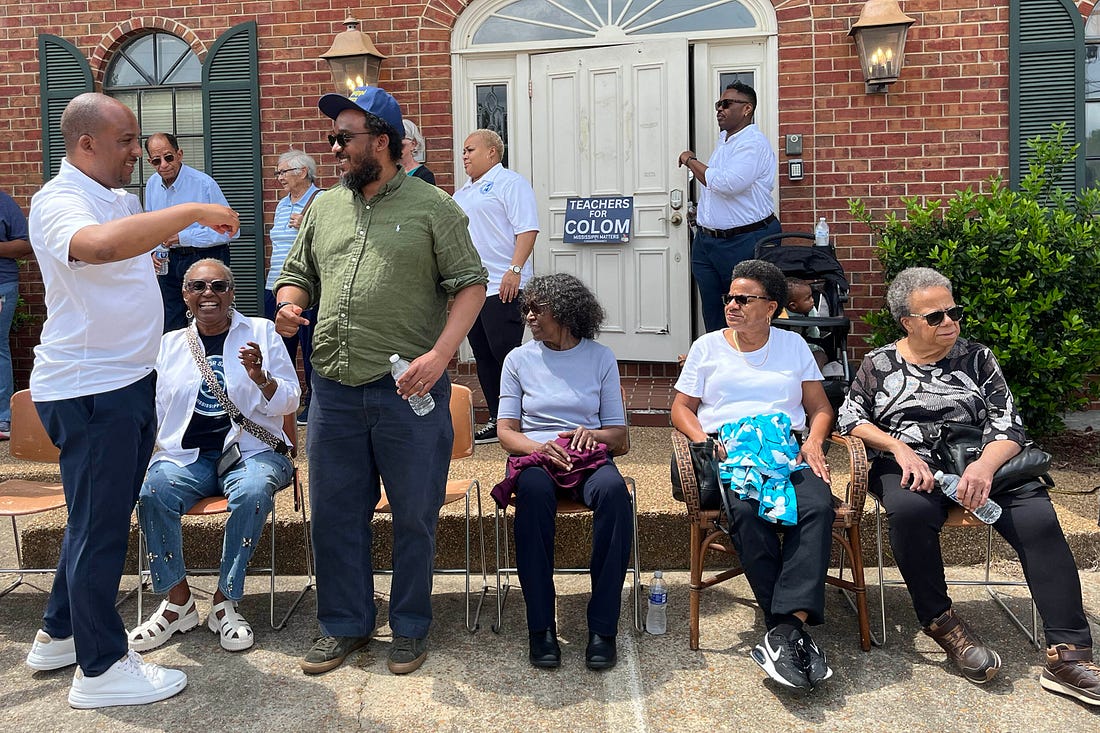
Eventually, enough quotes like this piled up in my notebook from enough influential Democrats that I was able to turn my editor’s eyerolls into a signoff to check out how real the hype is. So last weekend I made the trek down I-55—a stretch of highway that runs parallel to the Mississippi River, passing over bayous dotted with cypress trees—to spend a day on the campaign trail with Scott Colom, the Democratic candidate for Senate.
Colom is a 43-year-old district attorney, a devout Mississippi State sports fan, and father of two young girls. He was raised in a political household: His mom was an elected judge and his father ran for office as a Republican in the 1980s before eventually becoming a Democrat. In 2022, President Joe Biden nominated him to be a federal judge. But after getting approval from the state’s senior senator, Roger Wicker, Colom’s nomination was blocked by Sen. Cindy Hyde-Smith—the very Republican whom Colom is now trying to unseat.
Colom and I chatted in the back seats of his pickup truck on a recent Saturday morning with pickleball equipment and footballs strewn about our feet as his staff drove us to the first campaign event of the day. With a giant to-go cup of hot coffee in his hand (something that he seemed to have perpetually refilled throughout the day), Colom stressed that his campaign wasn’t about getting revenge on Hyde-Smith.
“As a Christian, I really had to forgive people,” he said.
And yet, there is something about Hyde-Smith that drove him to run. Democrats involved in the race believe she is a uniquely vulnerable candidate and that Colom would not have run if Wicker were the one up for re-election. Hyde-Smith, who was appointed to the Senate in 2018 to replace Thad Cochran, rarely if ever holds town halls or attends community events. And in a state that regularly ranks as the poorest in the nation, Colom argued that Mississippians are yearning for a senator who delivers.
That’s a common refrain for any challenger trying to unseat an incumbent. But in Colom’s case, there is fodder to work with. Whereas Cochran ended his four decades in the Senate as the chairman of the powerful Appropriations Committee—a post that helped him secure federal goodies for Mississippi—Hyde-Smith doesn’t have a comparable record of delivering for the state. She has taken votes that have placed rural hospitals at risk of closing. She has backed Donald Trump’s tariff agenda, even though it has hurt the state’s soybean farmers. And she voted against the 2021 infrastructure bill—which brought billions of federal dollars to the state—while even her fellow Republican Wicker supported it.
“The number-one rule of politics: Bring home resources for your state, look out for Mississippi,” said Colom. “You got to do that because we’re not a state that can afford to have partisan warriors.”
“You got to show up, you got to listen. You got to show that you’re running a different type of campaign, rooted in listening to people. And that’s what it’s going to take to win Mississippi,” Colom added. “I’m about to do more in one day than [Hyde-Smith] has done in six years, as far as interfacing with the public.”
That’s all well and good and makes for a buzzy campaign talking point. But this is still a state Trump won by double-digits. Plus, this isn’t the first time Democrats have talked up their opportunities in Mississippi only to go on to lose the election. Sen. Chuck Schumer has been publicly arguing since 2021 that the state could be in play. So what makes this year any different?
COLOM AND HIS TEAM came prepared with data about why their race should be viewed as just as competitive as those in, say, Iowa or Texas. They argued that Mississippi Democrats had been making consistent progress over the past few cycles: Mike Espy lost his Senate race to Hyde-Smith in 2018 by 7.8 points, then in 2019 the Democratic gubernatorial candidate, Jim Hood, lost by 5.5 points, while in 2023 Brandon Presely lost his bid for governor by just 3.2 points. Last year, Democrats broke the GOP’s supermajority in the state senate. And 158,196 voters participated in the Republican Senate primary in March compared to 150,641 in the Democratic primary—which Democratic pollsters told me was unusually high turnout and, they believe, a sign of a narrowing enthusiasm gap.
“This has the beginnings and makings of another race that could be in the single digits. I truly believe that,” said Democratic pollster Kevin Akins, who recently conducted a survey that found Hyde-Smith leading among likely voters with 42 percent of the vote compared to Colom’s 39 percent.
Any poll showing two leading candidates hovering right above or below 40 percent has to be regarded skeptically—if for nothing more than it shows the race hasn’t gelled yet. But part of the reason Democrats view Mississippi as one of the few places in the Deep South where they can compete is due to its large population of black voters, who’ve traditionally supported Democrats. Black people make up