
|
 |
 |
| ||

The Supreme Court's Decision in Louisiana v. Callais
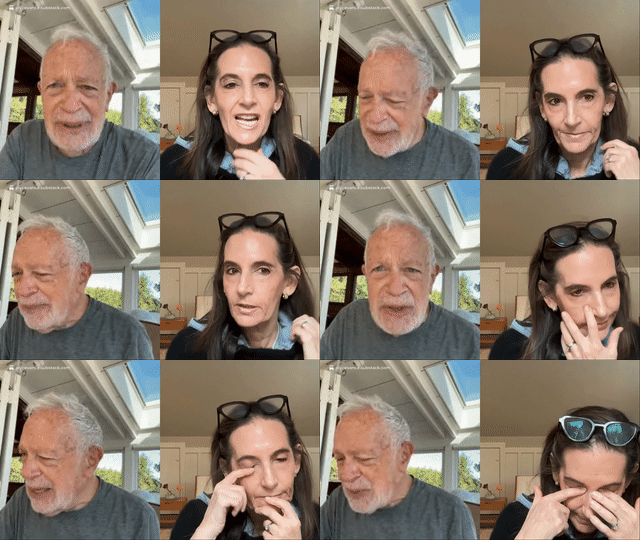
My Conversation with former Labor Secretary Robert Reich about today's anti-voting rights decision and other topics.
|

| |||||||||||||||


Today was not a good day for democracy. The Supreme Court issued its decision in Louisiana v. Callais, stripping the remaining vitality out of Section 2 of the Voting Rights Act. The result was not unexpected, but it was still deeply discouraging. This Court, which appeals to history and tradition to undo so many established rights, ignored the history of discrimination against Black voters to arrive at its decision today.
This is one of those moments that merits close reading, not hot takes, and I want to read and think about the decision further before I share my views about its holding, the test it adopts, and other legal technicalities with you. It’s only 92 pages, just over half of them in Judge Kagan’s dissent, but it deserves careful study.
But I’ll say this much tonight: the decision violates one of the key principles of democracy, that the people should choose their elected officials. Instead, the Court puts in place a rule that lets politicians choose their voters by making it virtually impossible to challenge racial gerrymanders.
They would not be trying to take away people’s right to vote if it weren’t so important. Callais is a clarion call for everyone who cares about democracy to do whatever it takes to vote. Because one of the truths about gerrymanders is that unusually high voter turnout can defeat them. That’s the good news takeaway from today.
In Callais, the Court didn’t just resolve a case—it told us something about how the Court’s conservative majority understands its role in a democracy that is undeniably under stress. The rule of law should be more than just a convenient slogan to trot out in politically expedient moments, like when Supreme Court Justices give speeches. Here, a decision that already has Republicans demanding that their legislatures reconvene to redraw maps that “cement @RealDonaldTrump’s agenda,” as Martha Blackburn put it in Tennessee, or “that would turn Alabama completely red,” even though almost 36% of voters in the state registered as Democrats, is a travesty.
One of the through-lines here is about power in America, the power the Constitution carefully reserved for the people. It’s about who gets to hold it and determine how it’s exercised. It’s about what comes next, now that the Supreme Court has, yet again, moved the goal posts that have protected the right to vote since the Voting Rights Act was passed on August 6, 1965.
Justice Alito authored the majority opinion. It is the kind of decision you parse carefully and sit with to make sure you understand it, because it’s going to have a major impact, and take an enormous toll on, our democracy. The same holds true for the dissent, written by Justice Kagan. Perhaps even more so. Justice Ginsburg used to say that dissents were written for the future, in hopes that they would someday become the law.
Fortunately, long before we knew today was going to be Callais day, former Labor Secretary and Berkeley Professor Robert Reich and I had a Substack Live planned. There is no one I would have rather discussed Callais with, after my first read through. And he puts it in context for us. Reich has spent a lifetime thinking about the intersection of law, economics, and democratic stability, which means he cuts through to the heart of the matter. I especially appreciated his ability to talk about where we are, not in the abstract, but as an experience we’re all living through, and weighing in on what comes next and what role we can play.
Our plan had been to discuss a film made about Reich’s teaching experience at Cal Berkeley, The Last Class, and we got to that, too. In a moment where the White House and red state governors seem to frequently be against education, or at least the kind of education that values teaching people to think for themselves, the kind of education that enables people to see the value of preserving democracy, education is a vital topic. It’s easy to forget that classrooms are one of the last places where we still practice the habits that support democracy—listening, questioning, and reasoning, and we learn to do it alone and in groups. Reich makes the case for education, which is really the case for democracy. I’ve been smiling all day as I reflect back on the wisdom and the optimism that Reich inspires. His students were very lucky. I hope you’ll enjoy our conversation as much as I did.
So, tomorrow, Callais. But for tonight, make some time and watch our conversation. Today’s decision raises hard questions about our future. Robert Reich reminded me that the answers don’t just come from courts. They come from us; they come from how seriously we take the work of democracy. Let’s take it seriously.
Thanks for being here with me at Civil Discourse. Your support makes the newsletter possible.
We’re in this together,
Joyce
 |