| |  | | | | | | Did someone forward this newsletter to you? Sign up here to get it in your inbox. In today’s issue: - The White House has pulled Trump’s surgeon general pick Casey Means and tapped Nicole Saphier instead, marking its third attempt to fill the role
- Means’s nomination collapsed after Republican senators raised concerns about her credentials and vaccine views, despite backing from Trump allies
- Trump is escalating his feud with Sen. Bill Cassidy (R-Louisiana) over the failed nomination, injecting health politics into a tight GOP primary
… And more. Welcome back to Health Brief, everyone! With the House wrapping up votes on several key (but non-health-policy-focused) measures, lawmakers are headed back to their districts for a week-long recess. And, much like Congress, I’ll also be out next week. But I’ve got some great help to bring fresh issues of Health Brief your way in the meantime. Please reach out to Rebecca Adams, the amazing lead health care analyst at Washington Post Intelligence, who will be helming the newsletter while I’m out. She’s at rebecca.adams@washpost.com. My talented WPI colleagues, Nour Wood and Kendrick Frankel, are also cooking up some great material for next week. But I’m still around for now, so you can still send me your best health care policy tips: megan.wilson@washpost.com. | 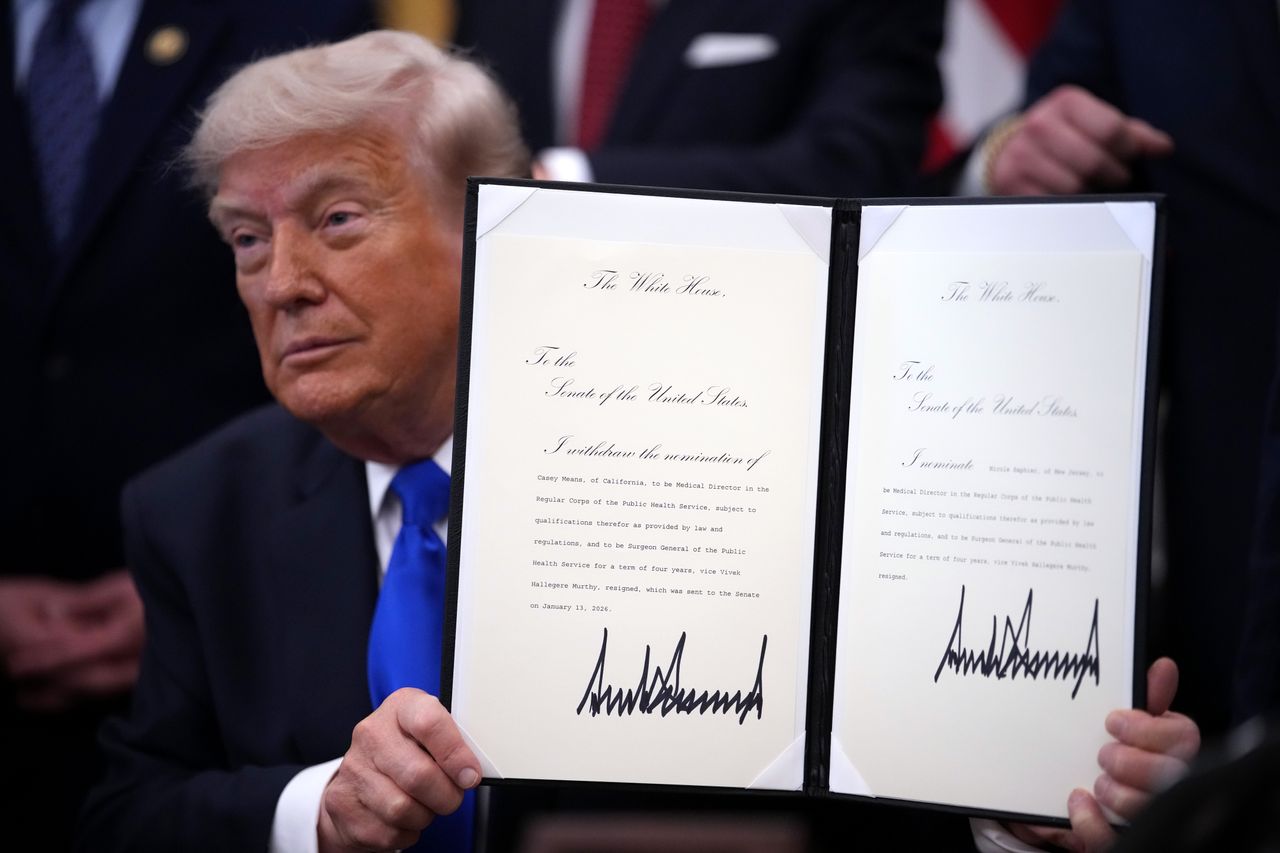 | | President Donald Trump holds up a document appointing Nicole Saphier as the new surgeon general during an Oval Office event on Thursday. (Andrew Harnik/Getty Images) | | | |  | The Lead Brief | President Donald Trump has pulled the nomination for Casey Means, his initial pick to serve as the nation’s top doctor, and selected Nicole Saphier for the role instead. Saphier marks Trump’s third attempt to fill the U.S. surgeon general post. The White House first selected Janette Nesheiwat for the role, but decided to withdraw her nomination and put Means forward last May. My WaPo colleagues Lauren Weber, Rachel Roubein and Dan Diamond have the full story. It’s filled with details about Saphier’s background and previous disagreements with the Trump administration, Trump’s backlash against a GOP senator he blames for tanking Means’s nomination and reaction from the Make America Healthy Again movement — including an interview with Means herself. Saphier is a radiologist at Memorial Sloan Kettering Cancer Center and had been a Fox News medical contributor until her nomination. In a Truth Social post, Trump called her “a STAR physician” and “an INCREDIBLE COMMUNICATOR, who makes complicated health issues more easily understood by all Americans.” She authored a book in 2020 called “Make America Healthy Again: How Bad Behavior and Big Government Caused a Trillion-Dollar Crisis,” encouraging Americans to take better care of themselves. “The only way to lower health care costs for everyone is to stop incentivizing bad health decisions. Plans like ‘Medicare-for-all’ would allow Americans to continue to eat poorly and lead sedentary lives. We can’t keep expecting doctors to fix behaviors that we have in our power to prevent,” Saphier believes, according to a Goodreads summary. After Trump claimed in a September news conference that Tylenol use by pregnant women is linked to autism in children, Saphier described the event as “very messy” — and said there was “no new evidence” to prove any connection. ‘CONTINUE TO FIGHT’ Means’s nomination had stalled following a confirmation hearing before the Senate Health, Education, Labor and Pensions Committee in February, despite lobbying advocates of the MAHA movement. Multiple Republicans on the panel — including Chair Bill Cassidy (R-Louisiana) — expressed skepticism about Means’s credentials and views on vaccines. Sens. Lisa Murkowski (R-Alaska) and Susan Collins (R-Maine) also had reservations, which complicated her ability to advance through the committee. “The decision about me and my nomination came down to three senators — three disgruntled senators — so I don’t think it represents the bigger picture of what’s happening with the [MAHA] movement, which is overall very positive,” Means told my colleagues on Thursday, pointing to a successful vote to strip pesticide provisions opposed by MAHA from the farm bill. Trump said in another social media post that Means would “continue to fight for MAHA on the many important Health issues facing our Country.” | | | |  | Election watch | After announcing that Saphier would become his new pick for surgeon general, Trump lambasted Cassidy as a key reason Means did not move forward — urging Republicans in Louisiana not to vote for him in an upcoming primary. Cassidy, who voted to impeach Trump during his first administration, is in a hotly contested primary race against Rep. Julia Letlow (R) and Louisiana state Treasurer John Fleming. He is falling behind both opponents, according to an Emerson College poll released Thursday. Cassidy’s office did not respond to a request for comment on Trump’s posts. Why it matters: Cassidy leads the Senate’s health panel and sits on the Senate Finance Committee, which has jurisdiction over some health care policy issues. If he’s unseated, it could change the composition of both. → Cassidy has been rebuked by Trump and followers of his Make America Great Again movement over the impeachment vote, and the president earlier this year said he endorsed Letlow for the Senate seat. But the rift with MAGA comes as powerful antiabortion groups are backing Cassidy in his bid to keep his Senate seat. Marjorie Dannenfelser, who leads the Susan B. Anthony List Pro-Life America, introduced Cassidy at a gala hosted by the organization Wednesday night, acknowledging the “tough” electoral spot he’s in. “You deserve all of our support,” said Dannenfelser, recalling that the Louisiana race that initially brought Cassidy to the Senate — beating Democratic Sen. Mary Landrieu in 2014 — was the first the group had ever engaged in. “I know you have a tough primary, and you need to win,” she said. | | | |  | From our notebook | Maine Gov. Janet Mills is dropping out of the race that Democrats hope will unseat Sen. Susan Collins (R) in a bid to regain control of the Senate. Liz Goodwin in The Washington Post newsroom reports Mills said she had run out of money to compete. This all but guarantees that Graham Platner, a 41-year-old oyster farmer who has secured an endorsement from Sen. Bernie Sanders (I-Vermont), will face off against Collins in November. → The health care angle: Platner, who has been drawing large crowds of voters to his events, recently unveiled his health care platform. It calls for breaking up pharmacy benefit managers, enacting Medicare-for-all and expanding the government’s drug price negotiation program. | | | | | | Litigation Report | The Trump administration told a federal court it would be appealing a decision to temporarily halt some of the sweeping changes the federal government has made to vaccine policy, including Health Secretary Robert F. Kennedy Jr.’s effort to overhaul an influential immunization advisory panel and replace it with his own picks. In March, a federal judge temporarily blocked the administration from implementing changes to the nation’s childhood immunization schedule. The decision prevents the advisory panel, called the Advisory Committee on Immunization Practices (ACIP), from meeting. Following the ruling, Andrew Nixon, a spokesperson for the Department of Health and Human Services, said the department “looks forward to this judge’s decision being overturned, just like his other attempts to keep the Trump administration from governing.” The decision is still in effect while courts mull the appeals process. Once the Trump administration files its appeal, the groups suing Kennedy — including the American Academy of Pediatrics, the American College of Physicians and the Infectious Diseases Society of America — plan to respond. “I have remained optimistic that it would not want to relitigate issues on which it is bound to lose,” said Richard H. Hughes IV, the lawyer at Epstein Becker Green who represents the public health and physicians’ groups. “We will, in due course, respond to the government’s appeal, and we expect to prevail.” Hughes tells me he expects the Justice Department to file its opening brief in June, in line with the standard timeline set by the U.S. Court of Appeals for the 1st Circuit, unless the administration seeks and wins an expedited schedule. | | | | | | | | | | |


_tstmp_1756933376-1920-1080.png)






