
|
 |
Hi, y’all. Welcome back to The Opposition. Today’s edition is about ongoing turmoil at the Democratic National Committee as officials become increasingly frustrated with Ken Martin’s leadership. Such party infighting and finger-pointing might seem like annoying palace intrigue. But as you’ll read in the piece, many Democratic operatives believe it’s vital to have a well organized and competent DNC going into the 2028 presidential election cycle. And there’s a growing concern that Martin isn’t the man for the job. Let’s get into it.
But first: if you’re not already a member, today would be a great day to try out Bulwark+—for free! Enjoy two weeks on us, and see what you think of our member community and full access to all our products.
–Lauren



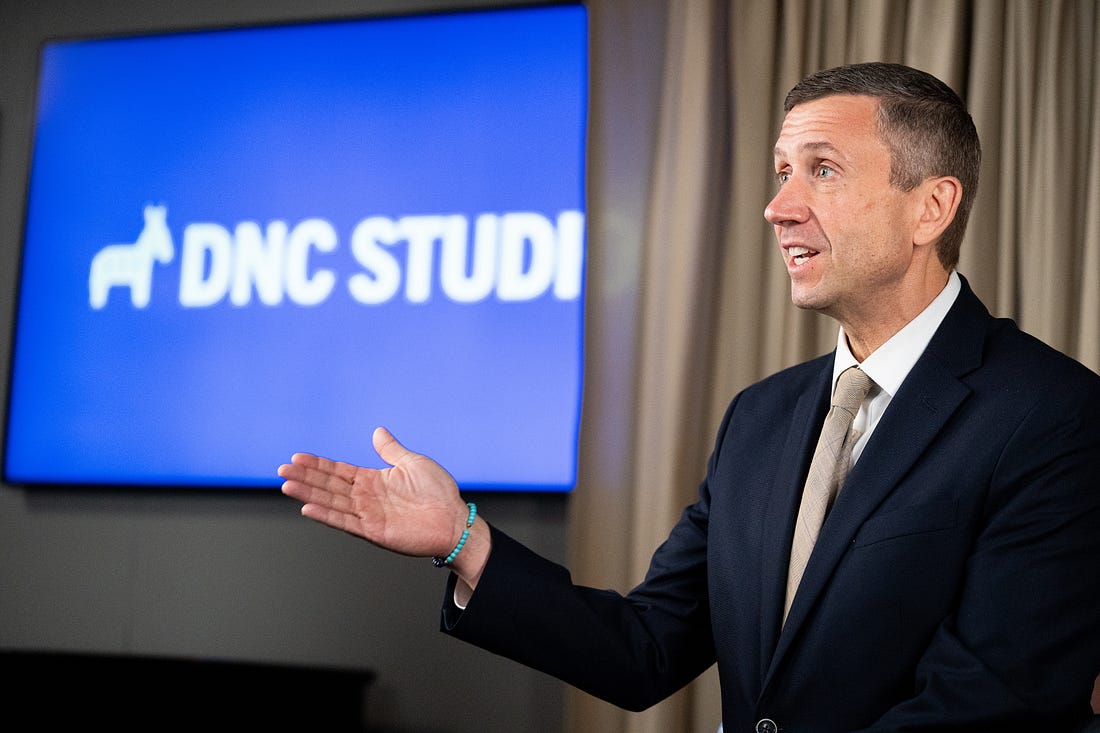 |
KEN MARTIN’S TENURE AS CHAIR of the Democratic National Committee over the last year has been defined largely by frustration with his leadership. That frustration crested last week when Martin went on Pod Save America to defend himself against charges that he has backed out of his promise to release an after-action report about what went wrong in the 2024 election—as well as accusations that the DNC has had trouble raising money and balancing its budget.
DNC members and party strategists I talked to after Martin’s podcast appearance said they believe his defensive comments further tarnished the party brand and deepened trust issues stemming from his decision to cancel the autopsy report.
The concerns have become so pronounced in recent weeks that some DNC members have privately discussed trying to force Martin out of the job, according to three people familiar with these conversations. The idea was put on hold after members failed to identify an alternative candidate willing to step into the role.
But the panic over the direction of the party hasn’t dissipated. Instead, it has led these worried party leaders to entertain other possible reforms, such as trying to force a resolution that would require Martin to rein in the DNC’s spending and balance its budget.
“I think that would be a very hard job, no matter who has it. But [Martin] seems to be uniquely ill-suited for it,” Democratic strategist Jesse Lehrich, who is not a party to those internal talks, told me. “The Pod Save interview was mind-blowing to me.”
Martin’s rocky tenure as party chair does owe something to factors out of his control. A party that is out of power but desperate to flex its muscle will naturally see its leaders as feckless. Martin, like Senate Minority Leader Chuck Schumer and House Minority Leader Hakeem Jeffries, is a convenient punching bag.
But much of the criticism is about things that are directly under Martin’s purview. Since 2025, the DNC has spent more money than it has raised and has more debt than cash on hand. The RNC has a roughly seven-to-one money advantage over the DNC, and last October, Martin took out a $15 million loan ahead of the elections in Virginia and New Jersey. Multiple people familiar with the DNC’s money issues said that the situation is so dire that Martin will likely be forced to make another tough call this summer: take out another loan or lay off staff. During his Pod Save interview, Martin repeatedly characterized the claim that the DNC is contemplating layoffs as “garbage.”
“The biggest strike against him is that he seems to be utterly incapable of managing a budget. To put the DNC in such a bad financial situation going into what is . . . likely be the most wild [presidential] primary we’ve had in a while—it reeks of irresponsibility and immaturity,” said a DNC member who asked not to be named due to the sensitivity of the topic.
“It just feels like we’re being gaslit at this point.”
The agita over the state of the DNC is not merely another round of Beltway bickering. It’s one of the more consequential storylines in Democratic politics these days. There is a deep concern among party officials that Martin is driving the committee into irrelevance, potentially harming Democratic chances in the midterms, and inviting uncomfortable questions about whether the 178-year-old committee should even exist anymore.
“The DNC should not be a useless or irrelevant institution,” said Democratic strategist Ross Morales Rocketto. “It’s currently irrelevant because of the leadership.”
THIS ISN’T THE FIRST TIME THE DNC has faced questions about its relevance. Following the 2008 election, Organizing for America, the political operation that grew out of Barack Obama’s presidential campaign, became the central organizing axis for the party. But when Democrats suffered heavy losses in 2010, and again after Donald Trump’s 2016 victory, party leaders demanded a shift back, blaming OFA for taking away donor money and volunteers from the DNC and leaving the party unable to coordinate effectively.
“I almost think of Obama as a similar figure to Trump in terms of having this movement of people that were so fired up about him. They weren’t exactly Democratic party super fans,” said Lehrich, who served as communications director for OFA (rebranded then as Organizing for Action) in the late 2010s. The goal of OFA, Lehrich explained, was to keep Obama’s loyal army of grassroots supporters engaged. “But the DNC was rightfully frustrated that it was funneling away people and resources and creating a shadow apparatus.”
Shortly after Tom Perez, the former labor secretary in the Obama administration, was elected DNC chair in 2017, OFA was quietly wound down. But while the DNC played important roles in helping the party win back the House in 2018—and the White House in 2020—it never quite reemerged as the central organizing entity in the Democratic party firmament.
Instead, much of that responsibility has been taken over by nonprofit organizations and super PACs. The Supreme Court’s 2010 Citizens United decision generated a wave of donations to non-party entities, empowering them in the process to handle traditional party functions like GOTV, research, and advertising.
Many Democratic strategists say that while they understand the trend, they have lamented it, too—noting that the DNC has at least one major advantage over these groups.
“The biggest . . . is they coordinate across campaigns,” said Steve Schale, a longtime Democratic strategist and Obama’s 2008 state director in Florida.¹ “It’s way fucking easier to run a campaign when you can talk to the main players in the operation. I can’t imagine, for example, on either Obama campaign, having to run a state where my entire field operation was outsourced to an organization I couldn’t talk to.”
“The DNC allows all that to work,” Schale added. “That’s why I think it’s pretty vital for it to be a—not even necessarily a thriving—but a competent, respected vessel for where donors have trust in sending their money.”