| | In today’s edition: Abu Dhabi signals long-term confidence, the Gulf looks for a Mediterranean trade͏ ͏ ͏ ͏ ͏ ͏ |
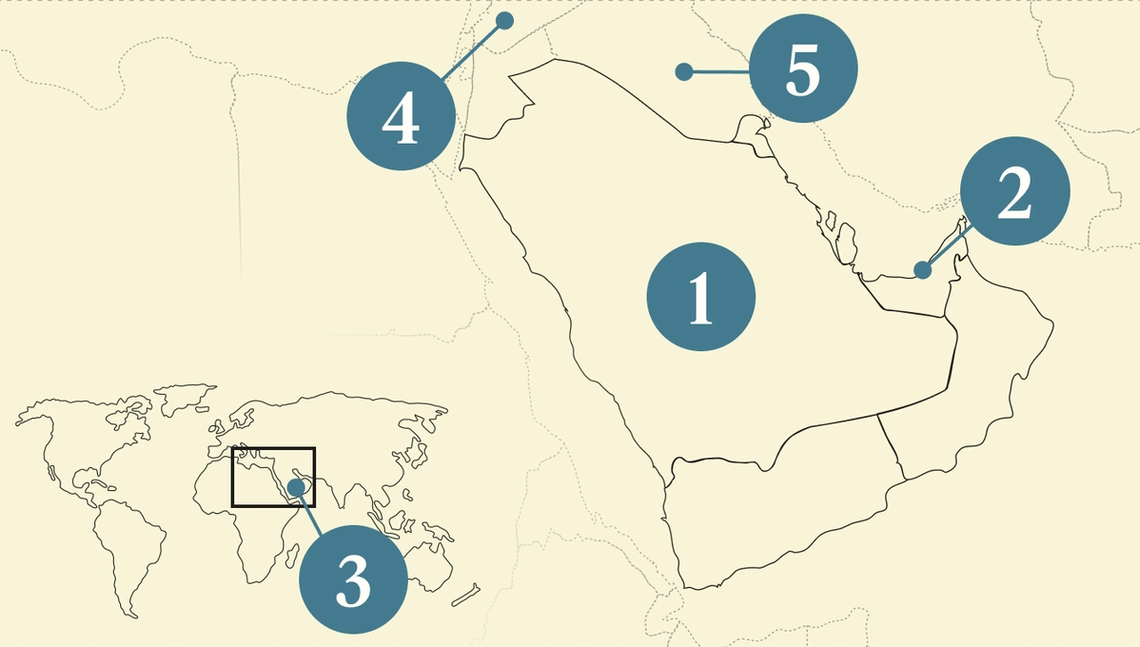
| |  Abu Dhabi Abu Dhabi | Baghdad |  Latakia Latakia |
 | Gulf |  |
| |
|
 - Gulf project activity tumbles
- UAE sells AI software to US
- Renewables’ supply pains
- Gulf’s Mediterranean outlet
- Iraq failures haunt Iran war
 Autonomous boats and weaponized dolphins. |
|
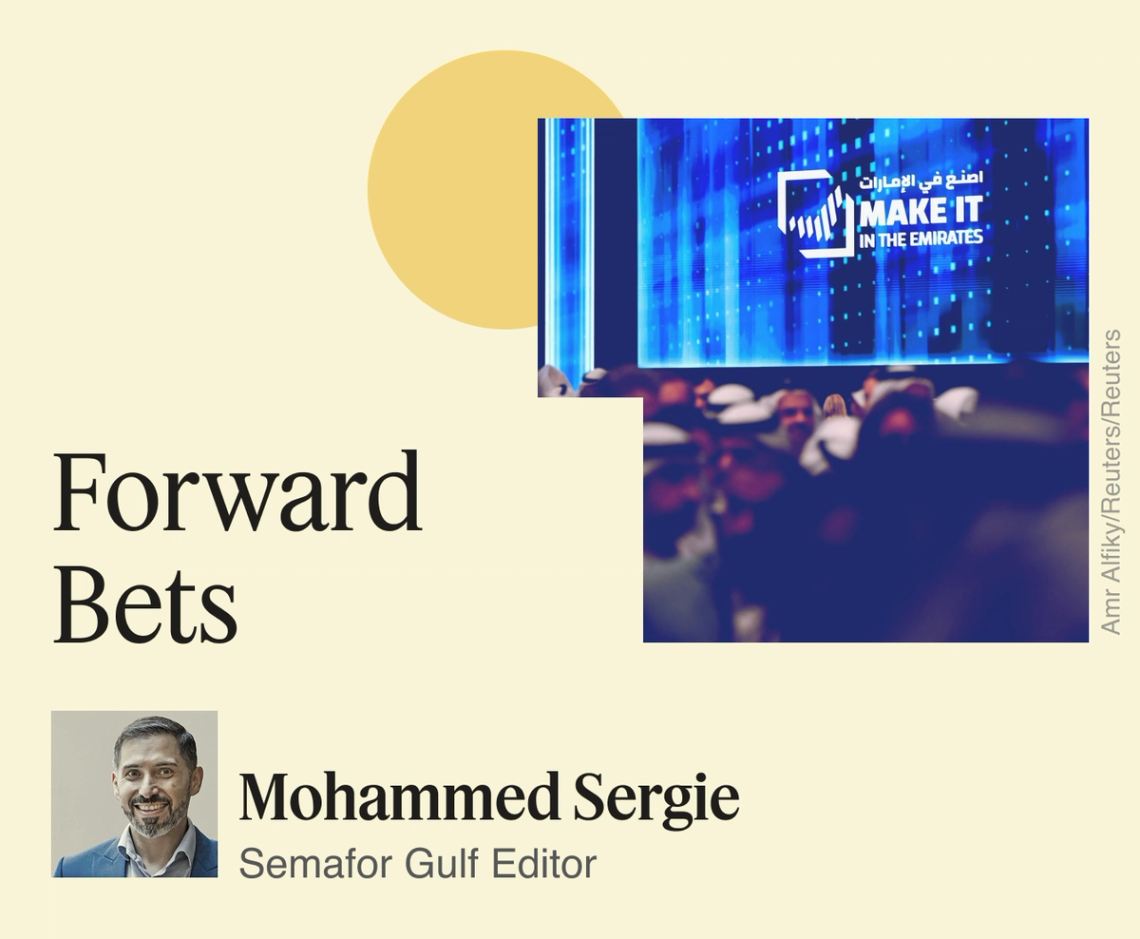 After two months of canceled or muted events across the Gulf, thousands flocked today to “Make it in the Emirates,” the biggest business convening since the war began. There will be others — a few over the summer and more in the fall — as governments try to project optimism and resilience, reinforcing that the Gulf’s golden era is on pause, not in decline. Traffic snarled around Abu Dhabi’s convention center, a rare nuisance these days for UAE drivers. More than 1,200 companies were exhibiting at the annual gathering, which serves as a platform to promote manufacturing and industrialization. Opening the event, Sultan Al Jaber — the UAE’s minister of industry and advanced technology and CEO of ADNOC — said the UAE’s push to expand energy output, localize industry, boost trade, and place big bets on AI is aimed at securing “sovereignty and resilience.” Last week’s decision by the UAE to exit OPEC, he said, will help accelerate investment in energy capacity, feeding into that drive. “The economies of the future will be built on three foundations: energy that powers, technology that thinks, and industry that produces … the UAE brings these pillars together within one integrated ecosystem,” he told a packed auditorium. Yesterday, ADNOC said it will spend $54.5 billion on its domestic energy industry through 2028, another signal that there is no retrenchment in the face of Iranian attacks. Outside the conference hall, the mood broadly matched this message. In conversations with executives and officials, there was no denial about the impact of the war on business or the closure of the Strait of Hormuz, but no one was going to bet against the UAE or the Gulf more broadly. The past two months have been a test of defenses and supply chains. Assuming the ceasefire holds and trade through Hormuz resumes, the rest of the year seems to be pointing to a recovery phase defined by greater self-reliance. Or, as Badr Jafar — special envoy for business and philanthropy to the UAE’s minister of foreign affairs — put it, invoking an Arabic saying: Nothing relieves an itch like your own nail. (Jafar, who is also CEO of Crescent Enterprises, is an investor in Semafor.) |
|
Gulf construction takes a pause |
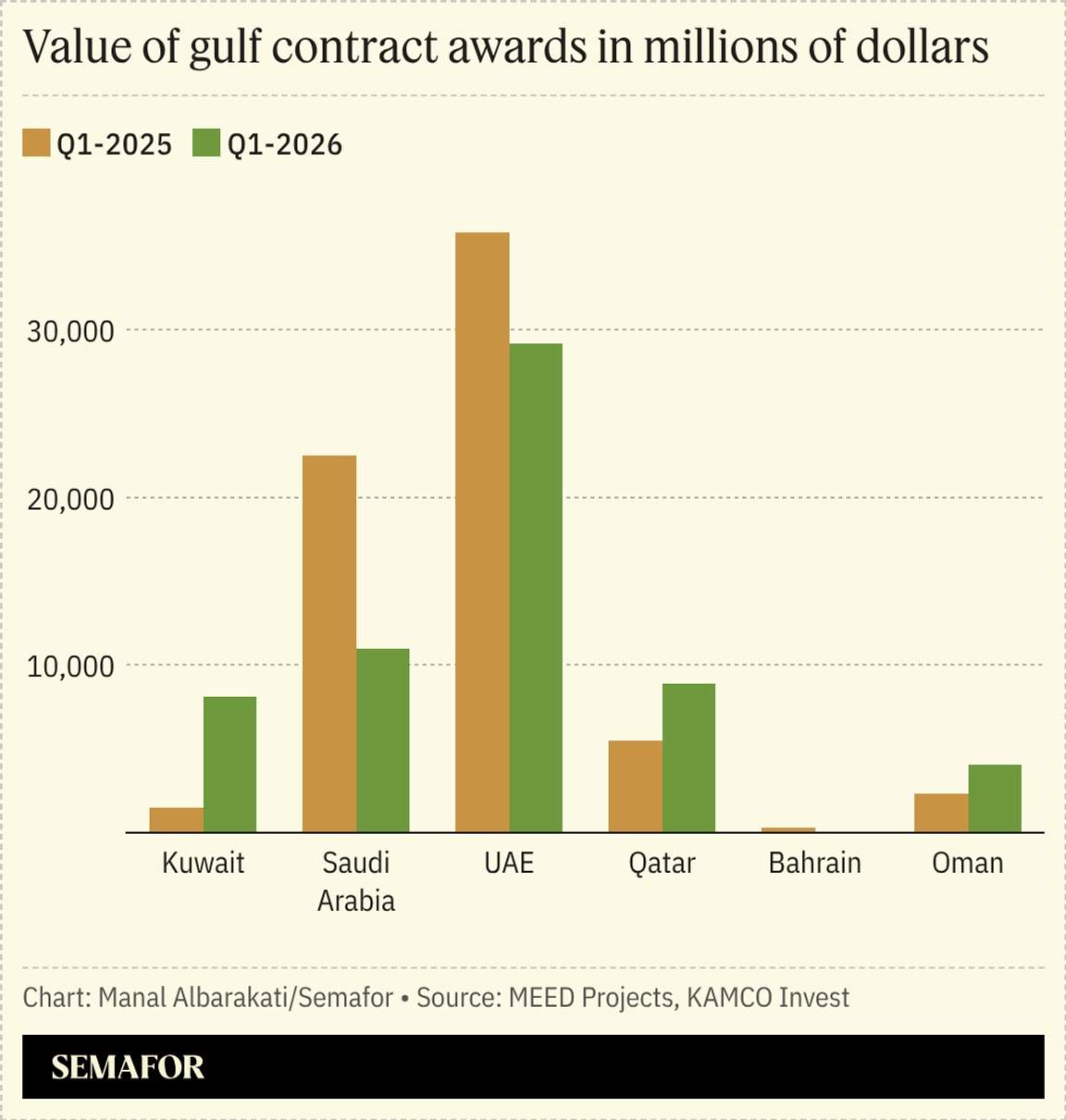 The Gulf’s construction market was worth $175 billion in 2025, built on gigaprojects and other oil-funded diversification plans; the war has put much of that on pause. The number of contract awards across the region fell from 80 in February to just 25 in March, with their value dropping from $26 billion to $11.8 billion, according to MEED Projects data cited by Kamco Invest, a Kuwaiti investment firm. Saudi Arabia, which accounts for nearly half of the region’s $2 trillion project pipeline, saw awards fall 51% year-on-year in the first quarter of 2026. The even bigger UAE market also saw a significant fall. The numbers are telling of something broader than a single bad month: The Gulf’s construction boom has always been primarily funded by oil revenues. Disruptions to the Strait of Hormuz and attacks on energy infrastructure since Feb. 28 have affected both production and exports, straining government budgets, disrupting supply chains, and making investors wary. Whether the projects now on hold or moving more slowly ever get built depends on what postwar priorities look like. Kamco says project activity is likely to remain “sluggish” through the rest of this year, but suggests a bounce-back is possible in 2027. — Manal Albarakati |
|
Abu Dhabi is California dreaming |
 Hamad I Mohammed Hamad I MohammedAbu Dhabi’s massive investment in advanced technology research is starting to pay off. The UAE capital’s Technology Innovation Institute sold a data privacy product to San Francisco-based AI firm OPAQUE in the “multi-million-dollar range,” a spokesperson told Semafor, while declining to specify the value or structure of the deal. It is the first time a US company has acquired AI technology of this kind developed in the UAE, according to TII. “This acquisition reflects what the UAE has set out to do — produce foundational technology that the world adopts,” Faisal Al Bannai, adviser to UAE President Sheikh Mohamed bin Zayed and secretary general of TII’s parent, the Advanced Technology Research Council, said in a statement. The government-backed group was established in 2020 to bring commercially viable research in areas such as AI, robotics, and new materials to the UAE. OPAQUE, which counts Anthropic and Accenture as customers, will use the technology to allow AI models to train on otherwise sensitive data — such as patient records, financial transactions, and classified intelligence — while keeping that data private, with encryption designed to withstand future quantum computers. — Kelsey Warner |
|
War causes headaches for clean energy too |
 Reuters/Masdar Reuters/MasdarHigh oil prices should trigger a rush to renewable energy, but the industry is being hampered by the Iran war too, with Gulf supplies of critical inputs on hold or much reduced. Many byproducts of the oil and gas industry are essential for making solar panels, wind turbines, and batteries, including plastics like ethylene and polypropylene, and sulfuric acid (used to process copper), S&P Global noted. Helium, another gas byproduct, is used to make the semiconductors in green energy systems. In normal times, Qatar produces a third of the world’s helium but has shuttered its gas industry. Aluminum supply chains have also been hit, following Iranian strikes on smelters in Bahrain and the UAE, pushing the price of the metal to a four-year high and testing panel and turbine makers who rely on it. The cost of materials for printed circuit boards used extensively by the renewable energy industry has also increased. Despite all this, oil price volatility makes the energy security that renewables can offer all the more alluring. The conflict could prove to be a net positive for solar, analysts told S&P. — Dominic Dudley |
|
Syria offers Gulf a new trade lane |
 AlekhbariahSY/X AlekhbariahSY/XThe war is reshaping the region’s logistics, prompting new routes to be opened while reviving others that have been impassable for decades. Syria, which itself only recently emerged from more than a decade of conflict, is becoming a critical node in Gulf supply chains. With the Strait of Hormuz effectively closed, some cargo is moving overland from the UAE to the Syrian port of Latakia. Iraq is also trucking oil and reviving plans for an export pipeline through Syria to the Mediterranean. Such developments have been made possible by rebels ousting Syria’s Iran-backed regime in 2024, allowing Damascus to reposition itself as a transit hub. Saudi Arabia is also getting a logistics boost: Shipping giant MSC launched a new network to move goods from Europe to Red Sea ports, with cargo then taken overland to the rest of the Gulf. |
|
View: Past Iraq failures haunt Iran war |
| |  | Alaa Shahine Salha |
| |
 Poster of former IRGC commander Qassem Soleimani and Iraqi militia commander Abu Mahdi al-Muhandis in Baghdad. Ahmed Saad/Reuters Poster of former IRGC commander Qassem Soleimani and Iraqi militia commander Abu Mahdi al-Muhandis in Baghdad. Ahmed Saad/ReutersUS failures in Iraq more than two decades ago are haunting US President Donald Trump’s war against Iran, and threatening the security of Washington’s Gulf allies, Alaa Shahine Salha, a senior executive at Saudi Research & Media Group, writes in a column for Semafor. Much like today’s conflict with Iran, the 2003 invasion of Iraq went ahead despite warnings from Washington’s Arab allies, and US mismanagement of the post-Saddam Hussein order then opened the door for Iran to build its influence over Iraqi political parties and militias; those militias have attacked Gulf states during the latest conflict. The future of Iran’s influence in Iraq is likely to be shaped by the outcome of the current war. “The bigger question is whether we in the region will once again be left to pick up the pieces,” writes Shahine Salha. |
|
 Defense- The US Navy launched Project Freedom on May 4 to offer protection to shipping through the Strait of Hormuz, using destroyers, aircraft, and drones. Iran said it hit one merchant ship in the area, but that claim has been disputed.
- Israel has reportedly sent air defense systems to the UAE during the war, including the Spectro drone detector, and a laser that shoots down projectiles. Iran launched more than 2,800 missiles and drones on the UAE, the vast majority of which were intercepted. — Financial Times
- The US has approved $8.6 billion worth of arms sales to its Middle East allies, including $4 billion of Patriot interceptor missiles to Qatar and other weapons systems to Israel, Kuwait, and the UAE. Secretary of State Marco Rubio is seeking to bypass the usual Congressional review, citing emergency circumstances. — Financial Times
Food and beverages- Dubai foodies have reason to celebrate: More than 100 restaurants, including several Michelin-starred venues, are offering three-course dinners for 250 dirhams ($68) as the city’s beloved Restaurant Week marks its 10th edition from May 1-17. — The National
- The only liquor store in Saudi Arabia, where high-earning expatriates can legally get their alcohol fix, is running out of stock because of the Iran war’s impact on regional supply chains. — Reuters
Tech- Amazon Web Services expects to take several months to repair data centers in Bahrain and the UAE that were damaged by Iranian attacks in early March. AWS recommended to customers last week that they migrate to other regions and restore lost files from other backups. — Reuters
- Oman is ramping up its AI bona fides with the establishment of a dedicated AI economic zone to attract technology companies. The sultanate has earmarked $170 million in incentives. — Oman Observer
|
|
 Dinuka Liyanawatte/Reuters Dinuka Liyanawatte/ReutersThere are many competing visions of how technology and military strategy should be combined in the Gulf’s waters, some of which cross into the bizarre. In the UAE, authorities are testing autonomous patrol boats to monitor waterways and enforce maritime rules in what is a normal use case. At the other end of the scale, Iran — whose yet-to-be-seen supreme leader has vowed to sink the ships of “foreigners who commit evil” — is reportedly planning to strap mines onto dolphins, in a program that dates back to the Cold War but which does not appear to have ever been put into action. The contrast is stark, but there’s a common thread: Asymmetric warfare is now as much a part of the Gulf’s security arena as traditional military tools. Iran has also threatened to cut subsea communications cables, The Wall Street Journal reports — though it’s unclear whether Tehran has a crab brigade that’s up to the task. — Mohammed Sergie |
|
|


