| Welcome, Weekenders! In this newsletter: |
| • Tech Culture: Billionaire tax brings new boom time to Tahoe haven |
| • Plus, Recommendations—our weekly pop culture picks: “The Interview: What Does Tucker Carlson Really Believe? I Went to Maine to Find Out,” “Hated by All the Right People,” and “Widow’s Bay” |
| |
| A very old proverb comes to mind when I think about this exact period in AI—because, really, it’s a moment when the enemy of your enemy can be your compute provider. |
| I’m referencing, of course, Elon Musk’s decision to strike a deal with Anthropic and sell it access to his data center campus in Memphis, Colossus 1. Until this week, Musk had seemed to view Anthropic strictly as a bitter rival to his xAI, which he recently folded into SpaceX; now the two companies are business partners. (Honestly, the AI industry treats labels and relationships much as a Fire Island share house does: It’s all very fluid.) Musk said he met with the team at Anthropic last week and decided to do the deal when “no one set off my evil detector.” |
| It’s a dramatic change in tone for Musk, who’d been merrily calling the startup “Misanthropic” as often as he could for several months. Perhaps he just misunderstood the word’s definition? No, it’s a matter of timing. |
| Anthropic’s Claude Code and Cowork products have become enormous hits, but the startup has faced a problem in securing the compute needed to keep up with demand. Having just really caught everyone’s attention after several years in the shadow of Google and OpenAI, Anthropic absolutely doesn’t want to slow down. It wants the compute as immediately as possible. |
| Meanwhile, Musk is incentivized to sell off Colossus access at this very moment in a way he wasn’t even a few months ago. |
| The Anthropic deal helps improve the financial situation for his SpaceX conglomerate as it prepares for an IPO next month. In addition, Musk got Anthropic to express interest in orbital data centers in its announcement of the Colossus deal; presumably, he’ll point to Anthropic’s interest when he talks up outer space data centers on his IPO road show, even if they remain a totally unproven concept, like Bigfoot. |
| I wonder what the Anthropic tie-up means for the deals Musk did just a few weeks ago—when he sold compute to Cursor, a top Anthropic rival, and said he’d acquired an option to buy the startup or fork over a $10 billion break-up fee. There’s a very good chance we’re a few months away from Musk suing to get out of paying that fee, especially if Anthropic continues on its recent pace and seems to dim Cursor’s prospects further, making the startup less attractive to Musk. |
| Another factor at play: Don’t underestimate how much motivation Musk may be drawing from the chance to screw over Sam Altman at an instant when their relationship has been put on full public display. |
| In the court case between the two over OpenAI, Musk’s lawyers have been trying their best to shove their fingers in Altman’s eye for the last two weeks. But they haven’t gotten close to securing a decisive victory, which must irritate Musk, who has publicly made Altman a total bête noire. |
| So with Anthropic, Musk gets another opportunity to kick the shins of one enemy by locking arms with another, which reminds me of another adage: With friends like these… |
| What else from this week… |
| • I generally try to take what political operatives say with a heap of salt, but when they tell NPR they’re rampantly using prediction markets to trade off their own campaigns’ internal information, I totally believe it. |
| • Hunters and fishers think technology has taken all the fun out of hunting and fishing. |
| • Vibe change alert! Ezra Klein has an argument that the AI job-pocalypse won’t come to pass. |
| • DeepMind has invested in Fenris Creations (formerly CCP Games), the Iceland-based maker of Eve Online, a venerable internet strategy game that involves empire building in outer space. The game “requires skills that AI has not yet fully mastered,” said DeepMind executive. Oh, great—once the AIs are done conquering this planet, we’ll have already taught them how to take over other ones, too. |
| • According to The Atlantic, the IRS once ran a “secret AI fight club.” |
| • Quirky doesn’t quite describe Corgi, an AI insurance startup, which was recently valued at over $1 billion and has seen annualized revenue top $100 million: It operates the all-night Corgi Cafe, an honest-to-goodness coffee joint, in San Francisco’s Financial District. Most conference rooms at its office have mattresses shoved in a corner—since many of the young employees simply choose to crash overnight rather than go home. And the staff share responsibilities for Trudy, the office corgi, managing the tasks via Telegram bot. |
| • The Met Gala has been attracting a who’s who of Silicon Valley for years, but at the most recent one, the traditional celebrities took the opportunity to express a strong anti-AI sentiment. It was incredibly blatant—Katy Perry–in-an-Optimus-mask blatant—and it’s the kind of very public snub I’m sure has in turn got the industry elite turning up the heat on their policy and publicist teams.—Abram Brown (abe@theinformation.com) . |
|
|
|
| Tech Culture |
 |
|
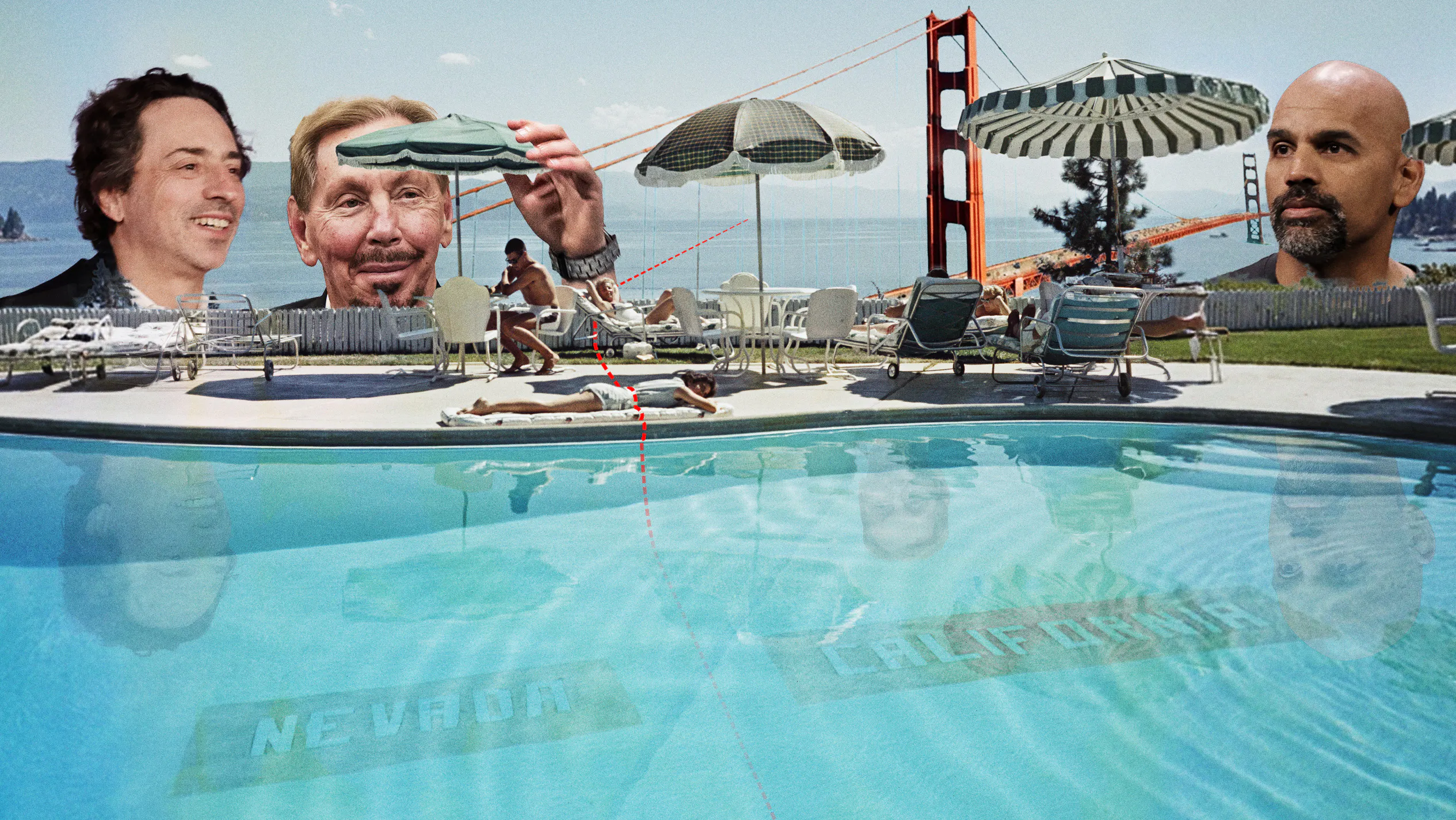
| Incline Village at Lake Tahoe has seen boom times before, and the likes of Sergey Brin, Steve Jurvetson and others have ignited another. One resident described it as “the nicest San Francisco neighborhood.” |
| |
 |
| Listening: “The Interview: What Does Tucker Carlson Really Believe? I Went to Maine to Find Out” |
| Reading: “Hated by All the Right People” by Jason Zengerle |
| These days, the rules of media are as pliable as Play-Doh. And I’m embracing the fact here by breaking a tenet of this newsletter and combining these picks as a twofer: Maybe a little Tucker Carlson, the main subject of both selections, has rubbed off on me. He’s definitely a fella who has prospered by ignoring conventionalities. |
| The first thing to do here: Pick up “Hated by All the Right People” from Jason Zengerle, a longtime political correspondent. The biography of Carlson covers his ascension from traditional media wunderkind—contributor to places such as GQ, CNN and Tina Brown’s short-lived Talk magazine—to network TV provocateur, which is how most of us think of him today. Such was Carlson’s seeming ubiquity in the late 2010s that I’d forgotten how he toiled in the conservative hinterland until 2016, when Fox News greenlit his show just days before Donald Trump’s first election. Carlson’s ascension has run parallel to Trump’s, their intertwined rise mapping broadly to the tumultuous changes in America over the last 15-plus years. |
| Zengerle has great fun chronicling the absurd relationship between pontificator and president, with Carlson hyping up Trump on air and then kicking dirt all over his Brioni trousers in private, mocking his taste for gold, marble and sleaze. Off-air, they spoke together often, but sometimes Carlson liked to play mind games with Trump and would refuse to take his phone calls, which only made Trump intensify his pursuit of Carlson’s approval. One White House official likened their relationship to Trump as the eager suitor of Carlson, “a hot girl that didn’t want to fuck him.” |
| Zengerle has known Carlson since the ’90s, but Carlson wouldn’t speak to him for the book, and I did long to hear Carlson joust back—to hear what he has to say for himself. That’s why I suggest following “Hated by All the Right People,” which concludes as Trump wins reelection, with a recent episode of “The Interview,” the very good New York Times podcast, which ran two lengthy conversations with Carlson last week. |
| Right now, Carlson’s on-again, off-again relationship with Trump is very much off: He and Trump aren’t on speaking terms at all. Carlson is strictly opposed to the war in Iran, and the conflict has made him regret his decision to campaign for Trump in 2024, he told “The Interview.” By the time Carlson was done talking on the pod, I had fresh appreciation for Zengerle’s book. Yes, it’s a colorful portrait, but it’s also a study in concerted restraint. Clearly, Carlson is exactly how Zengerle describes him.—Abram Brown |
| Watching: “Widow’s Bay” |
| In retrospect, Mayor Larry Vaughn, the “Jaws” mayor who turned his community’s seascape into a great white’s smorgasbord, had it pretty easy. He only had one terrible creature to handle. By contrast, Tom Loftis (Matthew Rhys) has it much, much worse as mayor of Widow’s Bay, a fictional New England beach town: He has to deal with a killer ghost clown, a zombie woman, a lethal fog—and that’s just what’s made it on-screen in the first three episodes of Apple TV’s new horror comedy. The show has a dry, tense humor, and it is handled with great deftness by executive producer Hiro Murai, an “Atlanta” veteran, who directed most of the season’s 10 episodes. (Ti West, director of the popular “X” horror film trilogy, helmed one, too.) |
| As the series opens, Loftis has been working hard to boost Widow’s Bay tourist trade, which begins to pick up just as things increasingly go bump in the night. (Not that anyone was ever getting any sleep at the creepy haunted hotel even in the best of times.) Loftis even manages to get The New York Times to visit. The reporter ends up loving the place even though he accuses Loftis of trying to steal a little too much of Salem’s energy when he already has a perfectly good alternative to Martha’s Vineyard; the exchange comes just as Loftis insists everyone must stay indoors—the man-eating mist has returned. |
| Still, I know what element of Widow’s Bay would scare the bejeezus out of many of you. Absolutely no cellphone service. Anywhere.—A.B. |