
|
 |


Here’s what the whole gerrymandering debate is about: Who gets to have and exercise power.
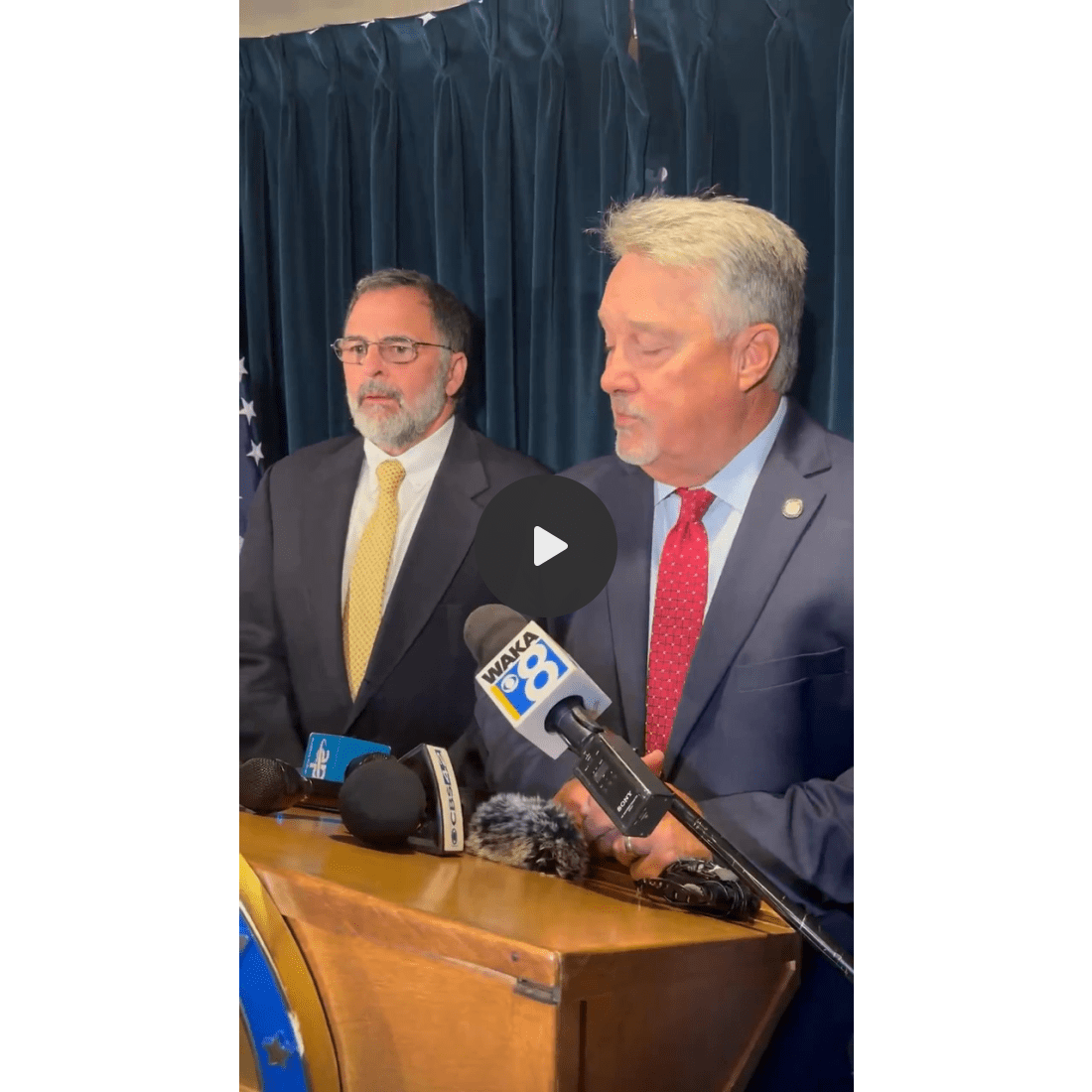
The Speaker of the Alabama House delivered a timely reminder, as the state legislature moved at lightning speed to pass “new” voting maps (they’re really, more or less, the old ones that the Supreme Court said were illegal a couple of years back). In a press conference, the Speaker, Nathaniel Ledbetter, called on the courts to “overturn the 14th Amendment.” Press play below to listen to his exact words. There is no ambiguity. He’s talking about the 14th Amendment to the United States Constitution.
Unfortunately, no one followed up to ask Ledbetter which part he objected to. There are five sections in the 14th Amendment. Donald Trump already objects to the guarantee of birthright citizenship: “All persons born or naturalized in the United States, and subject to the jurisdiction thereof, are citizens of the United States and of the State wherein they reside.” But the Supreme Court seems likely to hand him a loss in that regard; his executive order is currently on hold while it considers the case.
So maybe it’s the start of the next sentence? “No State shall make or enforce any law which shall abridge the privileges or immunities of citizens of the United States.” Or maybe it’s the following clause: “nor shall any State deprive any person of life, liberty, or property, without due process of law.” Maybe it’s the provision that prohibits states from denying “any person within its jurisdiction the equal protection of the laws.” Probably it’s all three. What’s clear is that he wants the courts to say Alabama can use maps that were drawn with the intent to prevent Black people’s votes from counting. In any event, the Supreme Court doesn’t overrule constitutional provisions; it’s job is to interpret them.
Ledbetter is wrong, no matter how you look at it. He’s wrong about the law and how it works, which is odd for such a highranking law maker. He was elected to the Alabama House in November of 2014, which means he’s been around for long enough to have acquired some experience doing the job and understanding how government works. So making a statement like this amounts to little more than pandering, and the only people to whom a statement like this appeals are (yes, I’m going to say it out loud) racists.
You would think Alabama would have learned its lesson. Selma. Birmingham, The Montgomery Bus Boycotts. Sixteenth Street Baptist Church.
When Alabama elected Doug Jones to the Senate, it was a marker for who the state thought it could be. It was Jones who brought the men responsible for killing four girls preparing for worship services at the 16th Street Church to justice as a prosecutor. It meant something for the state to elect him. It also means something when Alabama’s House Speaker stands for using racially discriminatory maps to intentionally do away with Black electoral representation.
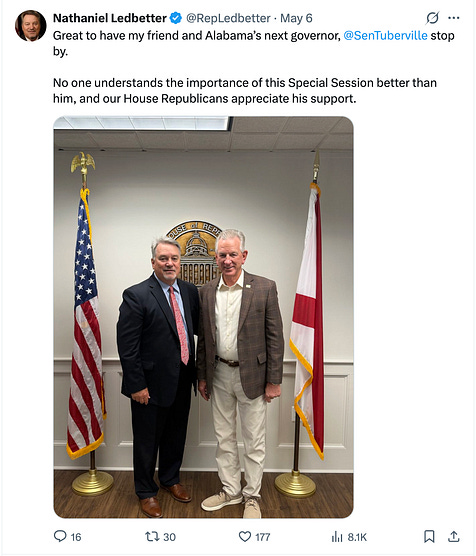
Alabama’s position here is unique. Because of Milligan, the case where the Supreme Court’s conservative majority, which has rarely seen a gerrymander it won’t sign off on said Alabama’s was a bridge too far, there is still an injunction in place that keeps Alabama from reverting to its discriminatory maps. (Background on Milligan here if you want a refresher). Of course, it raced to court to undo that after Callais was decided. And now, it's just a couple of days, working through Tornado warnings and flooding of the statehouse, the Republican supermajority has passed what Ledbetter called “a contingency plan” for the lifting of that injunction. “The moment we get relief, Alabama will be ready to act,” he tweeted on Friday.
In Ledbetter’s view, how the state should draw maps that are used to elect members of Congress is a matter of “conservative values.” He seems to be unaware that elections are about letting every eligible voter have their say, not about a political ideology. Who you vote for is a political choice, but the right to vote is foundational. That’s what the pro-Trump faction, not just in the Deep South, but across the country, is willing to overlook in order to stand by their man and stay in power. And in any event, the court-ordered maps that are currently in use in Alabama, which Ledbetter calls “nothing more than a racially gerrymandered disgrace that does not represent the conservative values held by Alabamians,” were imposed by a panel of judges consisting of two Donald Trump appointees and one Ronald Reagan appointee.
“Alabama has done its part in helping President Trump maintain a republican Congress, and we will continue fighting to ensure that our elections are decided by Alabamians, not activist judges.” Politicians who want to stay in power instead of protecting the rights of the people they serve, the voters, to decide who represents them.
 |
The stakes are the legitimacy of our democracy. Memphis, Tennessee, is where Dr. Martin Luther King was assassinated on April 4, 1968, because he demanded equality and dignity for Black people. Now, the Tennessee legislature, taking direction from the White House, has split up Memphis among three different congressional districts, eroding the right to vote in one of the places that was its cradle. Alabama, too, where people marched and were beaten bloody over the right to vote. Much of the rest of the South. And every place where elected officials are willing to sacrifice their constituents to the current occupant of the White House. We are indeed going back, and the problem isn’t just Alabama and Tennessee; it’s everywhere. It’s about who gets to register to vote, who gets to vote, and whose vote gets counted, and that affects all of us. In this moment, post-Callais, we have the opportunity to see, in blazing detail, the lengths Trump and his cronies are willing to go to in order to hold onto power. We can’t afford to sugarcoat the moment.
If Civil Discourse has been useful to you—helping you make sense of what’s happening and why it matters—consider becoming a paid subscriber if you aren’t one already. Your support is what makes this work possible and helps to build this community of people who care about democracy and want to do something to make sure we hold on to it.
We’re in this together,
Joyce
You're currently a free subscriber to Civil Discourse with Joyce Vance . For the full experience,