
|
 |


Here’s what to expect this week:
The Gerrymandering Epidemic Continues
The Supreme Court’s decision in Callais continues to make clear all the reasons we needed, and continue to need, a Voting Rights Act. And it isn’t about protecting white voters. Congress had an entirely different intent when it passed the Act, an intent that DOJ has forgotten to remove mention of from its website:
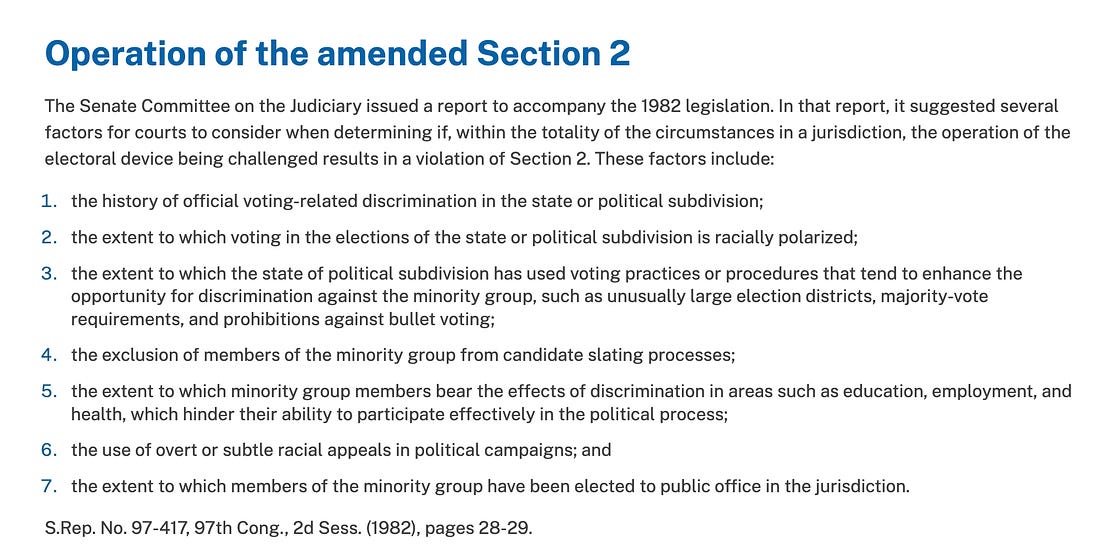 |
Section 2 “prohibits voting practices or procedures that discriminate on the basis of race, color, or membership in one of the [specified] language minority groups,” according to the website, which hasn’t been updated by this administration, at least not yet. “[T]he Supreme Court explained that the ‘essence of a Section 2 claim is that a certain electoral law, practice, or structure interacts with social and historical conditions to cause an inequality in the opportunities enjoyed by black and white voters to elect their preferred representatives.’” Congress clarified that the courts should look to “the history of official voting-related discrimination in the state or political subdivision,” when determining if the law has been violated. In the states hurriedly enacting new maps that eliminate Black voting power, that history involves denying Black people the right to vote. Instead of using Section 2 to fix that, the Court and Southern state legislatures are turning the law on its head and making a mockery of the rights it was meant to protect.
When the Court gutted Section 5 of the act in Shelby County v. Holder, Justice Ruth Bader Ginsburg accused the majority of shutting the umbrella that was meant to protect voters in the middle of a rainstorm who weren’t getting wet, because the umbrella was working. The case was decided in 2013, but even before the Supreme Court formally gutted Section 5 of the Act, repressive measures were being adopted in states like Alabama, which adopted a stepped-up voter identification requirement that made it more difficult for parts of the population, including Black voters, to exercise their rights, expecting that the Court would do away with Section 5’s preclearance provision.
A study at the Brennan Center explained the impact: “The racial turnout gap — the difference between white and nonwhite turnout rates in elections — has been consistently growing since at least 2008, reaching 18 percentage points in the 2022 midterm elections. If the gap did not exist, nearly 14 million additional ballots would have come from voters of color that year.” The analysis was based on nearly 1 billion vote records and controlled for factors like regional differences, income, and education.
The kind of behavior the Act was meant to prevent is exactly what’s happening, as Black voting power is diluted with new maps that are being adopted. And the Court seems to have abandoned its allegiance to the Purcell principle, which it has used in the past to prevent changes from being made too close to an election. Some of the new measures adopted by the states are being challenged, or will be challenged in court, and we’ll get a chance to see if the rules are different now that the Court is focused on protecting white voters from discrimination, which was the story behind Callais.
For instance, Tennessee’s extraordinary gerrymander was accompanied by a change to state law, so that election officials no longer have to advise voters about changes to their designated polling places as a result of the newly drawn maps. It’s easy to imagine how this plays out: voters with limited time because of family responsibilities go to what they think is the right polling place. They wait in a long line, maybe for hours, before being told they’re in the wrong location. At every step, the process is being redesigned to insert more friction, in hopes that Democratic-leaning voters will be dissuaded from participating. As Marc Elias noted, “Republicans defended the map by claiming that only population and politics were considered when the new map was created, not race.” But of course, the two are inextricably intertwined in Southern elections, despite the pretense the Court adopted.
To put all of this into context, consider the importance of the right to vote. At bottom, it’s the right that unlocks all of the other rights, the essence of democracy. Efforts by the Trump faction to impede that right—whether it’s by making it more difficult to register, more difficult to vote, or more difficult to have your vote count—is an effort to lock up all of our other rights.
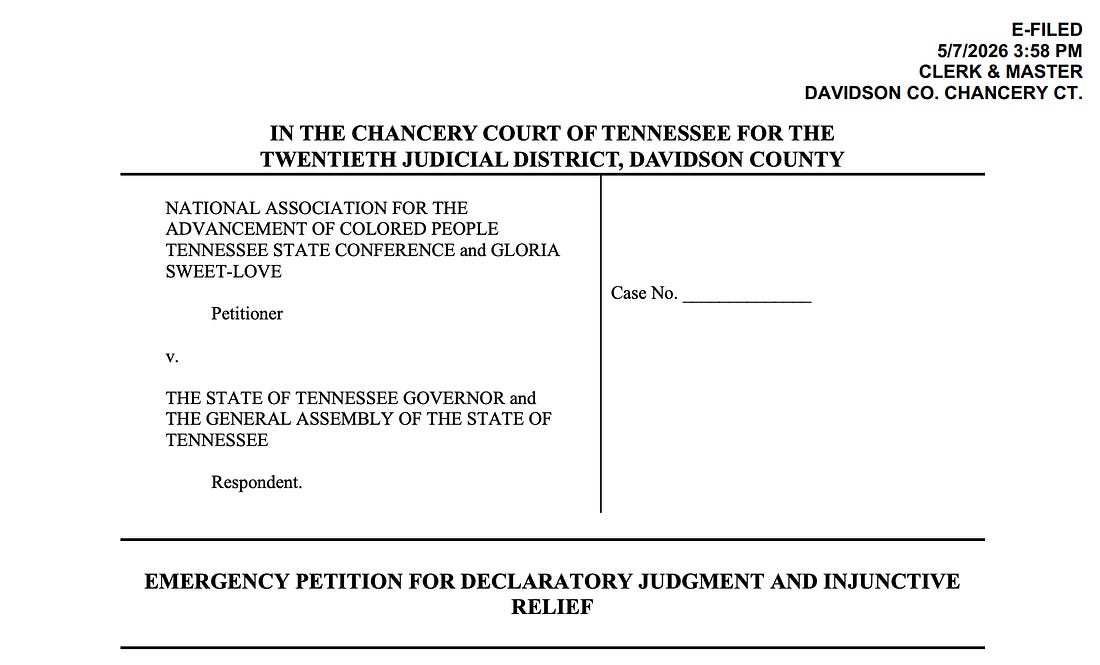
The NAACP filed a lawsuit challenging Tennessee’s new gerrymander late last week. The complaint explains that “The timing of drawing Tennessee’s congressional districts is governed by Tennessee law, including Section 2-16-102 of the Tennessee Code, which provides: ‘The general assembly shall establish the composition of districts for the election of members of the house of representatives in congress after each enumeration and apportionment of representation by the congress of the United States. The districts may not be changed between apportionments.’” The NAACP is asking the court to issue a declaratory judgment that the late-decade redistricting violates the law and to enter an injunction that will prevent the new maps from going into effect.
 |
There are reports that South Carolina is getting ready to join in this week, with a proposal that would gerrymander its only Black member of Congress, Jim Clyburn, into a district that, at least in theory, is designed to make it more difficult for the veteran Congressman to win. But it’s not clear that the South Carolina Senate will extend the legislative session to permit action to be taken. Currently, the state has seven seats in the House and only one Black representative, although the state is roughly 25% African American.
Alito’s Mistake in Callais
Late last week, The Guardian reported that Justice Alito relied on flawed data to justify his majority opinion in Callais. That opinion is predicated on the view that it is no longer necessary to apply the Voting Rights Act as a corrective for historic voter suppression because Black voter turnout has caught up. Of course, that doesn’t square up with the Brennan Center data we discussed up above. But Alito wrote that Black voter turnout exceeded white voter turnout in two of the five most recent presidential elections, both nationally and in Louisiana. He relied on data that the Solicitor General of the United States, who was not a party to the case, but who filed an amicus brief, presented to the Court:
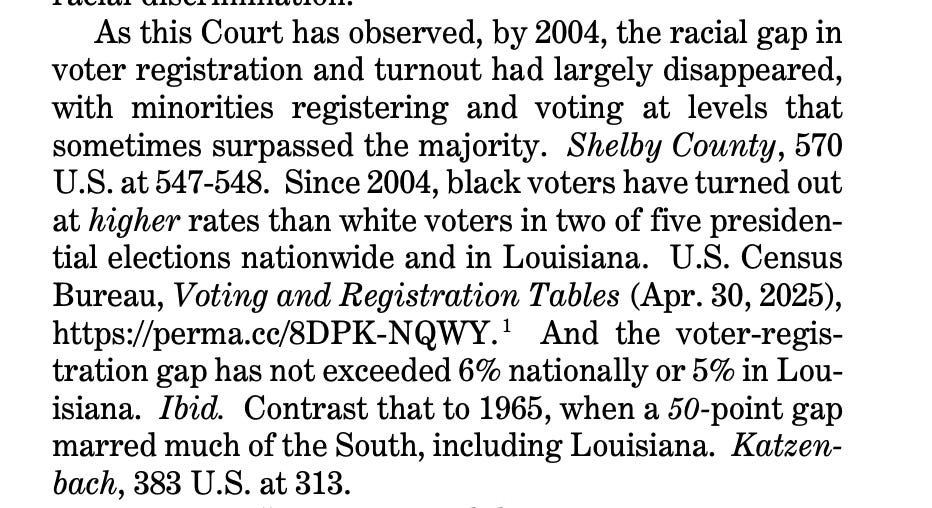 |
The data is flawed because it calculates voter turnout in Louisiana as a proportion of the total population of each racial group, for people over the age of 18. But that isn’t the same as calculating eligible voters, because total population includes non-citizens, people with felony convictions, and others who are ineligible to vote. For instance, Black people are