Hi! Hat-trizzy: Rapper Drake has surprised fans awaiting his first music release in years by dropping not one, not two, but three albums Friday morning, featuring a whopping 43 songs in total. Today we’re exploring: |
- Listening party: Spotify is celebrating turning 20 this year.
- World stage: The 2026 FIFA World Cup final might feel more like the Super Bowl.
- Greener grass: The myth of the job-hopping millennial gets a reality check.
|
Spotify wants us all to join its 20th anniversary celebrations |
“Please join us for your party of the year(s),” the digital invitation had read, as I was plunged into another interactive wrap reminder from Spotify that my music taste has remained exactly the same for over a decade.
Still, while my penchant for misery-tinged guitar music and some hyperpop stays steady, the Swedish streaming giant has been on a much more interesting journey since its founding two decades ago — hence the celebrations, with the personal retrospective just one installment from its “20 Days, 20 Data Drops” series.
Since it was founded in 2006, Spotify has grown to become the biggest music streaming service in the world, with one in 12 people at the start of last year counted as monthly active Spotify users. Although not every one of those 761 million users pays to use the platform, the premium subscribers that Spotify has locked down with its gargantuan song library (and various other offerings), account for the lion’s share of the company’s still-expanding sales.
|
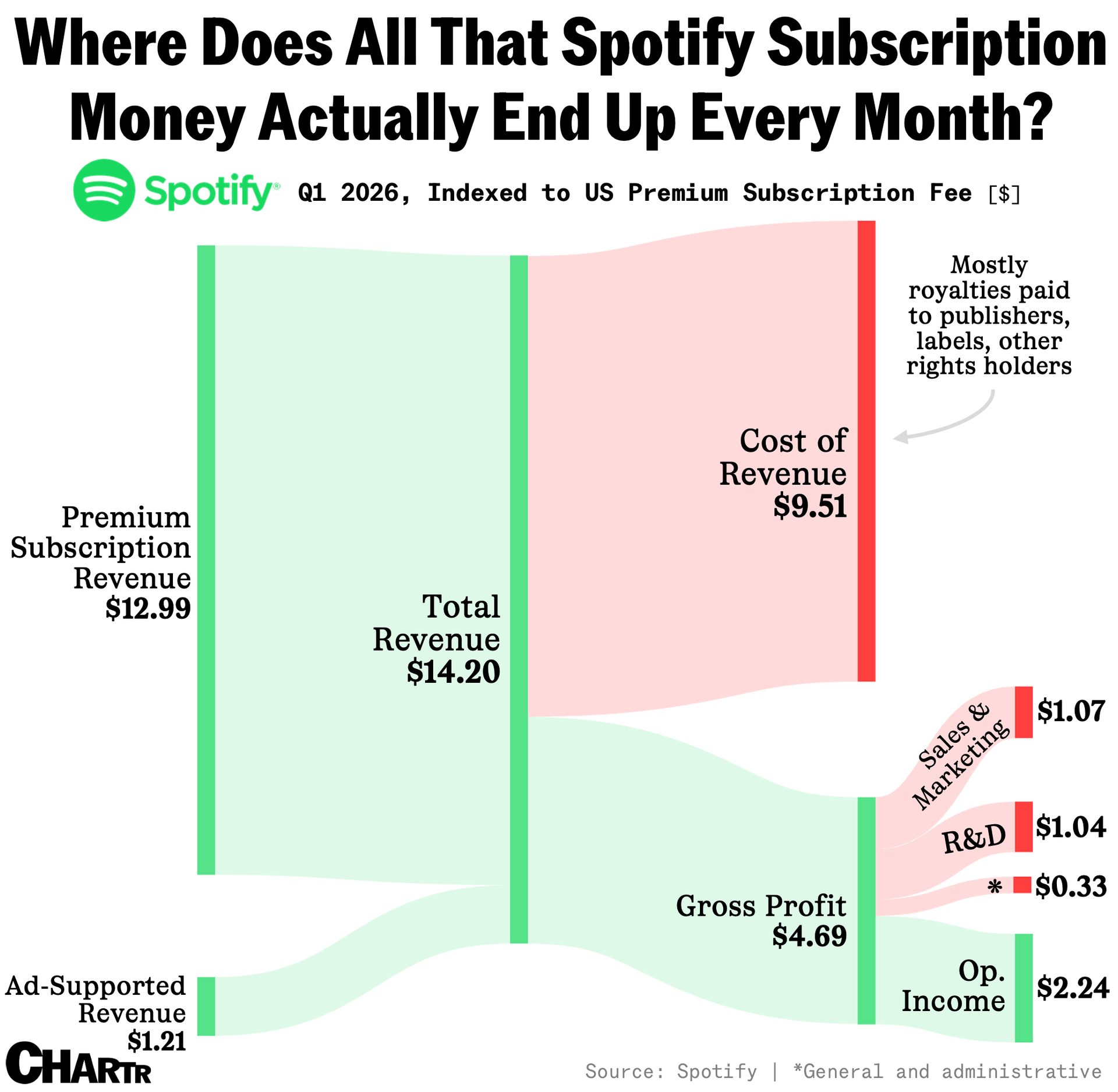
In Q1 2026, notably the first quarter since cofounder Daniel Ek stepped down as CEO, the company posted revenue that was up 8% from last year to €4.5 billion, or around $5.3 billion. For our own “Wrapped” take on Spotify’s balance sheet, we re-indexed the company’s Q1 incomings and outgoings to $12.99 — the cost of its premium subscription in the US, owing to yet another price hike in February.
For every $12.99 subscription fee Spotify receives, the company takes just $1.21 from monthly active ad-supported users, of which there were 483 million at the latest count. On its total revenue figure, Spotify eked out a ~16% operating margin, with the majority of its costs spent covering royalty payments… outlays that the company often likes to tout, as debates around fair compensation for artists in the music industry play on.
|
Could Madonna, Shakira, and BTS make the FIFA World Cup final more like the Super Bowl? |
Yesterday, FIFA announced in an Instagram post that the first-ever halftime show to take place during the World Cup final will feature performances from Madonna, K-pop group BTS, and Shakira, who’s also behind this year’s official song, following up her catchy theme from the 2010 World Cup in South Africa.
The stacked lineup is much more reminiscent of the Super Bowl halftime show than the traditional 15-minute break midway through a soccer game. With The Athletic reporting Wednesday that FIFA plans to use the entire field at the MetLife Stadium for the interval show, it’s likely to last about double that time.
Advertisers, to whom FIFA has already granted more slots during matches, will welcome an extended, star-studded break during the world’s most-watched sporting event — though, if it’s anything like the Super Bowl, commercials might be eye-wateringly expensive. For US viewers at least, the biggest football game on Earth more closely resembling the biggest American football game on Earth might not be so bad.
|
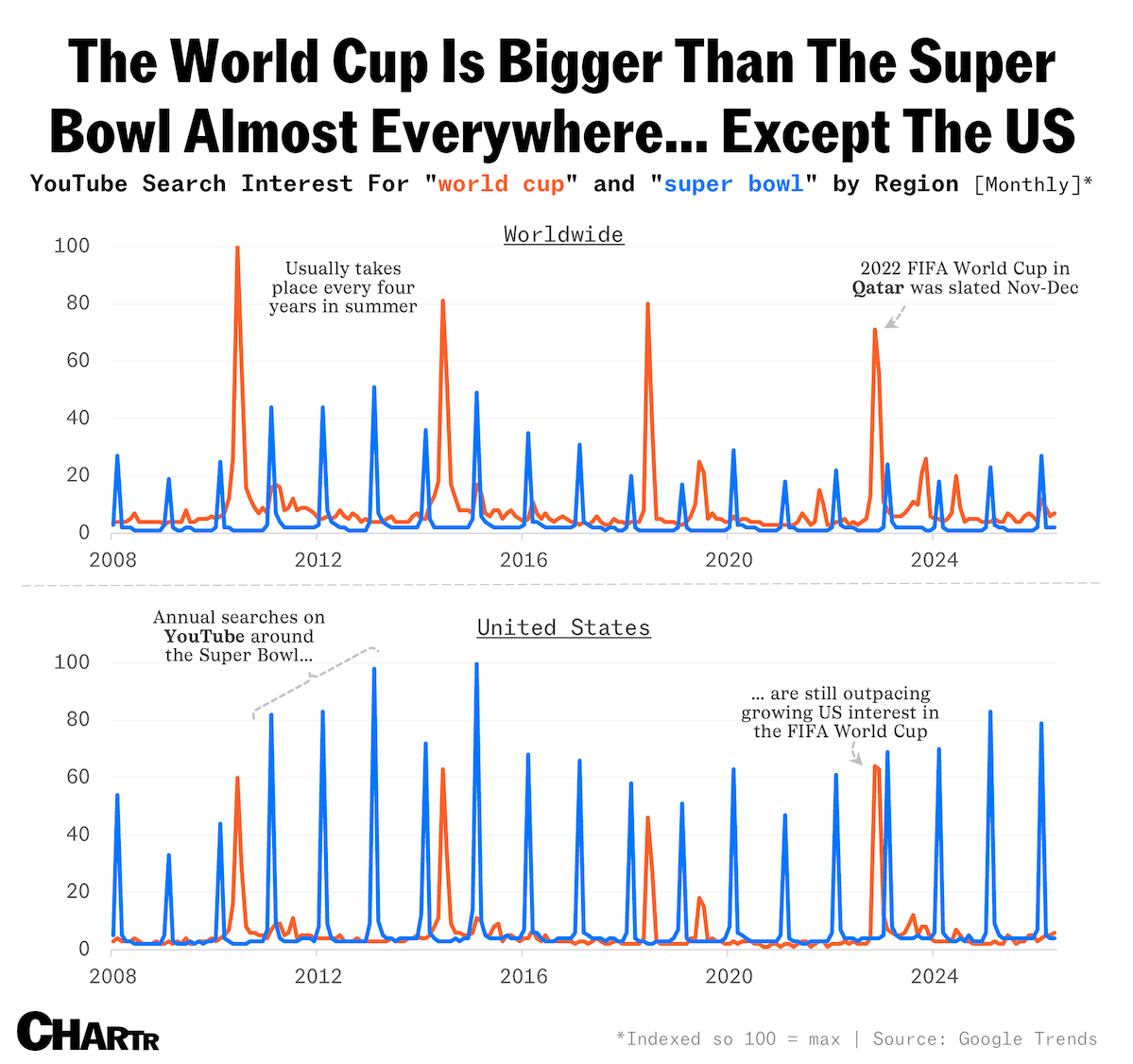
In the US, searches on YouTube for “super bowl” have consistently surpassed those for “world cup.” In terms of global searches, however, the term “world cup” generates up to 4x more interest than the American championship does on the platform when the quadrennial tournament takes place. (Note: The highest global peaks for this search align with the men’s soccer world cup, rather than various other world cup competitions.)
Audience figures tell a similar story: the 2022 Qatar World Cup final garnered an average global live viewership of 571 million, per FIFA, but just 25.8 million in the US. Meanwhile, Nielsen estimates that this year’s Super Bowl averaged 125.6 million viewers in the US. Though global TV figures weren’t given for Super Bowl LX, the NFL cited 62.5 million international viewers for Super Bowl LVIII in 2024 — about one-tenth the worldwide audience, excluding the US, that tuned in for the Qatar final.
|
|
|
|
Millennials may not have been the real job-hoppers after all |
Before Gen Z's blank stare took over the workplace discourse, millennials were the generation everyone had a theory about: entitled, purpose-seeking, allergic to office life, and, perhaps above all, job-hoppy. Indeed, many held the belief that millennials were less willing to commit, bouncing from employer to employer in search of better pay, faster growth… or maybe just a fun office with sleep pods and balance balls.
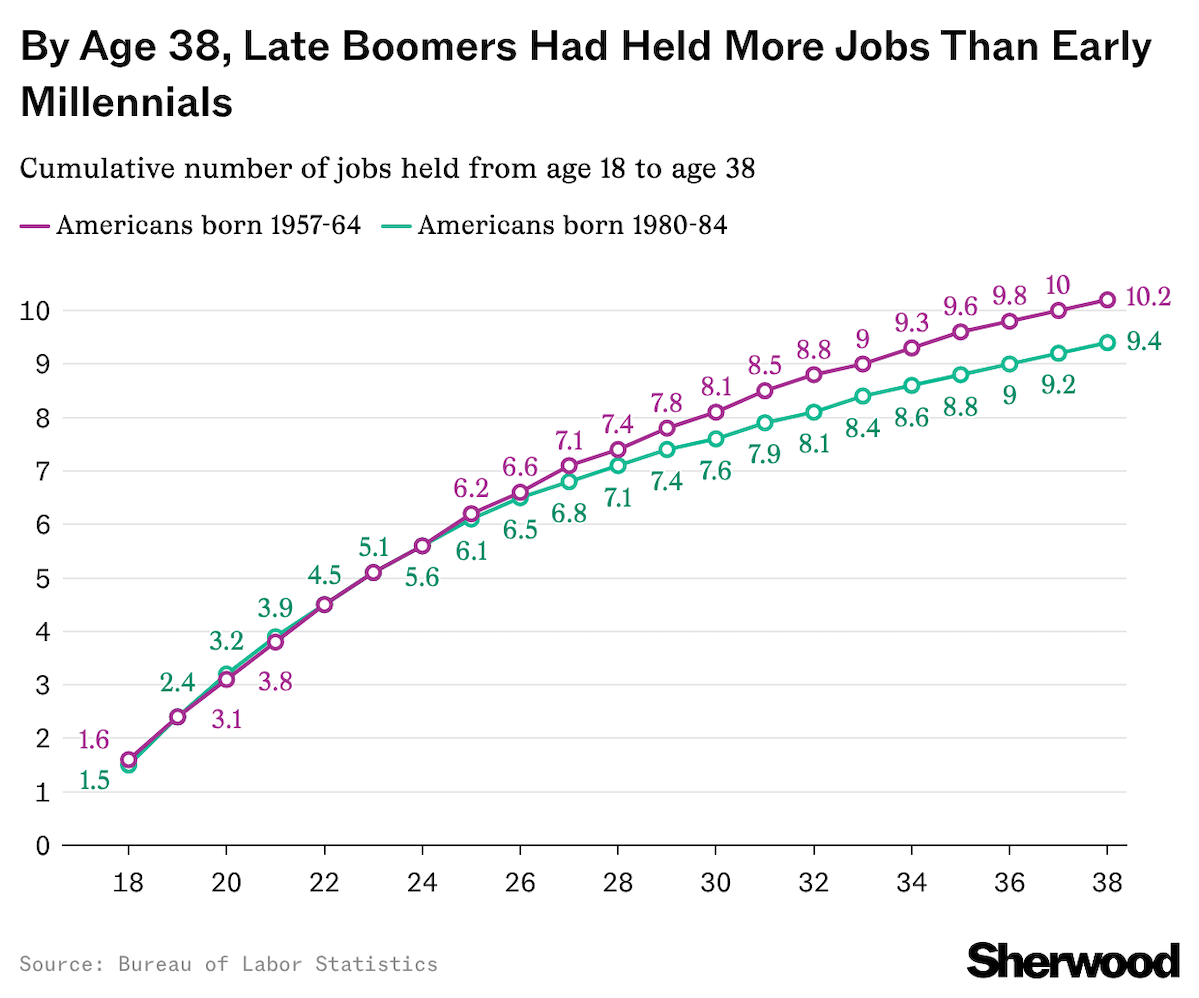
But new analysis from the Bureau of Labor Statistics tells a different story. According to the agency’s longitudinal survey data, Americans born from 1980 to 1984 had held an average of 9.4 jobs from age 18 through 38 — fewer than the 10.2 jobs held by those born from 1957 to 1964 over the same age span. |
The two cohorts accumulated jobs at almost identical rates until their mid-20s, when the boomer group began to pull ahead, ending up with nearly one additional job by age 38.
So, was the millennial job-hopper myth overstated? A September report from the National Institute on Retirement Security suggests it was, finding shorter tenures among younger workers to be “largely consistent across generations.” The bigger driver of job-hopping, per the report, is the kind of labor market that makes it worthwhile, where companies are hiring and wages are rising.
That surely wasn’t the backdrop for early millennials, who came of age during the dot-com bust and were just getting started when the Great Recession hit, both of which were likely to have made job-switching less attractive, or simply less viable.
Late boomers, by contrast, moved through their early careers in a far more mobile labor market: per the Institute of Labor Economics, job-to-job transitions ran higher through much of the 1980s and 1990s, before falling sharply after the 2001 recession and again after the 2008 financial crisis. |
|
|
|
-
As the energy crisis continues, electric vehicles are fast becoming America’s most affordable cars, with used EV retail sales more than doubling in Q1 2026 from three years ago.
-
Here we go again… Shares of Take-Two jumped on Thursday after an email reportedly revealed the preorder date for “Grand Theft Auto 6,” which is now 13 years in the making.
-
70% of Americans say they don’t want data centers in their backyard, per a new Gallup survey — a stronger aversion than they have to local nuclear power plants.
-
Netflix appears to be launching a GenAI animation studio called “INKubator,” just months after acquiring an AI filmmaking startup for ~$600 million.
-
Big screen scrolling: YouTube viewers are now watching over 2 billion hours of Shorts on TVs every month.
|
|
|
|
-
Check out this interactive map tracking the AI policies in your area.
-
Euroshrink: Half of Europe’s towns and villages have fewer residents than 60 years ago, visualized.
|
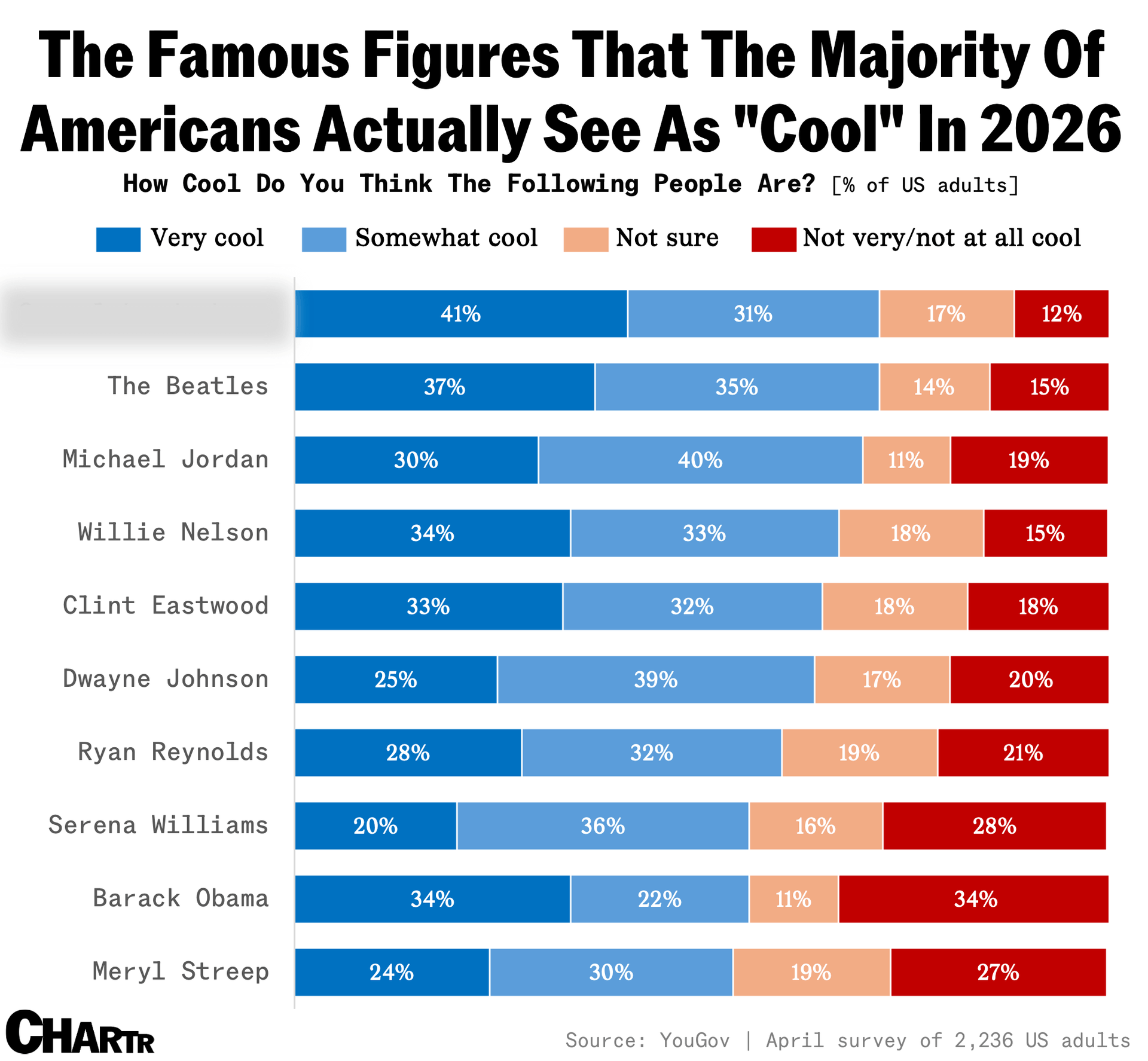
Off the charts: Which celebrity, who has starred in more $100 million+ movies than anyone else, recently topped a YouGov poll on who Americans find “cool”? [Answer below].
|
Not a subscriber? Sign up for free below. |
Sherwood Media, LLC produces fresh and unique perspectives on topical financial news and is a fully owned subsidiary of Robinhood Markets, Inc., and any views expressed here do not necessarily reflect the views of any other Robinhood affiliate... See more |
|
|
|
SHERWOOD MEDIA, LLC, 85 Willow Road, Menlo Park, CA 94025 |
|
|
|
|