
|
Every $300 Raise You Spend Is Costing You $340,000
Lifestyle creep is the silent millionaire-killer. Here's the math nobody runs on themselves.
|

| |||||||||||||||


The most expensive habit in America isn’t avocado toast. It’s congratulating yourself for a raise.
You get the bump. The next month, your rent is a little higher. Your subscriptions creep up. You upgrade your car payment, then your phone plan. Six months later, your bank account looks the same, and you genuinely cannot remember where the money went.
That’s lifestyle creep. And it’s the single most powerful wealth destroyer for people earning $80k to $250k a year.
The math, ungentle
Suppose you get a $300/month raise. You have three choices:
Spend it (the default)
Half-spend, half-invest it
Invest all of it
At a 7% return — roughly the long-run S&P 500 average after inflation — here’s what each version becomes after 30 years:
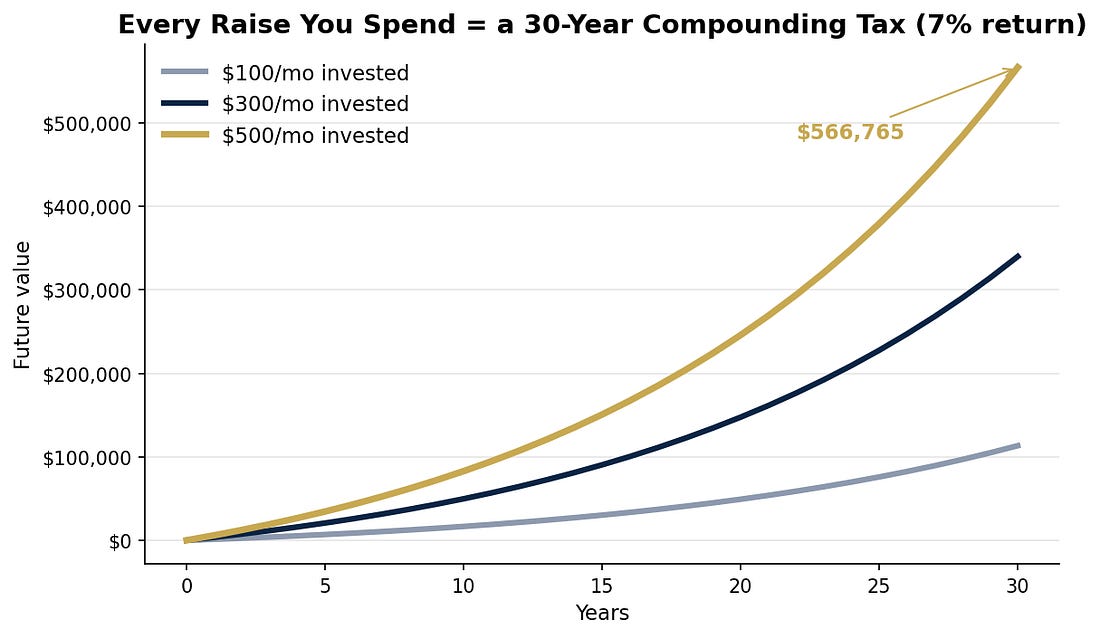 |
A $300/mo raise, invested instead of spent, becomes about $340,000. A $500/mo raise becomes about $567,000. Those aren’t numbers you have to grind for. They’re numbers you have to not flinch on.
Why this happens
Behavioral economists call it “hedonic adaptation” — fancy way of saying you adjust to whatever you have. You got a raise to afford the better apartment, then you got used to the apartment, and now you need another raise to feel rich again. The hamster is on the wheel.
The escape isn’t austerity. It’s automation. The dollars never have to enter your conscious life.
The “first paycheck” rule
When you get a raise, before the new money hits your checking account:
Bump your 401(k) contribution by the percentage of the raise
Or set up an auto-transfer to a brokerage on the same day as payroll
You’ll never see it. Your lifestyle stays where it is. The money quietly compounds for 30 years.
Action this week: Open your last 12 months of bank statements. Add up your “fixed monthly costs” (rent, car, insurance, subscriptions, gym). Compare to 12 months ago. If the number went up more than inflation, that’s your creep. Decide what to claw back.
The one-line version
You don’t have a saving problem. You have a “where the new money goes” problem. Solve that, and you basically can’t miss.
Sources
• SoFi — S&P 500 historical annual returns
• NGPF — Average U.S. household subscription spend
Disclaimer
Affluent Notes is for educational and entertainment purposes only. Nothing in this newsletter is financial, tax, legal, or investment advice. The numbers, charts, and strategies discussed are illustrative; your situation, tax bracket, plan rules, and risk tolerance are different. Past performance does not guarantee future results. Talk to a licensed CPA, CFP, or attorney before acting on anything you read here. The author may hold positions in securities or accounts mentioned.
Affluent Notes is free today. But if you enjoyed this post, you can tell Affluent Notes that their writing is valuable by pledging a future subscription. You won't be charged unless they enable payments.
|