| | In today’s edition: Dubai developers launch new projects, a Qatari firm expands in Africa, and Oman ͏ ͏ ͏ ͏ ͏ ͏ |
| |  | Gulf |  |
| |
|
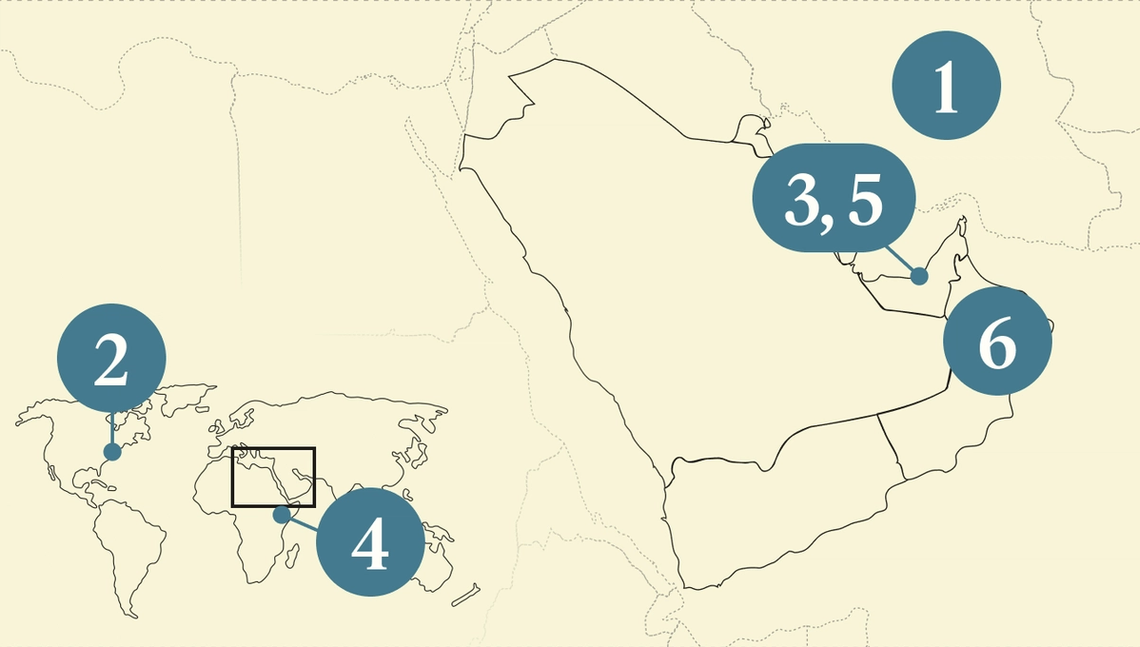 - Trump pauses strike plan
- Saudi, UAE trim Treasurys
- Emirates’ massive hangar
- Qatari firm eyes Africa deals
- UAE property mismatches
- Omani economic growth
 The pinnacle of Khaleeji luxury, from Stuttgart. |
|
Trump holds off Iran strikes |
 Evan Vucci/Reuters Evan Vucci/ReutersUS President Donald Trump said he called off military strikes on Iran — which were scheduled for Tuesday — at the request of the leaders of Qatar, Saudi Arabia, and the UAE, in order to allow “serious negotiations” to continue. However, Trump also said he had ordered the US military to be ready to attack Iran “on a moment’s notice.” Just how close the two sides are to a deal is hard to judge, but significant concessions will be needed from one or both to get across the line. On Monday, an Iranian foreign ministry spokesman said the adversaries had been swapping “a set of revised points and considerations” via Pakistani mediators. However, Iran appears to be sticking to demands — including a ceasefire in Lebanon, the right to enrich uranium, the lifting of sanctions, compensation for wartime damage, and the withdrawal of US forces — that Trump previously labeled as “garbage.” Tehran is also pressing its case for long-term control of the Strait of Hormuz, launching a new authority to oversee the waterway. |
|
Saudi, UAE trim US debt holdings |
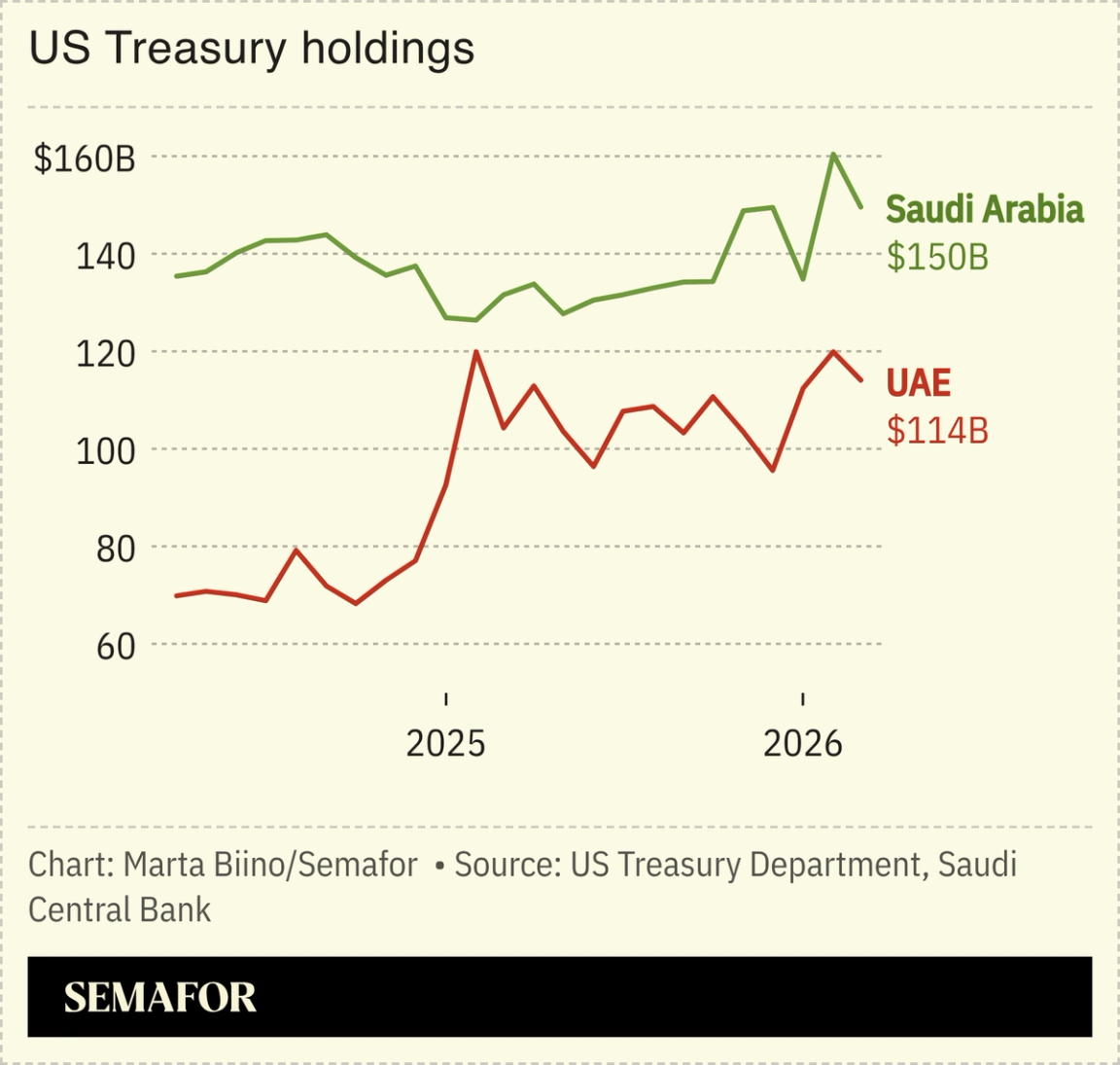 Saudi Arabia and the UAE trimmed their holdings of US Treasurys in March by nearly $17 billion, as the Iran conflict hit crude exports, their key source of dollar income. The two countries are usually some of the biggest buyers of US government debt, ranking among the top 20 holders of treasury bills. However, it is not just a question of oil revenues. The Saudi Central Bank, which manages the government’s foreign debt holdings, said in April that total foreign reserves rose in March to $497 billion, a six-year high, even as the US debt holdings fell. Saudi holdings of US Treasurys had also fallen in January but rose sharply in February, pointing to wider portfolio considerations influencing the changes. While the drop in treasury holdings in March gives some indication of the impact the war is having on the ability of Gulf oil exporters to put crude revenues into US assets, they remain at historically high levels. The UAE’s holdings are up by $44 billion, or 63%, over the past two years, as the country has doubled down on ties to the US, and Saudi Arabia’s holdings are up by more than 10% over the same period. — Matthew Martin |
|
Emirates’ new mega-hangar |
 Courtesy of Emirates Courtesy of EmiratesEmirates, owner of the world’s largest fleet of wide-body aircraft, is building a jumbo-sized engineering and maintenance facility as it prepares to relocate to a new airport south of the city. The $5.1 billion hangar — slated to be the Gulf’s largest steel building, and capable of servicing 28 planes at a time — aims to attract more engineering talent and parts production to Dubai. The facility is being built by China Railway Construction Corp. Emirates is also planning a nearby “cabin crew village,” a multibillion-dirham development to house up to 12,000 staff. Both projects are part of Emirates’ plans to move its operating base to Al Maktoum International, the city’s second airport, which will have twice the capacity of Dubai International once complete. The new hub is accelerating development along the otherwise sleepy corridor connecting Dubai and Abu Dhabi. |
|
Africa attracts Gulf’s expansionists |
 Tiksa Negeri/Reuters Tiksa Negeri/ReutersQatar Airways is expanding its African network with new routes and more flights from June, as Gulf companies push deeper into the continent. The Doha-based carrier will resume flights to the Seychelles and Kigali, add a daily service to Marrakesh, and launch a new route to Port Sudan as it kickstarts a network hampered by the Iran war. UAE state-backed firms have so far led Gulf investments into Africa — spanning agriculture, mining, renewable energy, and ports, to overtake China as the largest foreign investor — but other players are pouring into the continent with the world’s fastest growing population. Power International Holding, owned by Qatari billionaire siblings Moutaz and Ramez Al-Khayyat, is bidding for a contract to build a $12.5 billion airport near Ethiopia’s capital Addis Ababa — set to be the continent’s largest — and a 400-km highway project in the Democratic Republic of Congo, Bloomberg reported. The group is also planning a bovine airlift — one of its signature moves — of 30,000 dairy cows from the US to Algeria. Meanwhile, Dubai-based ride-hailing platform Yango Group plans to invest at least $150 million in Africa this year, entering 10 new markets as it bets on smaller cities its larger rivals have overlooked. — Kelsey Warner |
|
Dubai real estate in a standoff |
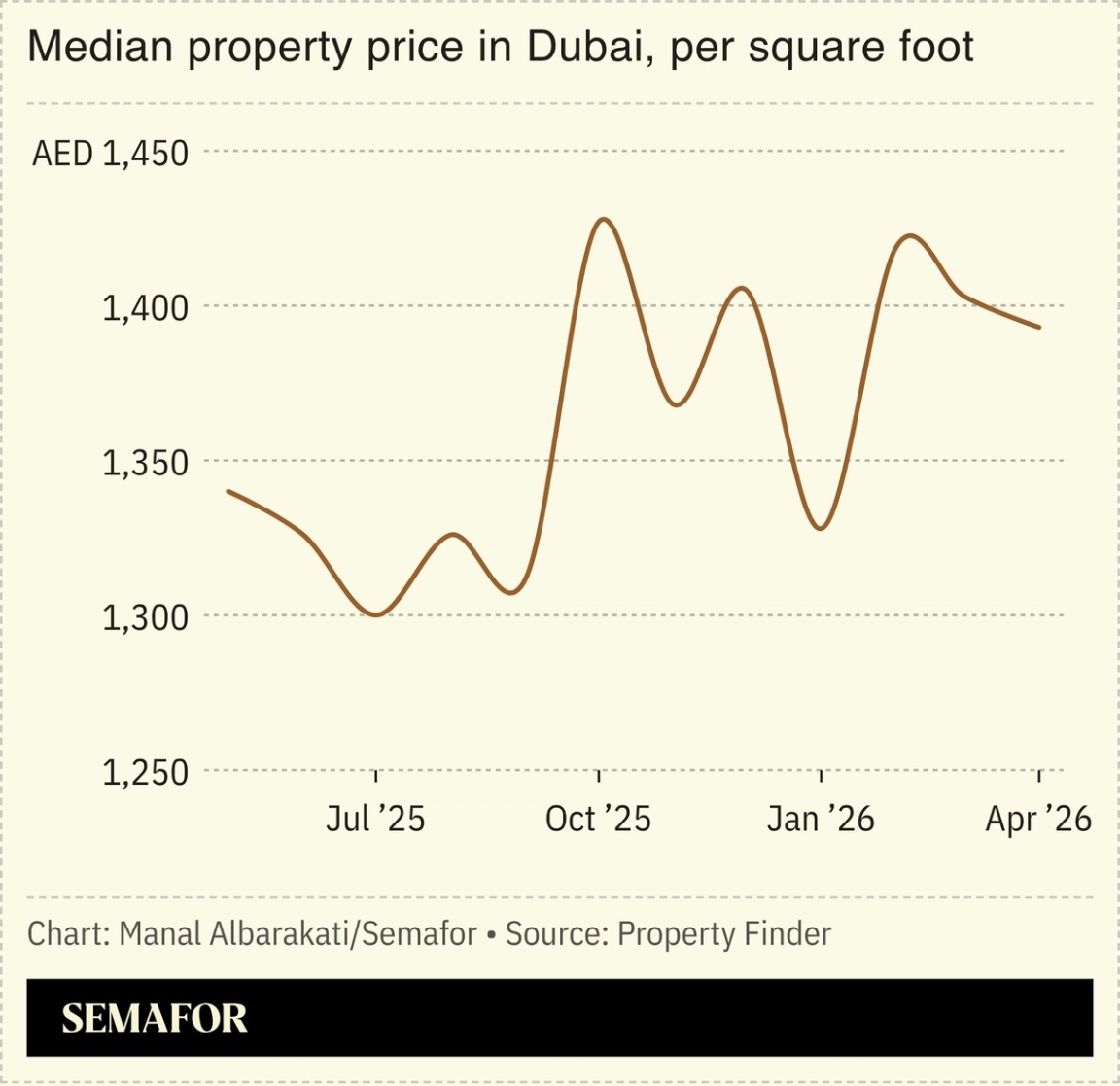 Activity in Dubai’s property market has not stopped, but buyers and sellers are finding themselves at odds over what is a fair valuation during war. There’s new supply hitting the market, and it’s finding takers: Danube Properties launched a new gated villa community this week, drawing more than 6,000 brokers to the launch event. But the company’s chairman admitted on stage that closing a deal now takes five or six hours where it used to take one, according to AGBI. Residential sales fell during the war, which isn’t surprising, but prices on aggregate have only slightly declined. ValuStrat data shows the prime end of the market is holding up, with deals for villas in Jumeirah Islands up 24.5% year-on-year. Many sellers who bought during the post-pandemic boom are refusing to lower their asks, while 70% of active buyers expect prices to fall further before they commit, according to a survey by listing website Property Finder. |
|
Oman reaps wartime rewards |
 Oman government revenues were up 13% year-on-year in the first quarter — highlighting how the country is one of the rare beneficiaries of the Iran war, in raw economic terms at least. The gain is mainly down to higher oil and gas revenues, which accounted for around two-thirds of the rise. It is not just the boost from oil prices that is helping the economy. Omani ports have become vital links in new regional logistics networks that have emerged in response to the war and the closure of the Strait of Hormuz. The value of goods using an overland customs corridor between Oman and Dubai reached 8 billion dirhams ($2.2 billion) in April, an eightfold increase on the month before. The success of the “green corridor” has led to a new route being opened between Oman and Sharjah in recent days. Adding to the positive atmosphere, the country’s sovereign wealth fund, the Oman Investment Authority, this week announced record profits for last year, at 2.9 billion rials ($7.5 billion). The Muscat Stock Exchange also remains well above prewar levels. — Dominic Dudley |
|
 What happens when every interaction on the internet becomes monetized? Joe Weisenthal, co-host of Bloomberg’s Odd Lots podcast, thinks we’re already finding out. After more than two decades reporting on business, he has witnessed the transformation of financial media firsthand, from the early “golden” era of Twitter, when amateurs would engage in what he calls “unmonetized transactions,” to now, when everyone with expertise is selling something. In this week’s episode of Compound Interest, presented by Amazon Business, Liz and Semafor Editor-in-Chief Ben Smith ask Weisenthal about the future of financial journalism in the age of AI, the creator economy, and what gets lost when every interaction becomes monetized. |
|
  Courtesy of Saudi Press Agency Courtesy of Saudi Press AgencyChecking In- The $690 million Shura Island resort opens its doors tomorrow, a year later than planned. The Four Seasons-branded property was developed by Public Investment Fund division Red Sea Global and Prince Alwaleed’s Kingdom Holding. — AGBI
Defense- Gulf countries received military support from several nearby allies early in the Iran conflict. Pakistan deployed 8,000 troops, around 16 fighter jets, and an air defence system to Saudi Arabia in April, while Egypt sent air defenses to Kuwait, Saudi Arabia, and the UAE, and Rafale jet fighters to the UAE. — Reuters, The Wall Street Journal
Logistics- Freight rates from China to the Gulf have hit a record, with the cost of a 20-foot container rising from $980 prewar to more than $4,100. Just a fraction of previous trade flows are actually getting through, with activity declining by as much as 80%. — Financial Times
Energy- International oil inventories will soon be depleted as demand for diesel, fertilizer, jet fuel, and gasoline increases in the northern hemisphere’s summer, according to Fatih Birol, head of the International Energy Agency. The IEA coordinated history’s biggest release of strategic reserves in March, agreeing to withdraw 400 million barrels. Around 164 million barrels had been released by May 8. — Reuters
- Iran’s government can still pay salaries by exporting a fraction of its normal crude volumes — around 250,000 barrels a day, according to a Bank of America analyst. Much of that oil is already at sea. But meeting its other obligations will become increasingly difficult, and could force Tehran to print money, pushing inflation toward 100%. — Asharq Business
|
|
|


