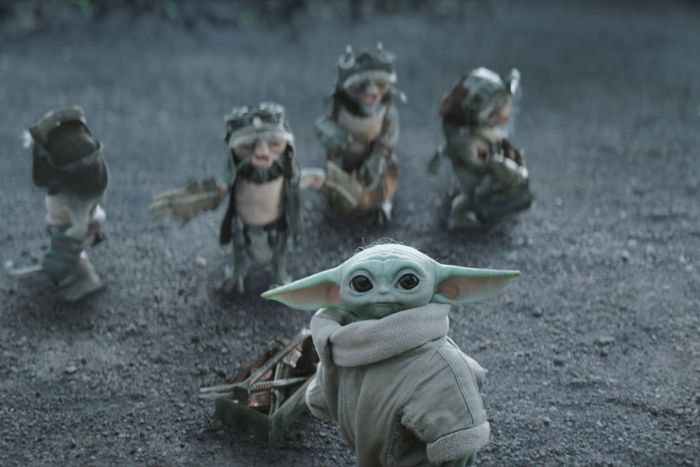
Baby Yoda was a mere 1 month old the last time a Star Wars movie — 2019’s widely reviled The Rise of Skywalker — was in wide theatrical release. COVID restrictions hadn’t yet thrown moviegoing into a Sarlacc pit. And Disney+’s Boba Fett–adjacent space western The Mandalorian had only recently begun to take hold of the pop-cultural conversation, becoming TV’s most-watched streaming series: a Zeitgeist-defining, corporate-ass-saving subscriber magnet for the Mouse House’s then-nascent OTT service.
What a difference six and a half years makes. Over that time, Star Wars’s studio distributor, Lucasfilm, basically abdicated its original mandate to make blockbuster movies. But not for lack of trying. Lucasfilm’s longtime chief executive and brand manager Kathleen Kennedy hired and fired a murderers’ row of pedigreed filmmakers — Phil Lord and Chris Miller, Colin Trevorrow, Game of Thrones showrunners D.B. Weiss and David Benioff, and Josh Trank among them — confounding Hollywood and infuriating fans with her seeming one-step-forward, two-steps-back development process.
While Disney+’s live-action Star Wars streaming series (Obi-Wan Kenobi, Ahsoka, The Book of Boba Fett, The Acolyte, Andor, et al.) have met with varying levels of success, the film part of Lucasfilm’s business has been out of commission for a generation. All of which combines to make The Mandalorian and Grogu (in theaters Friday) a vexing thing. The company’s first filmic offering this decade and one based on Lucasfilm’s most beloved content of the streaming era, it also arrives as the first franchise entry in Star Wars history to make the jump from small to big screen — an inversion of how things at the George Lucas–founded company usually work.
“It makes good sense for them to continue exploiting their most appealing piece of IP,” notes an executive at a rival studio. “But if it doesn’t work, what’s the play then? Go back to streaming?”
Although Star Wars continues to rank among Hollywood’s most enduring franchises — 33 billion minutes of films and shows based on the 49-year-old space saga were streamed last year, according to Nielsen figures — pre-release “tracking” estimates for The Mandalorian and Grogu predict the movie will take in between $74 million and $90 million over its opening four days in domestic release. Such an outcome would represent a new and troubling low. Solo: A Star Wars Story had the weakest opening for a live-action Star Wars movie to date, pulling in $103 million over Memorial Day weekend in 2018 (ultimately compelling Lucasfilm to mothball other planned spinoffs based on legacy characters owing to its soft box office).
According to close Star Wars observers, two factors can be blamed for M&G’s less-than-robust audience interest. The Galaxy Far, Far Away faithful — who have gained a reputation as the most outspoken, irascible, and often toxic fans on social media — were disappointed with the third season of The Mandalorian (namely its uneven pacing, shift of focus away from the Din Djarin character voiced by Pedro Pascal, and diminishment of the Lone Wolf and Cub–style intimacy that distinguished the show’s first two seasons). And with the conclusion of the Skywalker saga (i.e., Star Wars: Episode I through IX, which chart the rise, fall, and redemption of Anakin Skywalker and generations of his family), the franchise has simply exhausted its own canon.
“There are low expectations going in,” says Josh Atkins, staff writer for the fan website Star Wars News Net. “This film is not going to be a grand story in the vein of The Force Awakens or the sequel trilogy. People aren’t going in excited to see what happens next in the wider Star Wars galaxy. Let’s just hopefully have a good time with these two characters. I think Star Wars fans are as excited for The Mandalorian and Grogu as they would be for season four of The Mandalorian.”
Not exactly the stuff of event-movie enthusiasm. Not enhancing ticket presales either: Reviews for M&G out of its Hollywood premiere have been mixed to negative. Producer-journalist Simon Thompson posted on X that The Mandalorian and Grogu “is a grin-inducing crowd-pleaser that puts Star Wars back on theatrical track.” iO9 and Gizmodo reporter Germain Lussier said the movie “is as expected. A longer, bigger episode of the show, while entertainment reporter Jonathan Sim called it one of the “weakest Star Wars movies”: “An emotionless, predictable experience that doesn’t push Din Djarin anywhere interesting.”
To be sure, M&G takes place after the fall of the Galactic Empire and follows the exploits of bounty hunter turned white-hat hero Djarin and his Force-sensitive apprentice Grogu (a.k.a. Baby Yoda), who are tasked by the New Republic with rescuing Rotta the Hutt (Jeremy Allen White) en route to a more important target. Green-lighted by Kennedy in 2024 after the debilitating twin Writers Guild and Screen Actors Guild strikes forced Lucasfilm to pause production on The Mandalorian season four, M&G was directed and co-written by the show’s creator-showrunner Jon Favreau and co-written and produced by Dave Filoni, a former animator and George Lucas protégé embraced by fans for his geek fealty to canonical Star Wars verisimilitude.
Now, The Mandalorian and Grogu arrives on screens amid a kind of two-tiered regime change. It’s the first Lucasfilm release since Filoni ascended in January to become Kennedy’s replacement (longtime executive vice-president Lynwen Brennan will serve as his counterpart and co-prez handling business affairs) and the first Disney release since parks and “Experiences” ace Josh D’Amaro finally replaced Bob Iger as the boss of all Mouse House bosses in March.
Meanwhile, insiders say Favreau succeeded in getting a movie made where so many other would-be Star Wars auteurs failed through a unique combination of commercial instincts, drive, economical filmmaking, and dedication to geek goodwill. With its reported $166.4 million production budget (which, if you include a $21.75 million tax credit from the California Film Commission, drops the price tag to under $144 million), The Mandalorian and Grogu arrives as the lowest-cost Disney-era Star Wars theatrical film to date — several magnitudes cheaper than the franchise high of $317 million Lucasfilm spent to shoot The Last Jedi.
A below-the-line crewmember who worked on all three seasons of The Mandalorian as well as The Mandalorian and Grogu (and spoke to Vulture on condition of anonymity because they were not authorized to publicly comment) describes Favreau as a “huge geek and hard-core lover of all things Star Wars.” A relentless multitasker, Favreau impressed production staff during a relatively unchallenging day spent shooting interior shots of Djarin and Grogu flying their spaceship by pulling double duty: He directed the movie while cooking grilled-cheese sandwiches for 500 people on a portable griddle.
Moreover, in conjunction with Filoni, whom the crewmember describes as a kindred spirit, Favreau strives to make stuff that appeals to fans simply because he respects the fandom. Exhibit A: The director insisted Grogu be a functioning puppet as opposed to CG imagery added during postproduction. “There are a huge amount of visual effects, but he’s also using legacy effects,” this crewmember says. “Stan Winston’s practical-effects shop does all the monsters and creatures and robots and droids. Favreau is all about authenticity — almost to a fault sometimes, as far as trying to mix analog with this new digital technology. He’s all about being a fan of the originals. There are all these Easter eggs. You can really go down the rabbit hole.”
Another executive at a competing studio consulted by Vulture took a sacrificial view of The Mandalorian and Grogu’s positioning in the movie marketplace: as an anticipation builder for Star Wars: Starfighter, the non-trilogy franchise entry starring Ryan Gosling and directed by Shawn Levy (Deadpool & Wolverine, Night at the Museum), which is due in theaters next May. This executive somewhat snidely noted that releasing a disconnected series of standalone adventures like Starfighter and M&G “is not franchise management.”
Exhibitor Relations Co. senior media analyst Jeff Bock, however, takes a more sanguine view of The Mandalorian and Grogu’s box-office prospects. As he sees it, even if the movie comes in on the low side of tracking — taking in, say $75 million over the Memorial Day corridor — M&G can still reach the “This is the way” promised land of hit-dom. Especially if it manages to appeal to die-hard Star Wars fans and family audiences alike, the movie can leg it out in theaters absent significant blockbuster competition until the mid-June releases of Steven Spielberg’s sci-fi thriller Disclosure Day and Pixar’s Toy Story 5.
“This feels like a fun summer film, like the original Star Wars felt like a fun summer film,” Bock says of M&G. “You take one character that looks like Boba Fett and another character who is a baby version of a character you love — how can you lose?”
He points to the activation of a Mandalorian and Grogu–branded consumer-products flywheel — encompassing things like a $79.95 pedestal candle holder, graphic T-shirts, LEGO sets, “The Child”–logo ankle socks, and a $500 Grogu hover-pram-shaped diamond-and-silver pendant — where the studio will likely make its most serious money: Lucasfilm “took some time with Mattel to retool this vast universe of merchandising, which, let’s be honest, is what Star Wars is,” Bock says. “That’s why Disney bought it. They’re marketing the hell out of this one.”