| | New strikes by the US and Iran dim hopes for a deal over the Strait of Hormuz, fears of inflation an͏ ͏ ͏ ͏ ͏ ͏ |
| |  Mexico City Mexico City |  Ottawa Ottawa | New Delhi |
 | Flagship |  |
| |
|
The World Today | 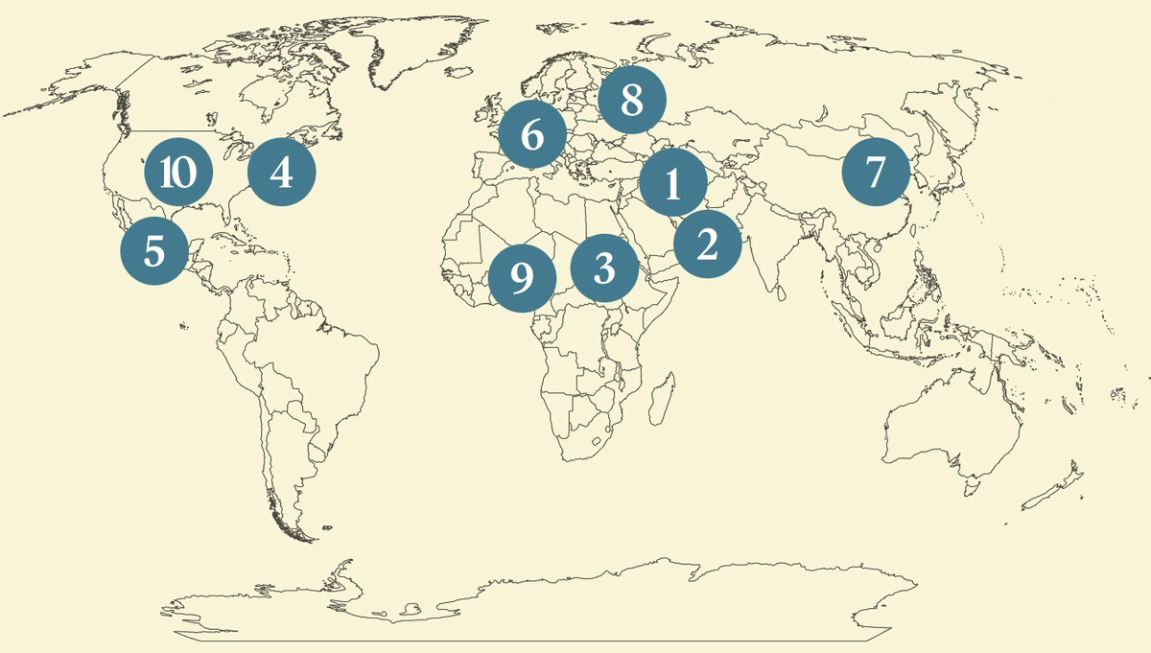 - New strikes by US and Iran
- Hormuz hopes dim, again
- Fears of global food crisis
- Central banks’ inflation fears
- North America trade tensions
- EU divided over China moves
- India, China show AI impact
- Russia’s heavy war casualties
- Africa’s Christian composition
- GLP-1s reshape food, fashion
 A timely, new book on how to do the most good possible. |
|
US, Iran launch new strikes |
 Majid Asgaripour/WANA/Reuters Majid Asgaripour/WANA/ReutersThe US and Iran traded fresh attacks, further undermining a protracted ceasefire and dampening hopes of the two sides reaching a durable peace deal. The American strikes were the second set this week of what Washington has characterized as defensive actions, with the most recent ones hitting Iranian drones and a launch site. Tehran said it targeted a US air base in the region; Kuwait, which is home to one such facility, said it had deployed air defenses against missile and drone threats. The ongoing pattern of negotiations interrupted by warnings and strikes points to the balance of leverage between Washington and Tehran, with one leading expert arguing that “a narrow deal is the likeliest end to this hot war.” |
|
Hopes dim for reopening Hormuz |
|
Fertilizer shortage risks global crisis |
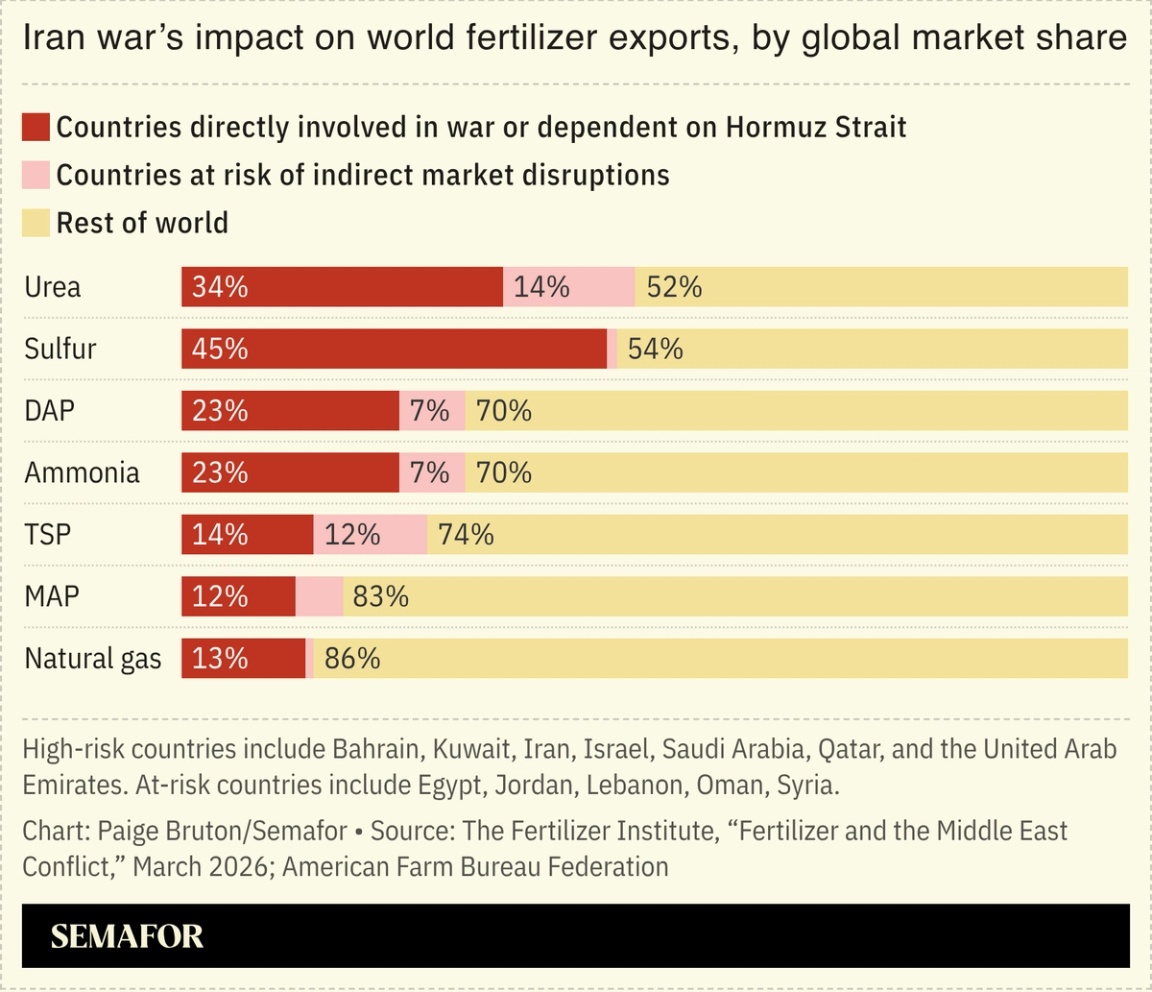 The de facto closure of the Strait of Hormuz risks a global food crisis that could extend for years, the UN warned. Global fertilizer companies have slashed production over shortfalls of sulphur, required to make many farming inputs; about half of the global supply passed through the strait before the Iran war. As a result, farmers are likely to produce lower yields in coming harvests. Richer economies like those in Europe are mulling building fertilizer stockpiles, reducing duties on imports, and onshoring production, but poorer ones have limited room to adapt. “We have a window to act, but that window is narrowing,” the head of the UN’s Food and Agriculture Organization said. |
|
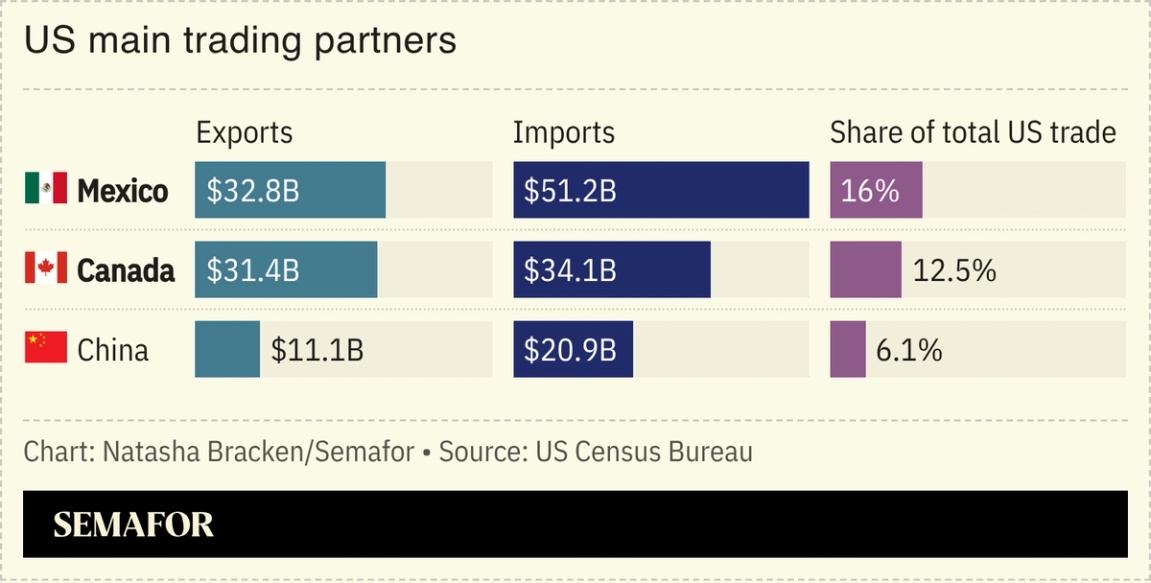 The US said it intended to maintain tariffs on some imports from Canada and Mexico, dimming hopes that they could uphold their free trade accord. All three nations must decide by July 1 whether to extend the US-Mexico-Canada Agreement, signed during President Donald Trump’s first term, for another 16 years. But the Trump administration had “significant” trade issues with Canada, US Trade Representative Jamieson Greer said, adding that the “giant” US trade deficit remained a cause of concern. Meanwhile, Mexico — which has in recent years surpassed China to become Washington’s biggest trading partner — this week reported a record monthly trade surplus, beating analysts’ expectations by a factor of 10. |
|
EU seeks to blunt China imports |
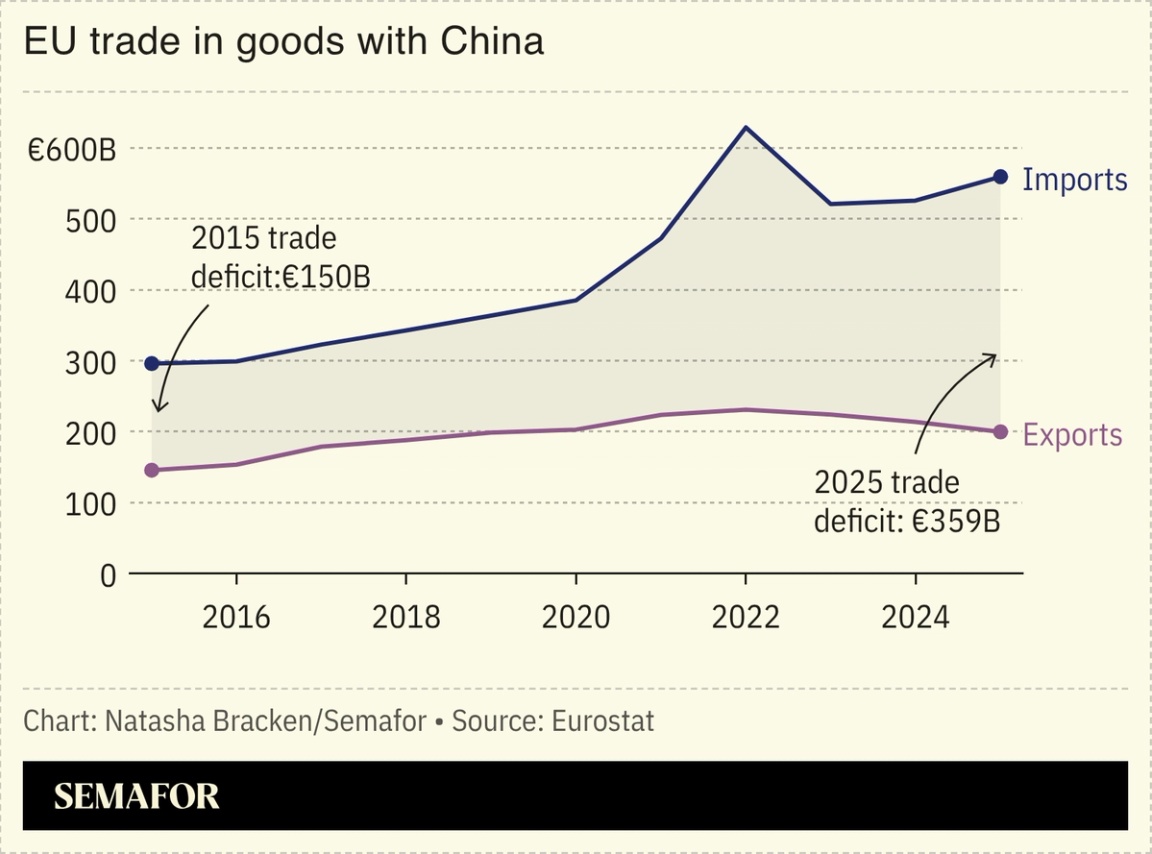 The EU moved to shield itself from what it sees as a growing threat from Chinese exports, while companies in the bloc said they were deepening reliance on the Asian power’s manufacturing prowess. The EU industry commissioner said Brussels would deploy trade measures, including import quotas and tariffs, across a range of sectors alongside requirements that firms diversify their supply chains away from China as part of a more “muscular” strategy. Yet even as he lauded this “less fragmented approach,” European companies surveyed by the EU Chamber of Commerce in China said they would maintain or expand their supply chains there to drive their global competitiveness. “We don’t see … de-risking becoming a theme,” the business group’s president said. |
|
China and India show AI impact |
 Stringer/Reuters Stringer/ReutersTwo of Asia’s biggest economies showcase the varying economic impact — and opportunities — presented by AI development. China’s optical-communication companies are seeing a boost thanks to huge demand for the underlying hardware required to build out AI infrastructure, including lasers, optical fibers, and transceivers: “Everything is in shortage,” one Guangzhou-based executive told Nikkei. India’s software sector, by contrast, is vulnerable to the growing use of AI in place of programmers and the country lacks major players in AI infrastructure, models, or chips, driving foreign investors to slash their exposure to its stock market. “What markets haven’t fully priced yet is that this isn’t an earnings miss story in India,” an investment adviser told Bloomberg, “it’s a terminal value story.” |
|
 Who gets to define the global story? Semafor co-founder and CEO Justin B. Smith joins Asia Society Hong Kong to discuss how original reporting and live journalism events can elevate global perspectives for today’s most influential decision-makers and equip them to navigate a rapidly evolving world economy. Justin will also share what it takes to build a new media company in a shifting industry, and why audiences are increasingly seeking deeper, cross-cultural insight to make sense of a changing global landscape. Semafor readers can register at a discounted rate with code 50SFOFF. May 29 | Hong Kong | Learn More |
|
Russia faces battlefield pressure |
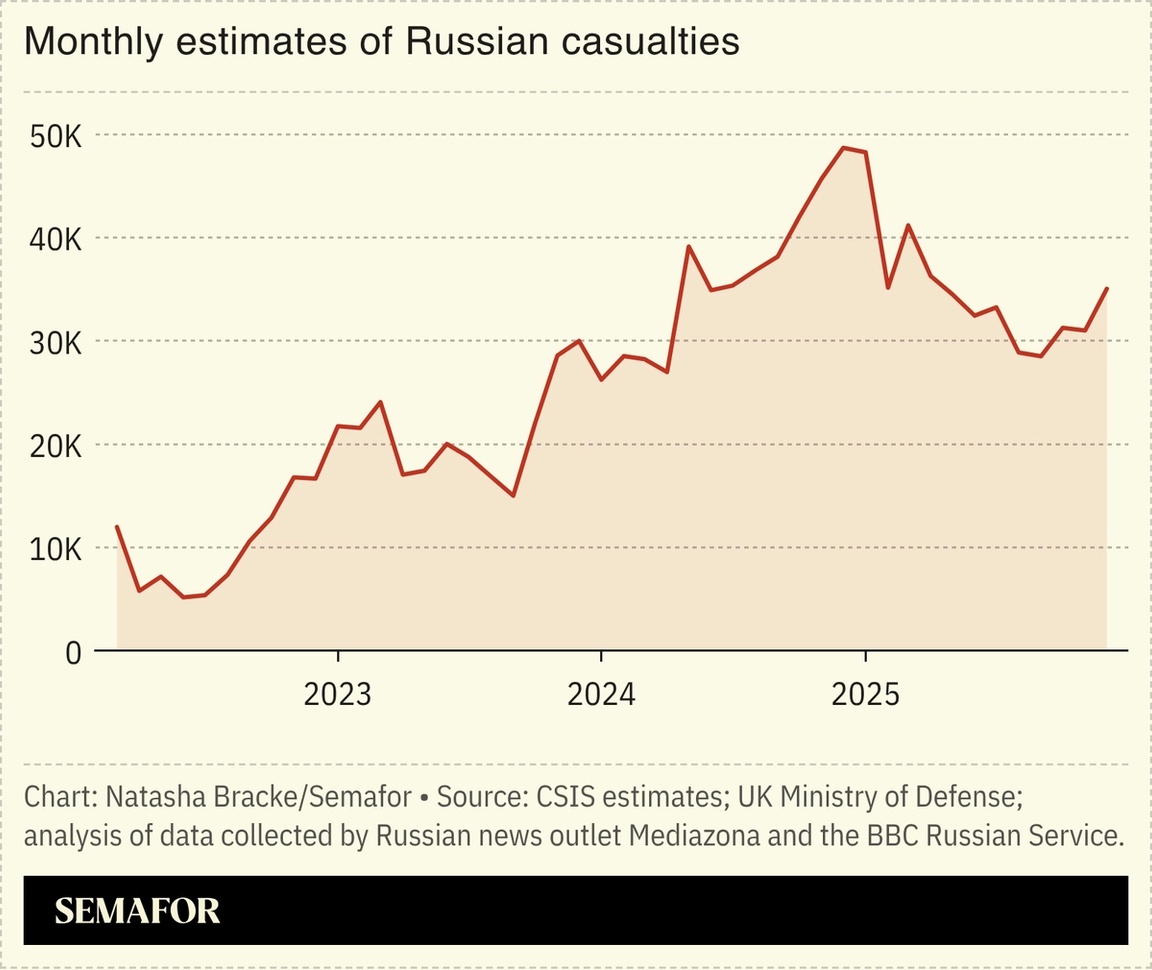 Russia’s armed forces are suffering dual pressures from significant battlefield casualties and struggles to recruit replacements, underscoring Moscow’s growing challenges in its war on Ukraine. Nearly 500,000 Russian soldiers have been killed since the Kremlin launched its full-scale invasion in 2022, the head of Britain’s largest intelligence agency said, after earlier UK assessments said the country had recorded more than 30,000 monthly casualties this year. At the same time, Moscow’s push to recruit contract fighters is showing “signs of strain,” the Institute for the Study of War said: The Kremlin is offering easier paths to citizenship for non-Russian fighters and debt relief for others, while also using force and forms of pressure to get some to sign up. |
|
 Guglielmo Mangiapane/Reuters Guglielmo Mangiapane/Reuters
The pope’s tour through Africa last month cemented the continent as key to Catholicism’s future — but it is not even the fastest-growing form of Christianity there, and soon may not be the biggest. The number of Catholics in Africa grew about fivefold from 1975 to 271 million last year, but numbers of Pentecostals and those of “charismatic faith” increased more than 10 times to 252.3 million. The latter group is more decentralized and draws believers with a “prosperity gospel” promising wealth via faith. Africa’s Catholic leaders have not been impressed: “Today, a lot of humans are thirsting for God, but that thirsting is not always fulfilled in the best way,” one bishop told The Washington Post. |
|
|


