
|
 |
This edition is unlocked for everyone. We’re going to connect the dots from Ukraine’s use of drones, to Trump’s imaginary battleship, to America’s defeat in Iran, to the end of the U.S.-led global order.
I hope you’ll take the ride, because this is how we look around corners.
And then I hope you’ll ride with us through the midterms and beyond.
Our giant flash sale ends Sunday.
Come be part of independent media.
Very Low-IQ Trump Too Stoopid to Win War
There’s a revolution in military affairs and America is on the wrong side of it.
|

| ||||||||||||


 |
1. Economics
Earlier this week Ed Luce noted the similarities between Ukraine and Iran: Both were attacked by much larger powers. Both have stopped the much larger powers in their tracks.
How? Because both Ukraine and Iran mastered a revolution in military affairs before their adversaries even understood that one was afoot.
Today we’re going to talk about:
What the Ukrainians and Iranians figured out.
What this revolution means for the future of war.
How Donald Trump failed to prepare the U.S. military, leading to our defeat in Iran and the end of the American-led global order.
In addition to Trump’s other failures, he has been buying up cavalry horses at a time when our adversaries are building tanks. This stupidity failed the American military, diminished American power, and made our interests across the globe less safe.
This is going to be a journey that is nominally about drones, but is really about Trump and the end of the American order.
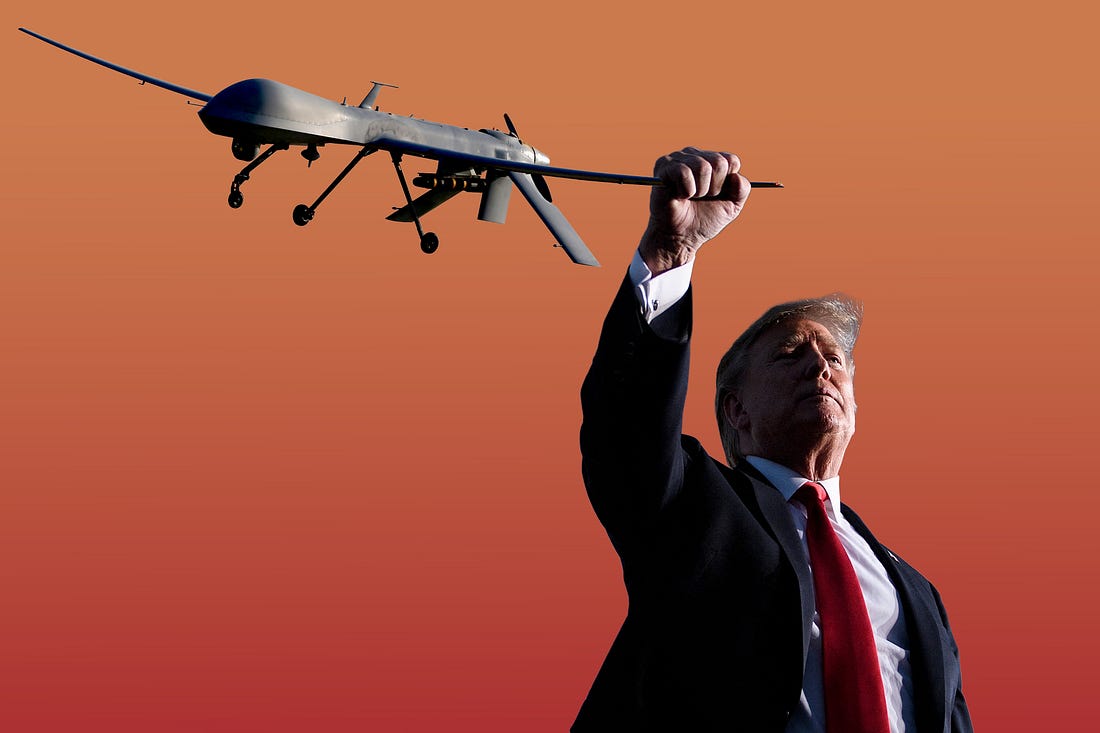
We start by understanding that the drone is both the present and the future of warfare. This is not new.
America was the first military to widely integrate drones and we did it thirty years ago with the Predator and then the Reaper.¹ The key insight was that where air forces historically prized speed and power, unmanned aerial vehicles (UAVs) could be valuable precisely because of how slow they could move. The Army could park a Predator over a patch of grass for hours at a time and it was the equivalent of having a geosynchronous satellite feeding them real-time intelligence—and for the tiniest fraction of the price.
We gradually turned surveillance drones into weapons platforms, but the emphasis in America was still on Big. Our drones were cheap by the standards of fighter jets, but they still cost real money.² Nations which did not have the resources to manufacture even “cheap” Predator-like drones looked to the consumer drone space for inspiration—and that’s when the real revolution happened.
In 2020 Armenia and Azerbaijan went to war for the second time in a generation. The First Nagorno-Karabakh War lasted six years. The Second Nagorno-Karabakh War lasted six weeks. That’s because the Azerbaijanis used a combined-arms strategy centered around the integration of cheap drones used both for surveillance and as smart-munitions. The Armenians, who fielded a conventional force based around armor, artillery, and infantry were routed.
Military planners in Kyiv and Tehran were paying attention. People in Donald Trump’s administration—and Vladimir Putin’s army—were not.
By this point the supremacy of drones in the Russo–Ukraine war is well-documented. You should understand that drones are also the reason America has lost the Iran war.
In a recent interview with the Atlantic Council’s Danny Citrinowicz, Isaac Chotiner asked:
The fundamental question I keep returning to is: Did the Iranians not realize how much control they had over the global economy before the U.S. and Israel attacked them? Or had they always known this and were they just waiting to wield that power?
The answer to this question is that that while the Iranians had a theory about controlling the Strait of Hormuz for decades, the practical ability to execute this plan did not materialize until the age of the drone.
In pre-drone times, Iran would have needed to rely on mines, fast-boats, and anti-ship missiles. Mines are hit-and-miss and slow to deploy—plus they’re hard to un-deploy, which is inconvenient for Iran because while they can close the strait in the short term, in the long term they need it open. Boats and missiles are relatively expensive and can be neutralized by conventional means. The Iranians needed another option—which is why they poured resources into their drone industry beginning in 2010.
It was the drone that allowed Iran to close the strait and win the war.
Next, we should understand what makes the drone so special. The drone does not represent a technical advance. It is an economic advance.
Guided munitions—smart bombs, rockets, and shells which can seek out targets after being fired—have done what drones do for a long time. What makes the drone different is the cost basis.
A guided munition is expensive. A Tomahawk missile, for example, costs about $2m. These munitions then need dedicated platforms from which to launch—typically a submarine or ship in the case of the Tomahawk. Other guided munitions can be fired from aircraft or land-based batteries or, in the case of some extremely short-range weapons like the Javelin anti-tank missile, by infantry.
In every one of these cases, the munition itself is costly but that price is dwarfed by the long tail of costs needed to put those munitions in the field. To stick with our $2m Tomahawk, it can be launched from an Ohio-class submarine—which cost about $3 billion each and requires about 155 crew members, never mind the dockside logistical costs to keep the boat running, pay veteran’s benefits, etc.
A Shahed 136 drone costs between $20,000 and $50,000. Do the math.
For the cost of a single American submarine carrying 154 Tomahawks, Iran can make up to 150,000 drones.
Here is the key insight that I want you to put on a pillow:
War is politics by other means. It is also economics by other means.
If you heard the term “cost-exchange ratio” you might think it’s about stonks. It’s not. It’s about the economics of destroying things.
Take Ukraine as an example. When Russia started firing cheap, Iranian-designed Shahed drones at Ukraine, the only thing the Ukrainians had on hand