Welcome back to Buffering, a newsletter that shares Mandy Moore’s unfettered vitriol for Cars 2. This week, we’ve got quick thoughts on Bari Weiss’s latest CBS News dustup, Taylor Sheridan’s latest ratings hit, and more. Then there’s a final word on this year’s Cannes from Alison Willmore and a breakdown of Euphoria’s final-season Emmy prospects by Joe Reid. Thanks, as always, for reading.
|
|
|
|
Subscribe now to get unlimited access to everything New York, including subscriber-only newsletters, exclusive perks, the New York app, and more. |
|
|
|
In this edition: Bari Weiss, Nick Bilton, David Ellison, Tanya Simon, Draggan Mihailovich, Cecilia Vega, Sharyn Alfonsi, Taylor Sheridan, Curry Barker, Jason Blum, Christopher Nolan, Steven Spielberg, Asghar Farhadi, James Gray, Ira Sachs, Na Hong-jin, Hirokazu Kore-eda, Vincent Bolloré, Maxime Saada, Léa Seydoux, Javier Bardem, Zendaya, Sam Levinson, and many more… |
|
|
|
➽ Bari Weiss Is Overhauling 60 Minutes |
Amid a spree of reported cuts, the CBS News editor-in-chief has picked a new executive producer, Nick Bilton, to lead the historically independent flagship newsmagazine program. Bilton is a former New York Times tech columnist turned Vanity Fair writer turned documentary filmmaker, and he has no prior significant experience in broadcast news, a trait that Weiss shared when David Ellison installed her at the top of CBS News.
Interfering with 60 Minutes is a Rubicon that Weiss has crossed before, when she held the program’s episode on the Salvadoran prison CECOT, but this latest shake-up is a messier gambit. In bringing Bilton in to run the show, she has also ousted its two most senior leaders, executive producers Tanya Simon and Draggan Mihailovich. She also let correspondents Cecilia Vega and Sharyn Alfonsi leave the building. (Alfonsi reported the CECOT story and just this week spoke out publicly against Weiss’s leadership when her 60 Minutes contract wasn’t renewed.) The program, critically, is also wildly successful. It’s been the No. 1 news show in America for 52 straight seasons. According to Nielsen, ratings for 60 Minutes are up 9 percent over where they were last year, a rarity for news in the streaming era and a detail that Simon noted in her parting memo to staff on Thursday, per Variety. If Weiss and Bilton think they can improve upon that, let’s hope they learned from her mistakes with Tony Dokoupil. —Eric Vilas-Boas
|
|
|
|
➽ Yellowstone Is Still Popular, Even When It’s Called Dutton Ranch |
If there’s one thing Taylor Sheridan is going to make sure of, it’s that he’s winning in the ratings. The prolific creator pulled off another huge win this month with the premiere of Dutton Ranch, the latest Yellowstone spinoff. The first two episodes dropped on May 15 on Paramount+ and together logged 12.9 million views within one week. That crowns Dutton Ranch the single best premiere in Paramount+ history, blowing past the previous record holder, Mobland, which scored a comparatively measly 8.8 million views. Unsurprisingly, it is also the number-one streaming series of the week on the Nielsen charts. Dutton Ranch also premiered on cable, airing on the Paramount network, where it scored 2.9 million views. Read more about it here. —Jason P. Frank
|
|
|
|
➽ The YouTube to Multiplex Pipeline |
One metric to show just how successful 26-year-old Curry Barker’s movie, Obsession, has become is that some people now think an older, more experienced person directed it, like how folks assumed Matt Damon and Ben Affleck couldn’t have written Good Will Hunting. Another metric is the money. The horror film’s box office actually went up by 39 percent in the second weekend of its wide release. Obsession made $17 million on its opening weekend domestically and $23.9 million over Memorial Day weekend. Including international box office, the movie has now made $75 million. The total amount is particularly shocking given the film’s comparatively minuscule $1 million budget. “Obsession is the ONLY wide-release horror film on record to grow in its second weekend at this scale — $22.4M, up 30% over opening,” producer Jason Blum, of Blumhouse, crowed on social media. This makes up for Blumhouse’s monumental loss on M3gan 2.0 around this time last year.
It’s also a towering success for Barker, who got his deal based on the success of a short horror film, titled The Chair, that he uploaded to YouTube. If the movie has any worry in the weeks ahead for its box office, it’s that it will now compete with another YouTube wunderkind-made horror movie. Kane Parsons’s Backrooms, based on his YouTube series of the same name and starring Oscar nominees Chiwetel Ejiofor and Renate Reinsve, is headed for theaters this weekend. Read more about it here. —J.P.F.
|
|
|
|
Don’t worry, Roku City remains untouched, but if you notice something’s off when you power up your streaming devices this week, it’s because the company is rolling out a major redesign of its home screen, the first in nearly a decade. The apps have been reconfigured in an effort to offer better curation and personalization, and sidebar nav text has been shrunk down to icons, a look that not only echoes mobile navigation but allows more room for both content tiles and splashy ad placements. There’s now a “Quick Access” section up top that arranges your most-used apps; a “Top Picks for You” section; and another called “Destinations,” which asks you which category of entertainment you’re in the mood for and helps you pick from there. It’s somewhat similar to Netflix’s new AI-search feature that lets you browse titles by searching for a phrase instead of a specific title. Overall, the changes aren’t so dramatic as to look unrecognizable, but they reflect the streaming-device company’s priorities right now: personalization, vibes-based searching, and greater monetizability. —Savannah Salazar
|
|
|
|
Photo: Kate Green/Getty Images |
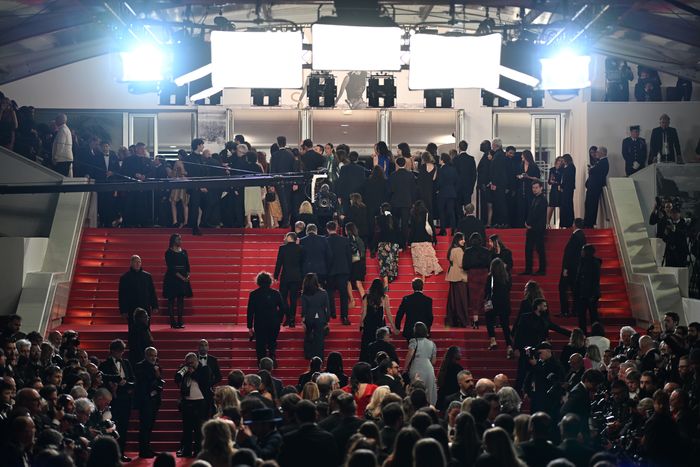
The poster for this year’s Cannes featured a promo shot from Thelma & Louise, which closed out the 1991 version of the festival. From inside the halls of the Palais des Festivals, atop the theaters, and along the sides of lamp posts, an impossibly cool Geena Davis and Susan Sarandon stretched out in blue jeans atop that 1966 Ford Thunderbird, icons of American rebelliousness looking down on an event whose packed streets implied more of a sense of urgency than the actual films generated on the screens inside. From the perspective of 2026, Thelma & Louise represents, with its mixture of thematic daring and commercial viability, an alchemy our mainstream movie industry seems to have since largely forgotten. It was a box office hit as well as a critical one that racked up six Academy Awards, burnished the star status of its leads, and fired up debates with its overt feminism. But every time I glanced up at those two faces, the thought that crossed my mind was that it famously ended with its characters driving off a cliff.
A lot has been made about the lack of Hollywood at Cannes this time around, about how the big studios, already creatively cowed, financially shaken, and in the midst of intensely politicized corporate consolidations, all opted out of the risk of putting a precious tentpole release in front of a famously tough audience. When you get more granular with the prospective blockbusters from prestigious enough lineages to have been Cannes candidates this year, however, their absence looks more like a question of timing than some more significant collective opting out. Christopher Nolan, now king of the multiplex, hasn’t taken a film to a festival since Insomnia in 2002, while, after Indiana Jones and the Kingdom of the Crystal Skull emerged from the 2008 Cannes with a mild stink from mixed reviews, Steven Spielberg probably didn’t want to. (I have no idea if there’s any truth to the rumor I heard that The Mandalorian and Grogu was actually screened for the fest and was rejected, but it makes spiritual sense — Cannes may occasionally make room for TV with auteurist pretensions, but a glorified collection of TV episodes masquerading as a movie is another matter.) Still, the overall lack of orgiastic feats of American marketing spend left me feeling curiously maudlin.
You don’t come to Cannes to watch a costumed Jerry Seinfeld zipline from the roof of the Carlton Hotel to promote The Bee Movie, like he did in 2007, or to find yourself surrounded by the same The Expendables 3 billboards adorning the roads back home, as an American festivalgoer would’ve in 2014. But those efforts did their part to contribute to the overall sense of the Cannes Film Festival as the center of the moviegoing world for 11 days in May, somewhere where crass corporate product lived alongside uncompromising arthouse efforts in a broad-spectrum display of what constitutes cinema. The fact that the halo effect provided by the festival was enough for Hollywood to haul itself out to the south of France meant something. Without it, the films in the main competition and various sidebars of the fest are left alone to hold up the pageantry and scrutiny the annual event demands. And, after an incredibly strong slate last year, this year’s offerings were unfortunately underwhelming, rife with disappointing outings from respected auteurs and other big names, and low on the kind of ecstatic experiences you come to the festival for (when not hawking your AI slop).
Asghar Farhadi directed Parallel Tales, a silly French melodrama that barely pretended it had anything to say about the consequences of using real people as inspiration for your work, while Pedro Almodóvar tackled similar themes in Bitter Christmas, a film that only really becomes interesting when it makes a late turn toward lacerating self-criticism. James Gray and Ira Sachs, the two Americans in competition, offered up handsome but minor riffs on themes they’ve tackled before in Paper Tiger and The Man I Love. With Sheep in the Box, Hirokazu Kore-eda turned out an update on the robot child concept of A.I. Artificial Intelligence that I felt more generous toward than most, but that would never be considered one of his best, while with Hope, Na Hong-jin contributed an alien invasion movie that might have fared better in the context of a midnight screening, with its spectacular action sequences and thuddingly obvious points about xenophobia.
But even with this relatively weak slate, one of the only films to draw a smattering of the boos Cannes is infamous for was The Unknown, directed by Anatomy of a Fall co-writer Arthur Harari, and, honestly, it deserved all of them for its pitifully incurious story of involuntary body-swapping. Even the festival’s notoriously demanding crowds seemed to feel protective this time around about a medium whose future, like that of so much in the world, feels precarious and uncertain. (What did get consistent hoots this year was the logo for Canal+, owned by France’s media-meddling conservative billionaire, Vincent Bolloré, especially after CEO Maxime Saada announced a few days into the fest that the company intended to blacklist the 600-odd signatories of a petition to rally against incursions into the film world by the far right.) And there were always performances to praise, even when the movies they were in let you down. If this year seems less likely to yield multiple Best Picture nominees than last, you can still imagine some of the actors making a run at other categories.
Léa Seydoux, consigned to stare morosely at nothing in particular in The Unknown, gets a much meatier role in Marie Kreutzer’s Gentle Monster, a clumsy portrait that nevertheless puts the French actor through her paces as a woman struggling with the revelation that her husband is being investigated for possession of CSAM. Javier Bardem is terrific as a former enfant terrible filmmaker who tries to reconnect with his estranged daughter by putting her in his new movie in The Beloved, which eschews the easy sentimental beats but also ends up short on many satisfying ones. A Man of His Time’s Swann Arlaud as an opportunistic career climber in Vichy France, The Man I Love’s Rami Malek as a performance artist dying of AIDS — there were some great turns in movies that might not break through. Sandra Hüller, meanwhile, is tremendous as Thomas Mann’s daughter Erika in Paweł Pawlikowski’s window into post World War II Germany Fatherland, a film that happens to be one of the competition’s true highlights.
But Fatherland is finely wrought while also firmly modest in scale, never reaching for more than it can manage — the kind of work that aims to impress rather than wow. It has that in common with Cristian Mungiu’s Fjord, the spiky assimilation drama starring Sebastian Stan and Renate Reinsve that won the Palme d’Or, and Andrey Zvyagintsev’s Grand Prix-winning Minotaur, a bitterly Russian take on the 1969 Claude Chabrol film that also inspired Unfaithful. It’s no wonder that audiences hungry for a big swing went wild for The Black Ball, an arms-flung-open film from Spanish directing duo Javier Ambrossi and Javier Calvo that weaves together the Spanish Civil War, flamenco, Federico García Lorca, and the stories of three gay men across a century. But that film also seems destined for a harsher reception when it’s released by Netflix, which picked it up in a competitive race. (It was a very queer Cannes, with high-profile competition titles like the Javis’ and Lukas Dhont’s WWI romance Coward, in addition to Koji Fukada’s more quiet countryside saga Nagi Notes, and sidebar offerings like Jordan Firstman’s buzzy debut Club Kid, Arie and Chuko Esiri’s Lagos-set take on Virginia Woolf Clarissa, and Jane Schoenbrun’s Queer Palme winning Teenage Sex and Death at Camp Miasma.)
Ryusuke Hamaguchi’s All of a Sudden, an earlier Palme favorite that ended up picking up the Best Actress award for its two leads, is maximalist in a different way, running three hours and 15 minutes, with much of that time devoted to continent-hopping conversations between Virginie Efira and Tao Okamoto. Efira’s character, the head of a senior home in France, and Okamoto’s, a Japanese theater director with a play on tour, have a chance encounter that leads to a connection that goes beyond friendship to something closer to a meeting of platonic soulmates. I’m still sorting out where I stand with All of a Sudden, which dares you to deem its earnestness and directness too much — there’s a point, during one of their talks about the seemingly doomed fight to do righteous work amid an overwhelming tide of economic forces, when Okamoto’s character gets out a whiteboard and diagrams her theory of capitalism. But I do feel like that sort of openheartedness feels riskier and more vulnerable in times as destabilized as these, in ways that should be commended.
That might be why the one genuinely euphoric experience I had at Cannes this year was early in the festival, with Schoenbrun’s film, which opened Un Certain Regard. Teenage Sex and Death at Camp Miasma could have easily justified a slot in the main competition, but there was something fitting about its place at the start of Cannes’ showcase for emerging talent. It felt like a fledgling thing — not because the film, the director’s third, came from a place of inexperience, but because it tried to get at the mindset of a young protagonist trapped in her inability to reckon with the things she loves not always lining up with her values. Teenage Sex and Death at Camp Miasma overflows with ideas about slasher films, conflicted relationships with nostalgia, fears about sexual dysfunction, and the best Counting Crows needle drop imaginable, but it’s also about a movie about liberating your own reactions to art that manages to feel creatively liberated and joyous itself. That it’s an American production, albeit one financed and being distributed by the UK-based Mubi, is just a nice added touch. We may be halfway off that cliff as a nation, but at least we still have things to offer.
➽ Here are our |
|
|
|
|