
|
 |
Recession-proof your summer reading now with 50% OFF an annual Bulwark+ membership. Ride with us through the mid-terms and beyond.



Our long national nightmare may be coming to an end: The White House and Iran are reportedly closing in on a deal to reopen the Strait of Hormuz, with Iran seemingly willing to forgo tolls or controls on the waterway in exchange for various U.S. concessions like sanctions relief and the unfreezing of assets.
If the deal materializes as promised, it’s likely a better outcome for the United States than the extraordinarily bleak one many expected, in which Iran felt empowered to throw its weight around in the strait in perpetuity—although, as always, the devil will be in the details.
Even here, the deal represents at best a return to the pre-war Hormuz status quo of open international navigation—and at a heavy cost. In addition to the thirteen American service members killed and more than 500 wounded, plus the eye-watering price to taxpayers of the war itself, the United States appears prepared to extend a major economic lifeline to Iran that will help it quickly rebuild. And Iran seems to have convinced the Trump administration to punt for now on further negotiations about its nuclear program. Why American negotiators think they’ll be able to get more concessions from Iran later, when they’re able to apply less economic and military pressure, is unclear. Happy Friday.
 |
It’s Still About Us, Not About Him
by William Kristol
On July 2, 1776, the Second Continental Congress, meeting in Philadelphia, voted to approve the resolution proposed by Richard Henry Lee of Virginia stating that the United Colonies “are, and of right ought to be, free and independent States.”
The next day, John Adams wrote to his wife, Abigail, explaining what the Congress had done. And he looked forward with pride and pleasure to the fact that July 2 would heretofore be celebrated as the new nation’s birthday, with “Pomp and Parade, with Shews, Games, Sport, Guns, Bells, Bonfires and Illuminations from one End of this Continent to the other from this Time forward forever more.”
As it happened, Americans decided to date our independence not from the vote on July 2 but from the adoption of the formal document declaring independence two days later. So July 4 became our national birthday. But Adams was vindicated in his hope that it would be commemorated by “Shews, Games, Sport, Guns, Bells, Bonfires and Illuminations.”
And so it will be this year, our 250th anniversary of independence.
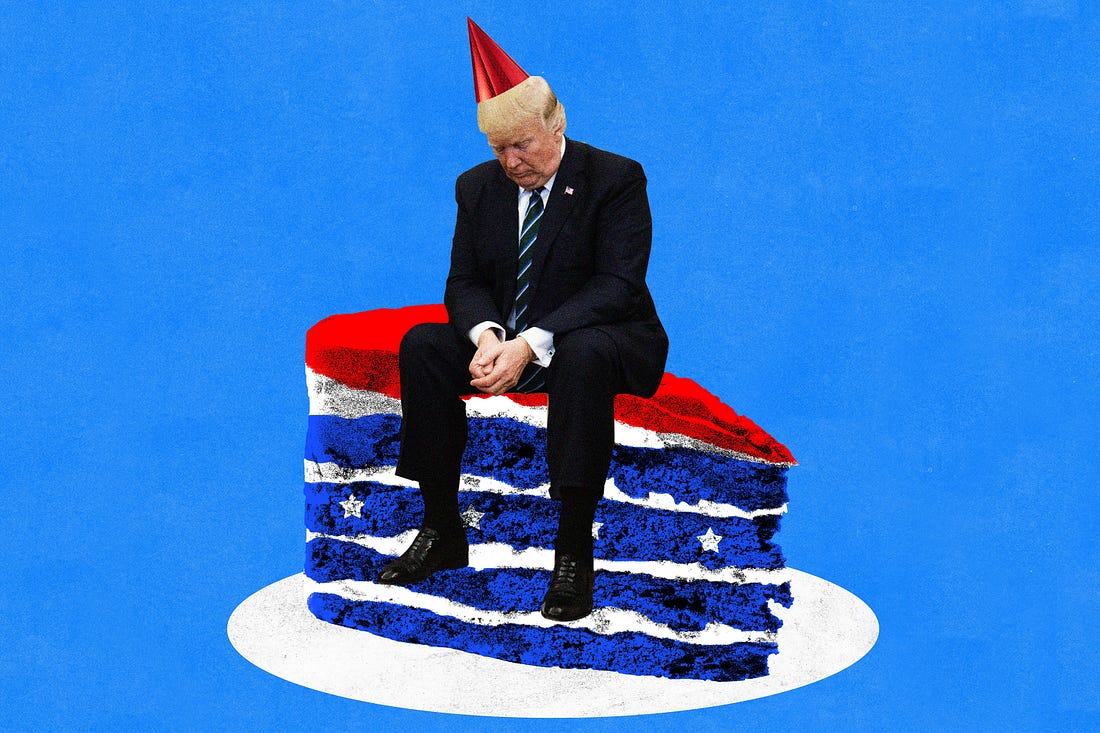
There is one small problem, though. We elected Donald J. Trump as our president in 2024. And so he will preside over the 250th birthday of a nation conceived in liberty and dedicated to the proposition that all men are created equal.
I hope the Supreme Judge of the World (as the Declaration refers to Him) is enjoying this rather dark cosmic joke.
It’s not just that Trump’s policies fly in the face of the principles of the Declaration, and seek to undermine a government that secures our rights and derives its just powers from the consent of the governed.
It’s also that Trump is doing his best to horn in on the celebration, to turn it into his event, not ours, to vulgarize it according to his taste, to personalize it in accord with his narcissism, and to distort its meaning in line with his prejudices.
And so we had the unseemly “Rededicate 250: A National Jubilee of Prayer, Praise & Thanksgiving” on the National Mall two weeks ago. And we have the plans for the grotesque 250-foot Trump arch desecrating Arlington National Cemetery. And we have the attempt by the Trump administration to feature Trump on a new $250 bill for our 250th birthday (about which more below). And we have the $1.776 billion slush fund to be dispersed to January 6th insurrectionists. And so on.
These efforts all need to be blocked by Congress and the courts if possible, and shunned and deplored by the public as necessary.
The good news is that this seems to be happening. Trump may succeed in pulling off individual events and even projects, for now. But his attempted hijacking of the meaning of America is failing. The public disapproves of his grandiose imperial arch by 51 percent