
|
A Truly Amazing Exercise of Justice
This Week's Joseph N. Welsh Awardees for Courage in the Face of Tyranny
| |||||||||||||||


 |
Friends,
I can’t overstate the importance of Judge Kathleen Williams’s decision on Friday to reopen Trump’s $10 billion case against the I.R.S.
She said she wants to investigate “grievous allegations” that the hasty deal to resolve it was “premised on deception,” and she ordered Trump’s lawyers to tell her by June 12 whether the lawsuit should be formally reopened because “the court was the victim of a fraud.”
The “deception” and “fraud” Judge Williams refers to were allegedly carried out by Trump and his Justice Department.
This is a big deal.
Judge Williams’s decision came in response to court papers filed on Wednesday by a bipartisan group of 35 former federal judges who urged her to revive the case and dig into the details of the agreement to settle it.
The judges’ brief is also a big deal. They call it a motion for relief from judgement or order or, alternatively, “leave to appear as amici curiae by thirty-five former federal judges.”
I don’t recall a similar instance of 35 former federal judges filing such a motion or amicus (friend of the court) brief.
In it, the judges argue that the parties’ — Trump and the Justice Department’s — so-called “settlement” agreement was made to circumvent the court ‘s possible finding that the case presented no actual controversy, since Trump is on both sides of it.
This, they conclude, constituted a fraud on the Court.
Let me quote the remarkable brief filed by the 35 former federal judges:
“The parties have used this lawsuit—which was never an adversarial proceeding over which the Court even had jurisdiction—as a means to allow a “commission” controlled by the President to dole out $1.776 billion in taxpayer dollars without constitutional or congressional authority to do so, and to confer unlawful private benefits to the President and his family by purportedly prohibiting the United States from prosecuting any and all claims against them.
And the parties have plainly tried to shield this conduct from necessary judicial scrutiny by short-circuiting this Court’s inquiry into whether the lawsuit is in fact an actual case or controversy by [seeking to dismiss the case] before they announced the “settlement”—clearly in hopes of preventing the Court from ever completing that inquiry, which, if it comes out against the parties, will undo their collusive “settlement.” ….
Accordingly, because “[t]he parties’ ‘collusive’ activity perpetrated a fraud on the judicial machinery itself, by fostering an appearance that the litigation involved adverse parties, when, in fact, it did not,” the Court should void its prior dismissal and reopen the case to assess in due course whether a fraud occurred.”
In her order on Friday, Judge Williams said she wanted to investigate the circumstances surrounding Trump’s efforts to settle the lawsuit in a way that benefited him and his allies.
She added that a federal court rule requires attorneys to ensure that court filings are “not presented for any improper purpose” and that “a party’s decision to file a frivolous lawsuit for the sole purpose of forcing a settlement may qualify as such an improper purpose.”
She also noted that the settlement appeared to run afoul of Department of Justice policies that require any settlements to be “specifically limited to the immediate subject matter of the claim.”
Finally, Judge Williams pointed out that a settlement addendum that waives all tax claims the U.S. may currently have against Trump, his two eldest sons, and his businesses and trusts was signed only by Todd Blanche, the acting Attorney General.
This could result in questions being asked of Blanche. Ultimately, it could result in his debarment or even imprisonment. Recall that Nixon’s Attorney General, John Mitchell, was convicted of conspiracy, perjury, and obstruction of justice for his role in the Watergate break-in and cover-up. He served 19 months of a two-and-a-half to eight-year sentence in federal prison before being paroled. He was the first Attorney General in United States history to be incarcerated.
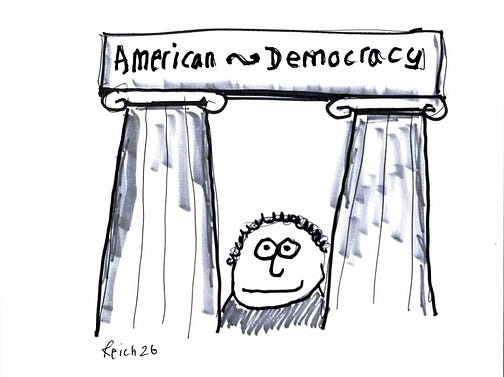
Let me just say that there are forces in this country — specifically, Judge Kathleen Williams and the bipartisan group of 35 former federal judges — bent on preventing Trump from exercising authoritarian power.
In so doing, they’re displaying extraordinary courage and commitment to democracy and the rule of law. They are in effect representing all of us — our system of justice.
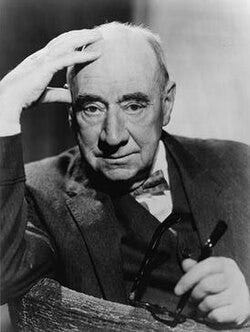
We owe them a great debt of gratitude. (I’m awarding them this week’s Joseph N. Welsh Award for Courage in the Face of Tyranny.)
 |
Mr. Trump, along with two of his sons and the Trump family business, first sued the I.R.S. in January, claiming they were owed at least $10 billion because a former contractor at the agency had leaked their tax returns (and hundreds of others) during the president’s first term in the White House. The Trumps claimed that the I.R.S. should have done more to prevent the contractor, Charles Littlejohn, from disclosing tax information to The New York Times and ProPublica.
Trump’s suit, as I.R.S. officials laid out in their memo and other lawyers have noted, had clear legal flaws. Potential defenses against it include that it was filed after the statute of limitations, and that it incorrectly faulted the I.R.S. for the actions of Mr. Littlejohn, previously a contractor employed by Booz Allen Hamilton. But the Justice Department never made an attempt to contest Mr. Trump’s suit. No government lawyer entered an appearance in the case.
That has fueled criticism that the deal the Justice Department struck with Mr. Trump was not a genuine attempt to avoid a loss on the merits to the president in court, but instead a scheme to provide him and his political allies with public benefits.
In a footnote, Judge Williams questioned the provision granting Mr. Trump, his family and their businesses immunity from I.R.S. scrutiny of tax returns they had already filed. She wrote that the audit protection may run afoul of Justice Department rules requiring legal settlements to directly relate to the issues in the suit.
She also noted that only Mr. Blanche signed the audit provision. The separate, nine-page agreement laying out the $1.8 billion fund was signed by Mr. Woodward and Frank Bisignano, who is serving as the chief executive officer of the I.R.S., a newly created role that is not subject to Senate confirmation.
So glad you can be here today. Please consider becoming a paid subscriber of this community so we can do even more.