
|
 |
Hi, y’all. Welcome back to The Opposition. I just got back from South Carolina, where I made a quick visit to Columbia to attend Rep. Jim Clyburn’s annual fish fry event. If you’ve been following Democratic politics for a while, then odds are you’ve seen photos of presidential candidates sweating on stage in the early summer heat as they try to win over Clyburn’s approval. I’ve been to the fish fry a few times and it’s always been a celebration of Clyburn’s long political legacy and the power of black voters in the state. So I was curious what the mood would be at this year’s event, as black political power is being torn up throughout the South following the Supreme Court’s decision gutting the Voting Rights Act.
Before we get into it, let me invite you again to sign up for Bulwark+ with this crazy deal. All the benefits of membership at half the price. But move fast: This offer expires tonight!
FINAL HOURS: Our 50% off deal for Bulwark+ membership ends tonight! Come ride with us:
–Lauren
A Brief Reprieve From Annihilation for Dems in the South
Jim Clyburn’s annual fish fry remains a pilgrimage site for ambitious Democrats. Whether its political world survives the redistricting frenzy is an open question.
|

| ||||||||||||


 |
Columbia, South Carolina
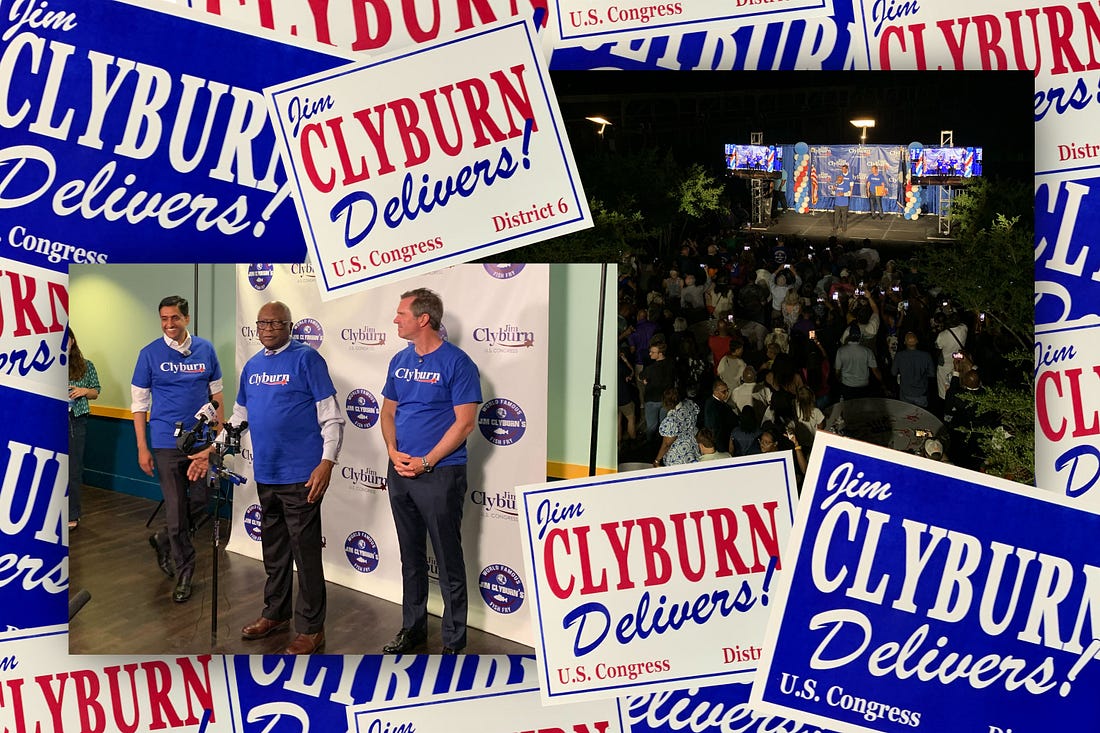
SOUTH CAROLINA REP. JIM CLYBURN’S “World Famous Fish Fry” is a storied tribute to Democratic politics in the South. The annual event is a jubilant affair; the type you get when you combine sticky summer air, deep-fried fish, music, booze, and a smattering of ambitious politicians eager to impress an early-voting state crowd.
But Friday’s fish fry felt more like a resurrection than a celebration.
Just days before attendees started showing up at the outdoor patio of a local children’s museum decorated with red, white, and blue balloon arches and “Jim Clyburn Delivers!” campaign signs, Clyburn had been granted a remarkable lease on his congressional life after the Republican-led South Carolina state Senate somewhat unexpectedly shot down a redistricting measure pushed by President Donald Trump. Had it been successful, the effort would have exploded Clyburn’s safe Democratic seat by spreading the district’s large population of black voters across new congressional lines. And so, rather than mourning the end of Clyburn’s thirty-three years in office, folks gathered with a sense of solace that the 85-year-old veteran of the House—the last of the old guard of Democratic leaders there—will serve at least one more term.
A woman named Phyllis I spoke with, who seemed only mildly annoyed that I interrupted her dancing to Beyoncé, told me she felt “vindicated” and “electrified” by last week’s state Senate vote. Another woman, Jackie, said she was relieved Clyburn wasn’t going anywhere: “We trust him. He’s done so much and he means so much,” she told me. And in between bites of her fried fish (which she rated a 10 out of 10), another voter, Gelinda, said she’d come to her first fish fry to “celebrate that Clyburn is still here.”
These are trying times for Democrats in the South—success is measured not by progress made but by harm mitigated. Following the Supreme Court’s ruling last month gutting Section 2 of the Voting Rights Act, Southern Republicans raced with shocking speed to redraw congressional lines to benefit themselves, along the way threatening to erase an entire generation of Southern black political leadership. So far, they’ve largely succeeded—or have positioned themselves to do so in the coming years.
As I watched the hundreds gathered at the fish fry—dancing, drinking, and holding plates of whiting fish deep-fried to a flaky perfection and served on white bread with mustard and hot sauce—I couldn’t help but see the moment as a crossroads: a party clinging to its traditions while political trends outpace them.
Clyburn’s fish fry began in 1992 in the parking lot of his campaign office. It’s become a must-stop for Democrats with presidential ambitions, serving as an early testing ground for a candidate’s ability to appeal to black voters in the South. It’s also a way to pay homage to the congressman—a kingmaker in South Carolina’s early presidential primary—who exhibits great pleasure in making would-be presidents don matching blue “Clyburn” t-shirts and vie for his approval in front of a large and loyal crowd.
For all the relief, this year’s fish fry could very well be one of the last. There’s no guarantee Republicans won’t eliminate Clyburn’s district in 2028 or 2030 when the political environment could be more favorable for the GOP. More broadly, the political system that gave voice to the Black Belt over the past sixty years is ending. In its place, much of the former Confederacy appears to be marching toward a deeply gerrymandered structure, in which the overwhelmingly white Republican party is largely assured of holding power, while Democrats, many of whom are black, are left politically voiceless.
I ASKED CLYBURN HOW HE FELT about all this and he referred me to his recent book, The First Eight: A Personal History of the Pioneering Black Congressmen Who Shaped a Nation. The book, which came out last November, chronicles the black South Carolina congressmen who served during and after Reconstruction. He also mentioned Ralph McGill, the white anti-segregationist publisher of the Atlanta Constitution in the 1950s and ’60s who advocated for the “New South,” a modernized, upwardly mobile region that retired longstanding racist, romanticized visions.
“We’ve got some people in Washington who would love for us to revert to the Old South,” said Clyburn. “What I think about it: I think that good, positive thinking Southerners are going to continue this thrust toward a more perfect union, irrespective of those people up in Washington, who day after day are insulting the intelligence of Southern voters.”