
|
 |



This week, work continues on the planned celebration of Donald Trump’s 80th birthday, which coincides with Flag Day, on June 14. Work continues on the bizarre structure that is being built to serve as the Ultimate Fighting Championship (UFC) arena for the cage matches that will be held on the White House lawn. UFC President Dana White has suggested in interviews that the administration is “hoping the spectacle will inspire patriotism among Americans at a time many are feeling uncertain about the economy, foreign conflicts overseas and other issues.”
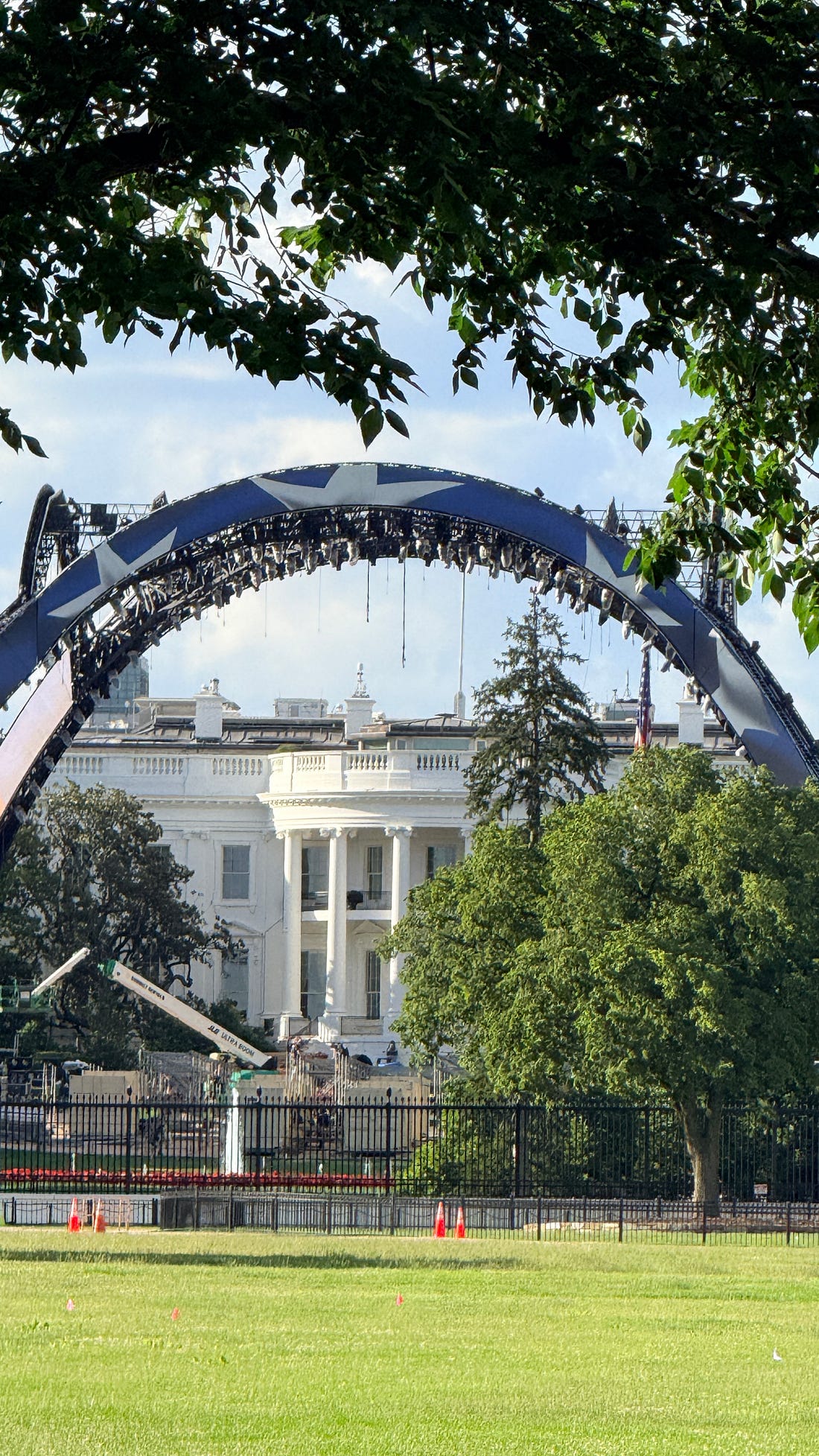 |
It’s impossible to avoid conjuring images of what would have happened if Barack Obama, Bill Clinton, or George Bush—either of them—had built a venue for cage matches on the White House South Lawn. The spectacle is part Hunger Games, part Back to the Future—the part about Biff Tannen’s Pleasure Paradise, the garish, multi-story casino plastered everywhere with Tannen’s name and face. Biff was modeled on Donald Trump.
 |
The Pentagon is recruiting soldiers to attend in uniform, after paying for their own travel. They must also be tall and fit. “No fatties” will be permitted to attend, according to a CNN report. But Trump, according to a medical report released late last Friday, has gained and weighs 238 pounds, which is close to clinical levels of obesity for a man of Trump’s stature. He will undoubtedly be in attendance since the fights are how America will mark his birthday.
But it’s not just the hypocrisy we’re in for a dose of this week. As we’ve been discussing, it’s the kleptocracy. And yet, there is good news on this front to take to heart: Lawyers and courts are pushing back, with more developments on the way this week and next.
The $1.776 billion slush fund Trump is trying to get the courts to sign off on so he can reward January 6 defendants for their loyalty came under attack from an unexpected front last Wednesday, when 35 former federal judges filed a brief urging Judge Kathleen Williams to reconsider her dismissal of the case. They argued that the situation requires “judicial review of the extraordinary—and historically unprecedented—circumstances presented by this litigation and by the collusive ‘settlement’ that invokes this litigation as the legal justification for its terms.”
The requirement comes from Article III of the Constitution, which requires an actual “case or controversy” exist before a federal court can hear a case. Courts may only consider actual, concrete disputes between adverse parties.
As we’ve discussed before, although the case is styled as Trump v. IRS, it’s really Trump on both sides of the “v,” given his assertion of power to control all decisions in the executive branch as the unitary executive. Here, that means, as Trump has openly said, he had the ability to decide how much money he would pay himself to settle the IRS litigation. He even acknowledged that it “sort of looks bad.” Sort of. Courts only have jurisdiction over truly adversarial proceedings. That means the parties on opposite sides of a case, the plaintiff and the defendant, can’t be on the same side. They must have opposing interests and truly seek a resolution from a judge who acts as a neutral arbiter of their differences.
Even though the case has already been dismissed, the former judges argue that under Federal Rule of Civil Procedure 60, a judgment can be set aside and the case reopened if the judgment results from a fraud on the court. “The purported ‘settlement’ that the parties never placed before this Court raises profound questions about the parties’ candor toward the Court and manipulation of the judicial system, which threatens to undermine confidence in the administration of justice.” They argue that they are entitled to ask for relief even though they were not parties to the original lawsuit, because under caselaw in the Eleventh Circuit (this case is out of a federal district court in Florida), “in ‘extraordinary circumstances,’ a non-party may raise a challenge of fraud on the court through Rule 60 even when the non-party’s interests are not directly affected by the judgment.” The judges go on to explain their view that the circumstances here are, indeed, extraordinary.
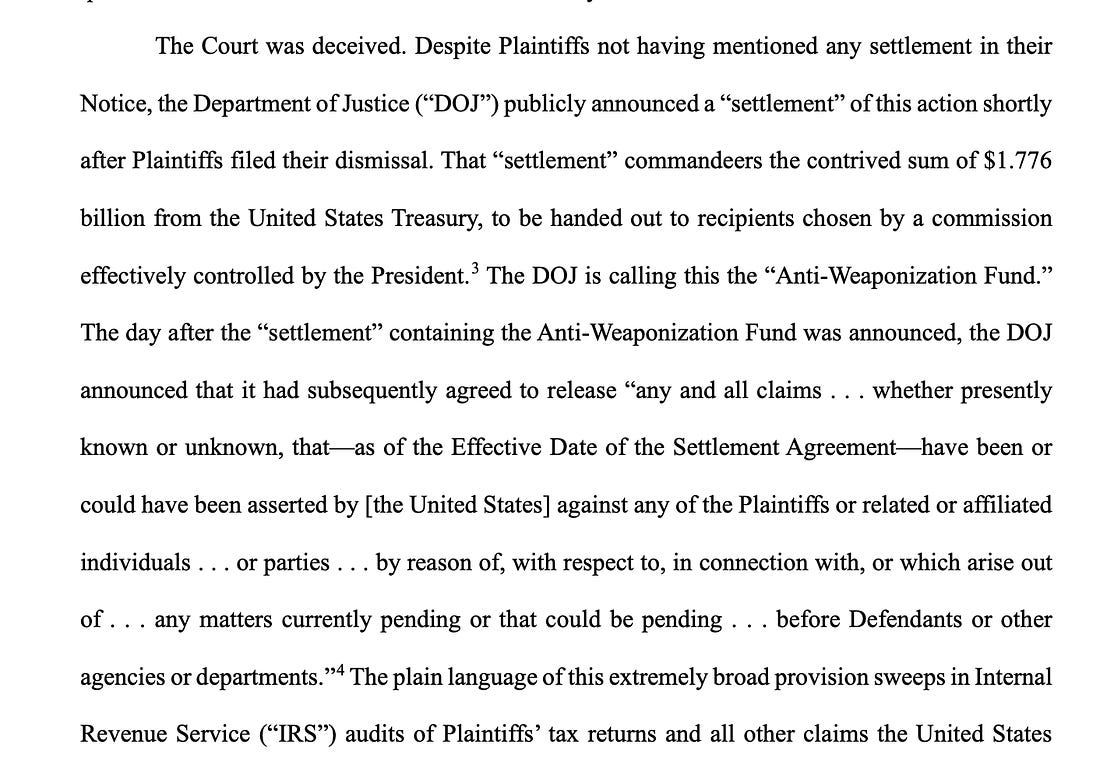 |
The argument is a smart one, asking the court to set aside its earlier dismissal of the case and open an inquiry into whether there truly was a case and controversy here and whether Trump perpetrated a fraud on the court: “Movants submit that this ‘settlement’ [the slush fund] is a product of collusion and is itself a fraud on the Court. But the Court need not decide that ultimate issue now. At this juncture, Movants request only that the Court exercise its powers under Rule 60 to set aside its order ending the case based upon Plaintiffs’ voluntary dismissal. That will allow the Court to commence an inquiry into whether the Court was deceived, including with respect to the existence of an underlying case or controversy and any purported arms-length negotiations undertaken to resolve it.”
In Trump’s case, the creation of a settlement fund that allocates an exceptional amount of taxpayer funds that have not been designated for this purpose by Congress suggests the parties were not adversaries. This is not the kind of deal the Justice Department could sign off on, yet here, both the acting Attorney General Todd Blanche and the Associate Attorney General Stan Woodward have personally put their signature on parts of it. In addition to getting free use of taxpayer funds, Trump sweetened the deal by giving himself and his family forgiveness from any debts they owe the government, which some estimates suggest could be as high as $100 million owed from tax audits. In their brief, the judges write that the Trump plaintiffs’ lawsuit amounts to manipulation of the court, “which threatens to undermine confidence in the administration of justice.” They continue:
“The parties have used this lawsuit—which was never an adversarial proceeding over which the Court even had jurisdiction—as a means to allow a ‘commission’ controlled by the President to dole out $1.776 billion in taxpayer dollars without constitutional or congressional authority to do so, and to confer unlawful private benefits to the President and his