
|
 |



The courts continue to let the White House know how this democracy works. It’s become hard to keep track of all of Trump’s losses in court as they continue to add up.
Here are the details on some of the newest ones:
In the Kennedy Center case, Judge Christopher Cooper held that adding Trump’s name to the facility violated the clear language of federal law that requires the building to honor “President Kennedy and President Kennedy alone.” He pointed to statutory language that referred to the “John F. Kennedy Center” more than two dozen times and prohibited additional plaques or memorials honoring others to reach that conclusion. The administration has until June 12 to remove Trump’s name from the building, the Center’s website, and related materials. Chalk this one up as a big win for Ohio Congresswoman Joyce Beatty, an ex officio member of the Kennedy Center Board of Trustees who brought the lawsuit, as well as for Americans who love the arts and the Constitution.
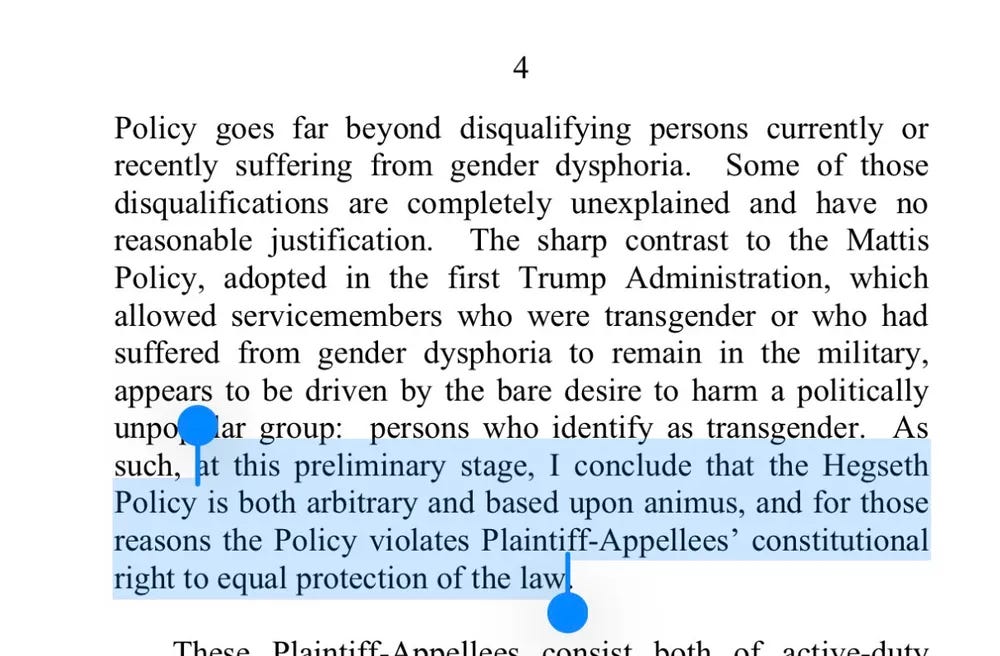
The DC Circuit enjoined Pete Hegseth from enforcing his anti-trans policy Monday. It was designed to keep transgender people from serving in the military. Hegseth vilified them as “categorically unfit for military service explicitly because of their gender identity.” The court concluded that “Unless we are going to fall for the old Groucho Marx line—’who are you going to believe, me or your lying eyes?’—we have direct evidence in this case that animus motivated the classifications in the Hegseth Policy.” Happy Pride, y’all.
 |
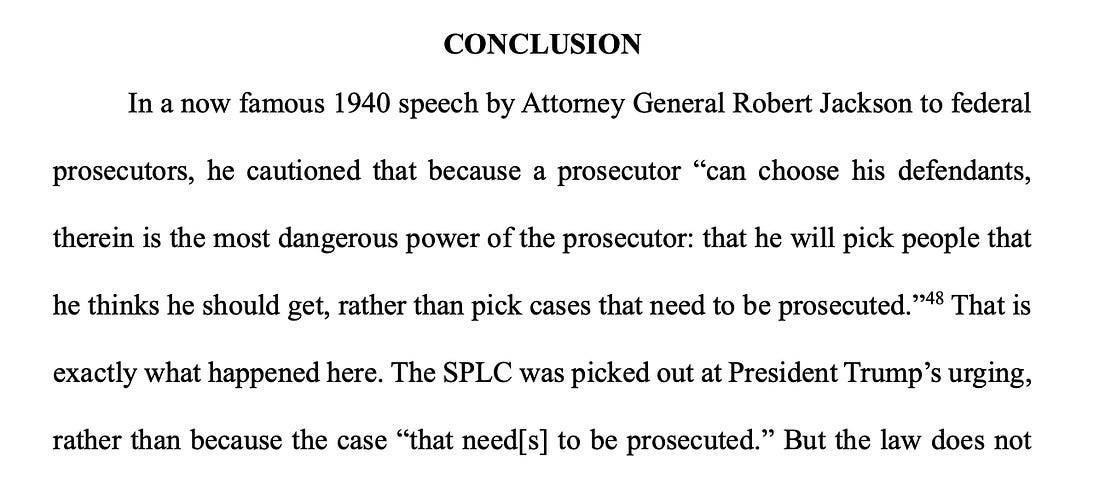
The Southern Poverty Law Center filed its motion to dismiss DOJ’s indictment due to vindictive prosecution last week. The motion starts with a post Trump made on Truth Social: “The Southern Poverty Law Center, one of the greatest political scams in American History, has been charged with FRAUD.” They argue that it is “the latest manifestation of a top-down, retributive campaign in which he directed his Justice Department to go after those individuals and groups he deemed his political enemies, including the SPLC.” Trump has also claimed the SPLC was “a part of the rigging of the [2020] election,” which is a sort of crazy claim to make against a group based in Alabama, where he won handily. The motion to dismiss is still pending.
 |
A few days later, Magistrate Judge Kelly Fitzgerald Pate responded to a previously filed SPLC motion to “Address the Government’s Materially False Statements and to Enforce Rules Prohibiting Further Prejudicial Extrajudicial Statements,” which we discussed here. The SPLC says it has been sharing information about white supremacist groups with federal law enforcement and statements made by the government to the contrary were intentional falsehoods.
Judge Pate denied SPLC’s motion. But her written order comes off as a win for them. She wrote that DOJ had already corrected its errors, with acting Attorney General Todd Blanche publicly conceding the error, so that there was no longer a need for the court to enter an order in SPLC’s favor.
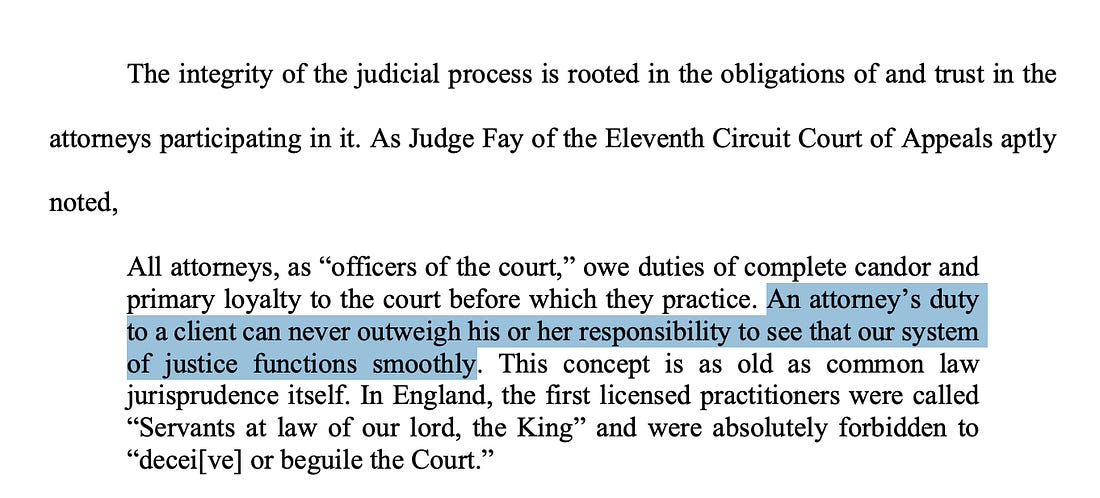 |
The Judge went on to admonish prosecutors against any repetition, noting that beyond the “foundational obligations” they must comply with as officers of the court, “there are other expectations placed upon prosecutors.” She quoted a Supreme Court decision that echoes what the SPLC referenced at the start of its vindictive prosecution motion:
“The United States Attorney is the representative not of an ordinary party to a controversy, but of a sovereignty whose obligation to govern impartially is as compelling as its obligation to govern at all; and whose interest, therefore, in a criminal prosecution is not that it shall win a case, but that justice shall be done. As such, he is in a peculiar and very definite sense the servant of the law, the twofold aim of which is that guilt shall not escape or innocence suffer. He may prosecute with earnestness and vigor—indeed, he should do so. But, while he may strike hard blows, he is not at liberty to strike foul ones.”
That doesn’t sound like a win for the government. She went on to cite an Eleventh Circuit case to remind the prosecutors of their duty: “[w]e must return to the original principle that, as officers of the court, attorneys are servants of the law rather than servants of the highest bidder. We must rediscover the old values of our profession. The integrity of our justice system depends on it.” She concluded, “Like any officer of the court, the prosecutors are bound by their statements to this Court. On this record, the Court finds no further relief is warranted at this time.”
Although the government technically wins the motion, the Judge made it clear that any repetition of the prior conduct would be out of bounds.
Axios reported this afternoon that Trump was going to abandon the slush fund he’d awarded to himself in “settlement” of his lawsuit against the IRS. But it’s unclear whether he is pressing pause in hopes the public spotlight will fade, or whether he really means it. Republican Senators seemed to turn on Trump over the fund, although their momentary courage has had a way of quickly fading in the past. Trump seemed to be taking it seriously enough to try and walk away from the mess before he could take any more hits.
But even if Trump abandons his plans, Judge Kathleen Williams, who handled Trump v. IRS, the case the settlement took place in, may have more to say. As we discussed Sunday night, she is now considering whether to set aside the dismissal, as a group of 35 retired federal judges asked her to do, because the case was never a legitimate adversarial process, but rather, a fraud on the court. It’s unclear how she will proceed, but she could open an inquiry, under a federal rule that allows judges to sanction parties who bring frivolous cases or motions, into whether the lawsuit was a sham, designed to get a court to legitimize Trump’s slush fund. There is also the addendum, signed by acting Attorney General Todd Blanche, that forgives any outstanding taxes audits may have determined Trump and members of his family owed. This one has been a big loss for Trump so far, in both the law courts and the court of public opinion.
“All the winning” isn’t going so well for Trump this week. The courts continue to hold the line.
Pieces like this one take time — tracking cases across multiple courts, connecting the legal dots, and translating what actually matters into plain English. If t