We’re at the Pizza Hut. We’re at the Taco Bell. We’re wondering what will happen to the combination Pizza Hut and Taco Bell if this happens: private equity firm LongRange Capital may pick up the pizza purveyor from parent Yum! Brands. For years, the cheesy chain has been the laggard of its fast-food franchises, with Taco Bell leapfrogging ahead to become the company’s second-best brand.
Stocks continued to power higher on Monday, with the S&P 500 and Nasdaq 100 setting new record closing highs, though the Russell 2000 dipped. The S&P 500 has risen for its eighth straight session, its longest winning streak in over a year. |
|
|
|
-
“There is no question this reinvention of the computer is as big of a deal as the reinvention of the phone into what we now know as the smartphone,” Nvidia CEO Jensen Huang said at the Computex trade show in Taipei.
-
Nvidia said the company is reimagining the PC “for the first time in 40 years” and the new platform is built for “agentic AI,” allowing AI models and assistants to run locally on laptops rather than relying entirely on cloud computing.
-
Microsoft simultaneously unveiled its Surface Laptop Ultra powered by RTX Spark, while Dell, HP, and Lenovo are expected to launch systems based on the chip later this year.
- RTX Spark combines an Arm-based CPU, Nvidia’s Blackwell graphics architecture, and dedicated AI hardware into a single chip designed for AI-heavy workloads.
|
|
|
|
Trade the market, not just the tickers |
More and more traders are using index options. Why? |
- Benchmark-level exposure: Nasdaq-100 Index® Options allow for more macro expressions than single-stock securities, giving traders the potential to participate in upside or mitigate downside portfolio risk.
-
Enhanced leverage: With index options, traders can control larger positions than they access with single stocks. Available in two contract sizes, NDX® and XND®, Nasdaq-100 Index Options can be suitable for all portfolio types.
-
Potential Tax Benefits: In many cases, there are meaningful tax benefits associated with index options compared to similar stock or ETF options. Consult a tax advisor before investing.
|
Nasdaq-100 Index Options are cash-settled at expiration, rather than in shares — and as European-styled options, they carry no risk of early assignment.
Discover the NDX advantage. |
|
|
|
Fresh after rejuvenating investors with alternate revenue streams, Meta is throwing them a curve. It believes the path to those software riches requires pushing even deeper into money-losing hardware.
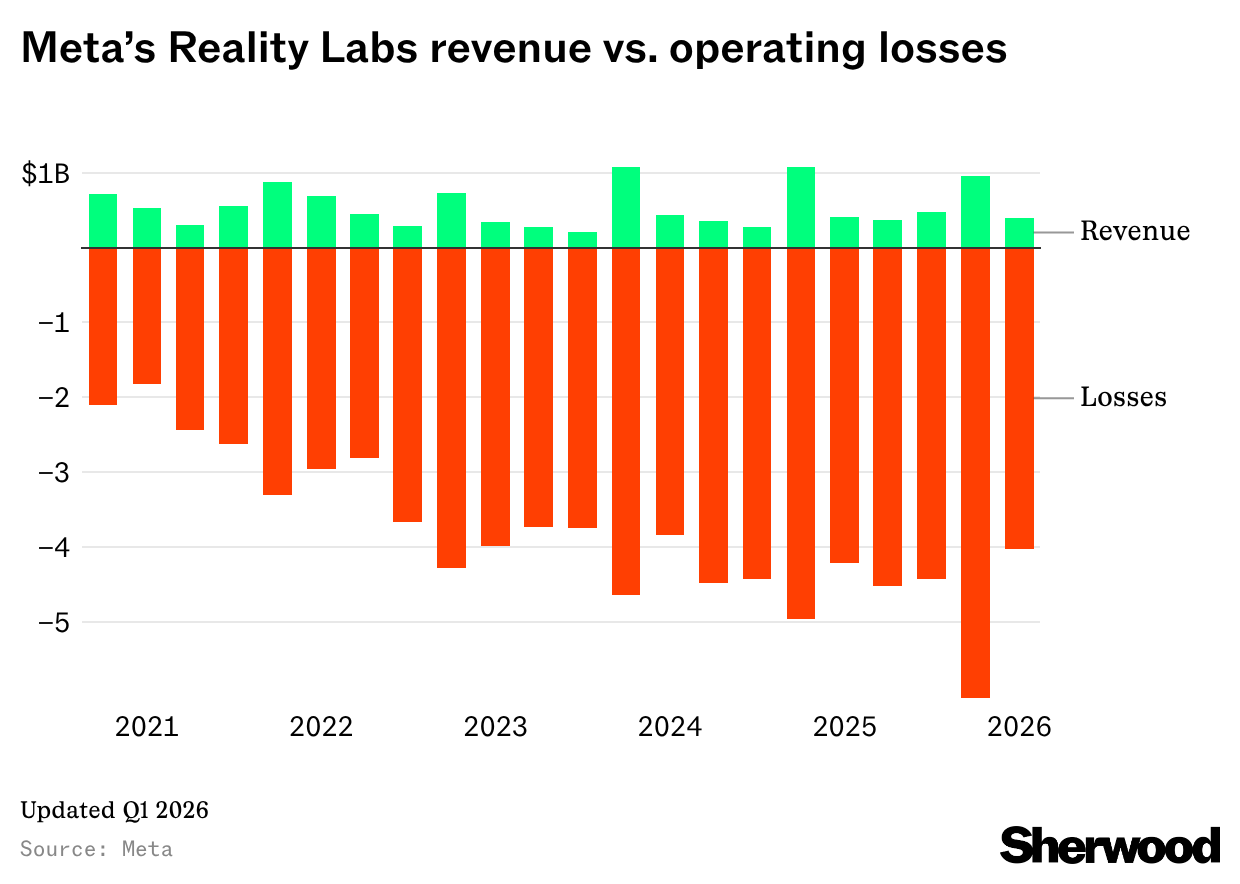
While Mark Zuckerberg’s Reality Labs division continues to rack up losses at a spectacular rate — to the tune of $4 billion last quarter alone and $83 billion since the fourth quarter of 2020 — a newly leaked internal memo reported by The Information reveals Meta thinks it can use physical gadgets as the ultimate Trojan horse for AI software subscriptions.
|
- Meta is reportedly prepping an ambitious new lineup of wearable devices, including expanding its smart glasses lineup, testing an AI-powered pendant, and targeting 10 million device sales in the second half of 2026.
-
But the real strategy shift isn’t about selling gadgets; it’s about monetizing the software inside them. Meta’s VP of wearables, Alex Himel, noted that to “build a sustainable business beyond hardware margins,” the company needs to push users toward paid subscriptions for its Meta AI chatbot and other apps.
-
Like much of the tech world, Meta is hoping to develop a cozier relationship with its users by also selling the devices on which they access its software. The thinking is that Meta will sell the hardware as the gateway, and charge monthly for the AI brains.
-
Wall Street, however, is deeply skeptical for a very simple reason: the math is brutal. Reality Labs lost over $19 billion last year, and Zuckerberg earlier this year said he expects 2026’s losses to be similar.
|
|
|
|
If we assume a utopian, best-case scenario where literally every single one of those 6.8 million users ponies up for an $8-a-month Meta AI subscription ($96 a year), it would generate roughly $653 million in annual revenue. That covers 3.4% of Reality Labs’ annual operating loss.
To actually break even on an $8 monthly sub, Meta would need around 200 million paying subscribers. For context, Spotify has 293 million paying subscribers globally — and it took the streamer over a decade to get there without asking anyone to wear a camera around their neck or on their face.
|
|
|
| |