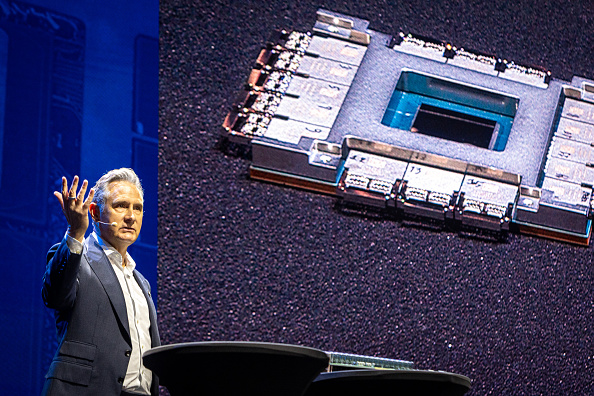
Marvell Chairman and CEO Matt Murphy (Cheng Chia Huang/Getty Images) |
|
|
|
It looks like Christmas came early! If by Christmas, we mean Amazon Prime Day, which used to have a sort of Christmas in July feel but will now happen in late June. The “day” that lasts four days is moving due to scheduling clashes, but interestingly will also move the revenue into Amazon’s second quarter.
The S&P 500 closed at a record high on Tuesday for the sixth straight trading session and gained for the ninth straight session, while the Nasdaq 100 posted its fourth closing high in a row. The Russell 2000 also gained, closing just shy of records. |
|
|
|
-
Huang made the comments at the Computex expo in Taipei on Tuesday. It’s not the first vote of confidence for Marvell from the world’s most valuable company: Nvidia announced a strategic partnership with Marvell in March, saying that it has invested $2 billion in the company.
-
Marvell’s market capitalization as of Monday’s close was around $192 billion, meaning that Huang’s prediction hinged on a more than 420% rally. It made good headway on that on Tuesday, finishing with a roughly $254 billion market cap.
- Huang said computing is becoming increasingly disaggregated and distributed, creating a need for advanced connectivity, which is what Marvell specializes in.
-
“That’s the reason why Marvell is so essential,” he said, standing onstage next to Marvell CEO Matt Murphy. “That’s why you’re going to be the next trillion-dollar company.”
|
The stock is up more than 244% since the start of the year. |
|
|
|
Access the stability of America’s corporate giants in just one trade |
In uncertain markets, many investors don’t chase what’s new. They stick to what’s proven. Like DIA, the only ETF to track all 30 of the Dow’s blue-chip companies.
And since the Dow is the oldest and most widely quoted indicator of the US stock market, DIA offers stability and leadership investors have trusted through every kind of market—so you can stay focused on your long-term goals. Find out how DIA can help you achieve yours.
Getting there starts here. |
|
|
|
Not so long back, Uber was the go-to example of a capital-hungry business, raising about $8 billion and change when it went public in 2019. By comparison, Alphabet, already flush with cash, is raising 10x that amount in an equity round announced Monday evening.
|
- While Alphabet stock is down, as investors anticipate some dilution, many of those with starring roles in the AI trade ripped Tuesday on the news.
-
Suppliers with close ties to Alphabet, most notably Broadcom, were particularly bid up, with the chip giant up nearly 5% on Tuesday, as investors presumably see upside to the pair’s long-term deal that runs through 2031 and sees Broadcom supply chips to Alphabet.
-
To raise this funding, Alphabet has had to exercise a corporate muscle that it hasn’t used in a long time — the last time the company raised substantial primary equity was back in 2005.
-
Eschewing the debt markets is an interesting decision. Alphabet has already tapped the credit markets a bunch of times in the last year, and the company’s long-term debt has spiked to a little over $90 billion.
|
But before you envisage Alphabet drowning in borrowings, that’s not even enough to put the company into a net debt position overall, owing to its enormous cash balance.
So we have a company in a net cash position deciding to dilute shareholders rather than raise debt. Why is that? |
| |
|
A couple possible reasons come to mind. Perhaps Google execs think the stock has run a little far and want to cash in on that high share price. Or maybe behind the curtain, preliminary conversations about raising more debt suggested that the interest rates for something this big might have been suboptimal from a pure corporate finance cost-of-capital perspective, or potentially spooky for investors (see: Oracle), or damaging to its credit rating.
Still, Occam’s razor might just suggest that Google execs want to suck up some of the equity funding available. There are a few major IPOs coming down the pike in the AI space, most notably OpenAI and Anthropic, and hoovering up some of the equity funding in the room just before those go live feels like a pretty solid strategy.
|
|
|
|
June isn’t busting out, but going bust for bitcoin, it seems. The largest cryptocurrency by market cap nearly dropped below $67,000 on Tuesday, a level it hasn’t seen since the first days of April. Is everyone freaking out because the biggest corporate bitcoin bull, Strategy, sold off a small slice of its stash, or is that “immaterial”?
|
|
|
|
|