Smoke billows from southern Lebanon, following Israeli strikes, as seen from Nabatieh, Lebanon, June 4, 2026. REUTERS/Stringer |
-
Israel and Lebanon agreed to implement a ceasefire to end hostilities, the Trump administration said, in a boost to hopes for a broader deal to end the US-Israeli war on Iran.
-
The Republican-led US House of Representatives approved a resolution to block President Donald Trump from continuing the war against Iran, reflecting growing concern among members of his party about the three-month-old conflict.
-
Two of Trump's cabinet members distanced themselves from his pick of loyalist Bill Pulte to serve as acting US spy chief, as Republican lawmakers criticized his lack of national security experience.
- Trump was riding a near-perfect record of endorsements, with wins in Indiana, Louisiana and Texas. But that ended with the defeat of US Representative Randy Feenstra in the Republican primary for Iowa governor. Here are five takeaways from Tuesday's primary elections.
-
New World screwworm, a parasitic fly that eats warm-blooded animals alive, has been found in a calf in Texas, the US Department of Agriculture said, exposing the nation's cattle herd to a serious new threat.
-
President Vladimir Putin faced two rival outlines of Russia's future as he hosted his premier annual investment conference with the war in Ukraine unabated.
-
Taiwan will sharply increase its arsenal of powerful anti-ship missiles to more than 1,800 by early 2029, as it seeks to enhance its capacity to counter a mounting threat of blockade or invasion by China, according to a Reuters calculation.
-
A Nepali Sherpa guide has been rescued from Everest after surviving about a week on the slopes of the world's highest mountain without food or oxygen in a rare case of survival in such conditions.
-
South Africa has seen a wave of anti-immigrant protests, which have sometimes turned violent, in recent weeks. Some African migrants have had to flee into the mountains, while others are sheltering in local town halls.
|
|
|
|
The SpaceX Starship and Super Heavy Booster creates sound waves as it lifts off from the launch complex in Starbase, Texas. May 22, 2026. REUTERS/Steve Nesius/File Photo |
-
SpaceX is gearing up for a history-making IPO, setting up a fixed share price of $135 and gunning for a $1.75 trillion valuation - a number that's leaving some investors struggling to make the math work. But as Echo Wang explains on the Reuters World News podcast, there's something called the 'Musk premium' and other investors won't put a price on it.
- India's red-hot initial public offering market may look irresistible as foreign firms line up for listings, but the rush is not about raising funds to expand in a fast-growing market; it's about sending billions of dollars back to headquarters.
-
As the European Union unveiled its technology sovereignty package, a top official posted in glee: "Today is Tech Liberation Day". True technological independence from US Big Tech, however, will take longer to attain.
- In the US, supporters of a long-stalled push to expand nationwide sales of higher-ethanol E15 gasoline are pursuing an uphill strategy to get the measure through a divided Senate, the last big hurdle before the policy lands on the president's desk for signing.
-
Bumper returns promised by the $3.5 trillion-bank lending industry are giving way to rising defaults and falling income. In this week’s Viewsroom podcast, Breakingviews columnists discuss how old-guard financiers juiced the trade with extra leverage, and the fresh dangers it poses.
|
|
|
|
Park Gyeong-je, a migratory beekeeper, checks the weather in Gimcheon, South Korea, May 5, 2026. REUTERS/Kim Hong-Ji |
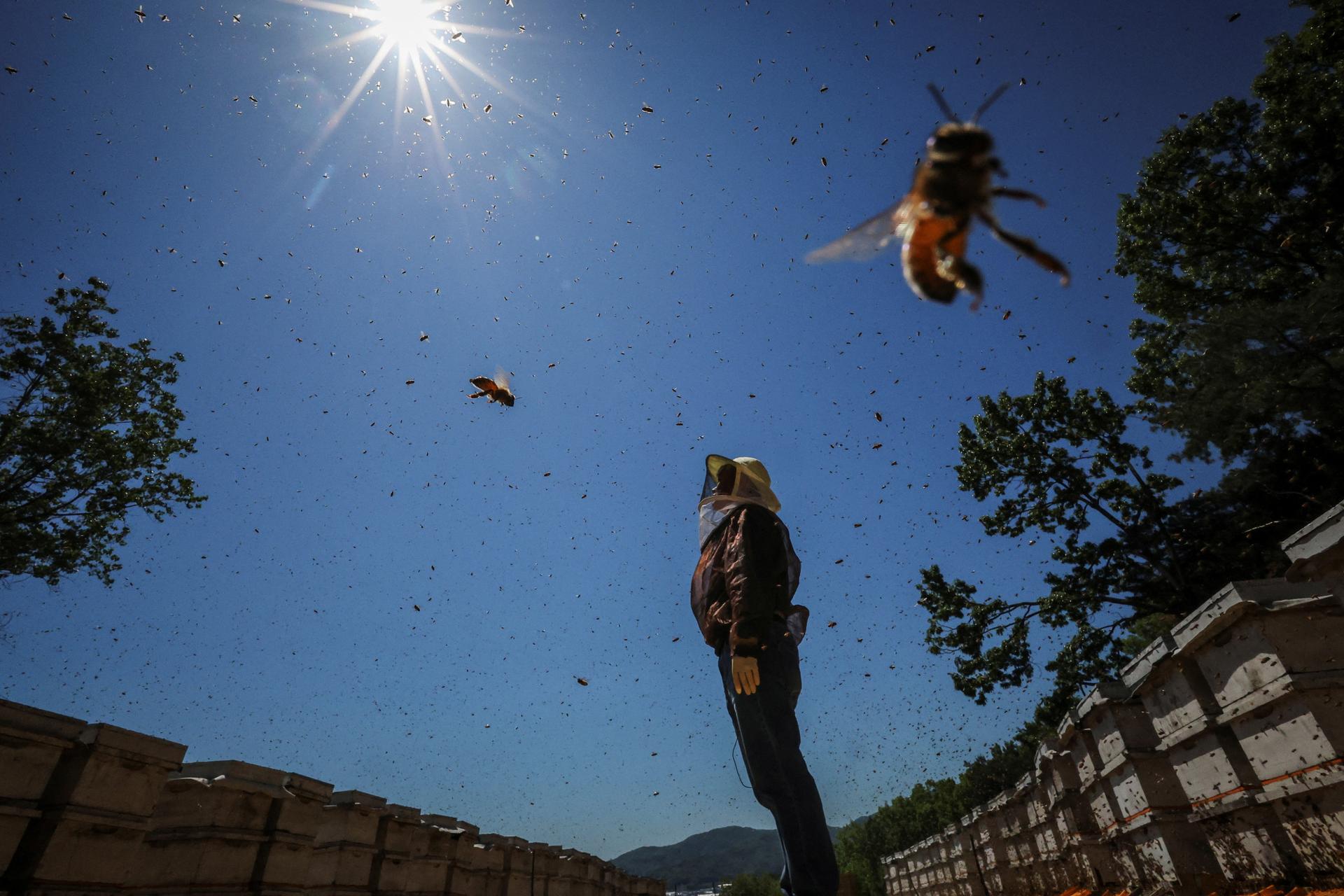
Park Gyeong-je started tending beehives almost five decades ago, making it his livelihood because he liked spending time in nature. These days, however, the changing climate is making him question how much longer he and his fellow farmers can survive.
The 65-year-old runs a beekeeping farm in South Korea’s southern Sancheong county, but he is a migratory beekeeper, meaning he criss-crosses the country with his hives to chase seasonal flower blooms. However, rising temperatures due to climate change are shortening seasons, causing flowers to bloom earlier and for shorter periods. The weather changes have also brought strong winds, which can make it harder for bees to find their way back to their hives.
|
|
|
|
The remains of a frozen female cave lion cub named Sparta. Yakutsk, Russia, in this photograph from 2018, obtained on June 3, 2026. Love Dalen/Handout via REUTERS. |
The cave lion was one of the biggest cats to ever live, prowling a huge swathe of territory from Western Europe across Siberia and into North America and hunting large prey - and perhaps even people - before going extinct around the end of the Ice Age. New genome research reveals what made this big cat unique and how it differed from the modern lion, its smaller cousin. |
|
|
|
|