| | US oil reserves drop to a 20-year low, DeepSeek closes in on a $7.4 billion funding round, and mathe͏ ͏ ͏ ͏ ͏ ͏ |
| |  | Flagship |  |
| |
|
The World Today |  - US oil reserves fall
- Chip stocks slide after rally
- Private credit jitters rise
- DeepSeek’s first fundraise
- AI boom’s power challenges
- Hezbollah rejects ceasefire
- Undersea cable sabotage
- Prediction markets’ future
- Alarm over AI in math
- World’s largest scorpion
 Some “humorous asides” in a dictator’s biography. |
|
Countries adapt to Iran energy shock |
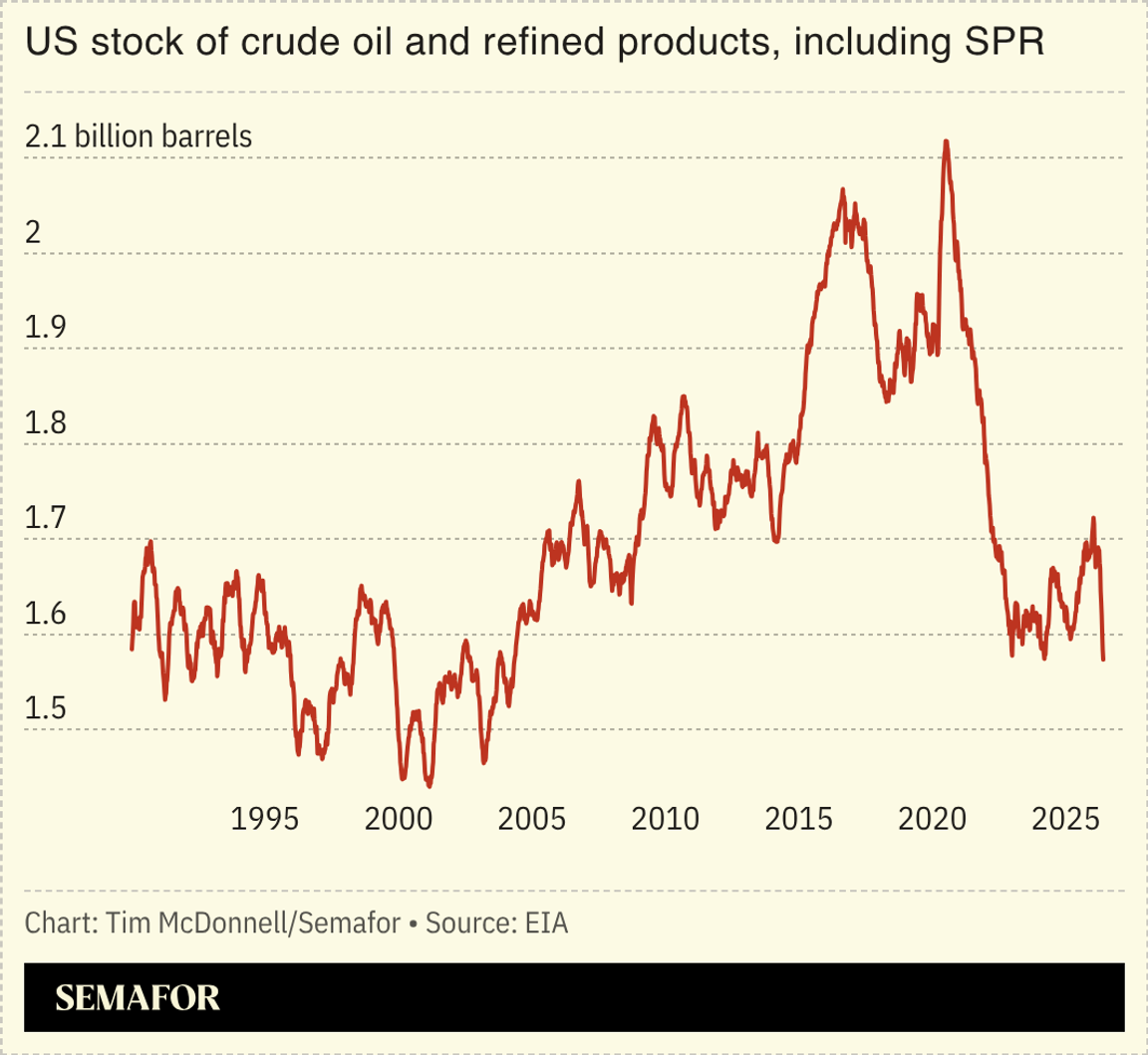 US oil reserves are at their lowest level since 2004 as the energy impacts of the Iran war pile up, but countries are finding ways to adapt. The energy shock from the largest supply disruption in history feels “remarkably mild,” Semafor’s climate and energy editor argued. A decline in China’s oil imports has “shielded the rest of the oil market,” one strategist noted, while a new study showed impacts to the US are less pronounced than the 1970s energy crisis, owing to a rise in domestic oil production. “The world is learning to live without the Gulf’s seaborne exports,” a former US Treasury official wrote: The conflict has forced Asia and Europe to accelerate their transition to renewable energy. |
|
Chip stocks fall after extended rally |
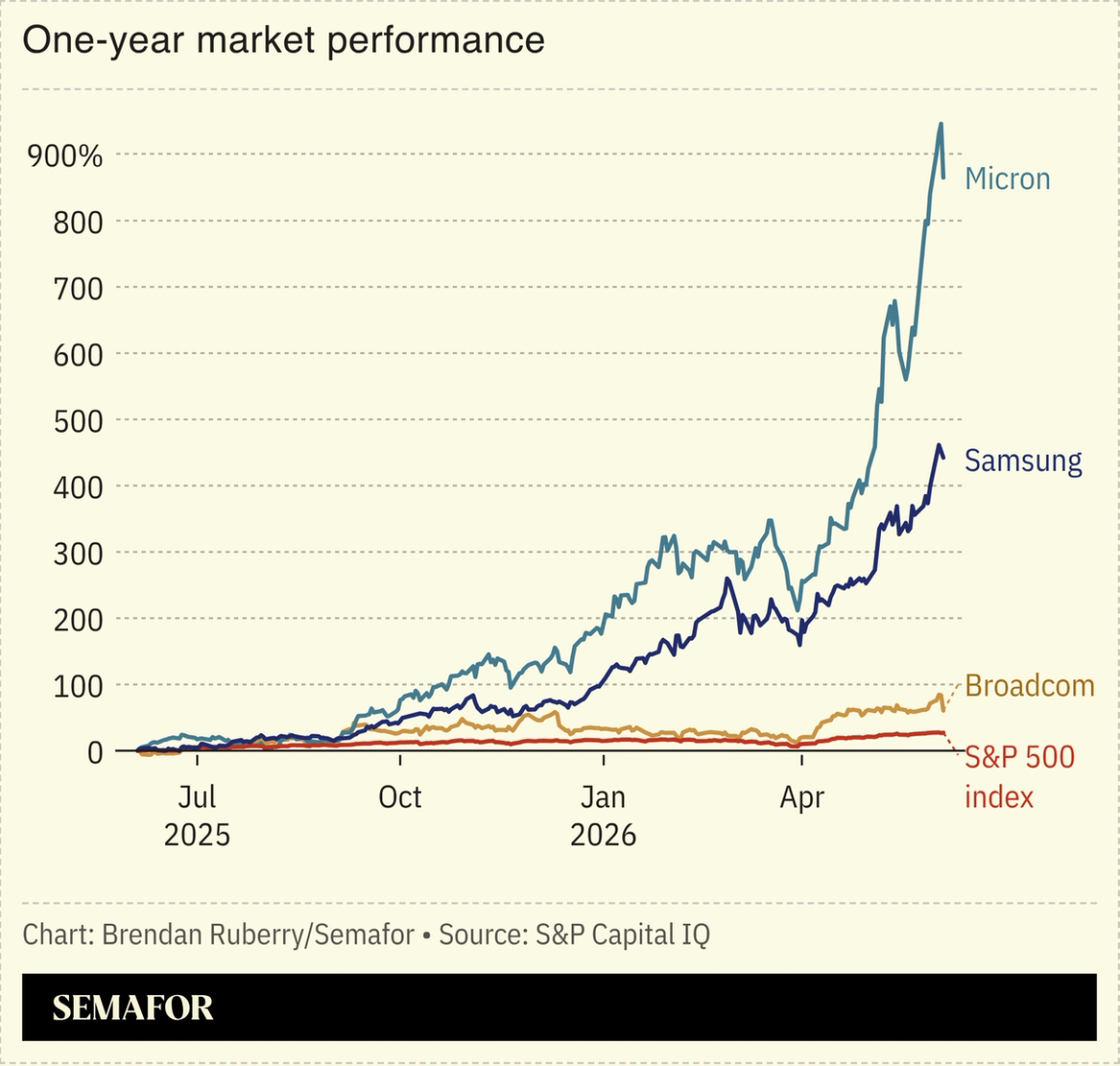 US chip stocks tumbled on Thursday as fresh doubts surfaced over the sustainability of the AI spending boom. The selloff, which hit firms like Broadcom and Micron Technology, comes after a historic rally for semiconductor stocks. “We’re due for a rest,” one strategist said, adding that markets are often “two steps forward, one step back. We’ve had three steps forward, so maybe at least a mini step back, or at least some sideways chop.” Shares of other companies powering the AI ecosystem, though, rose this week after Nvidia CEO Jensen Huang complimented them on stage — it’s a new spin on the “Trump bump,” which has boosted shares across companies favored by the US president. |
|
Private credit anxiety deepens |
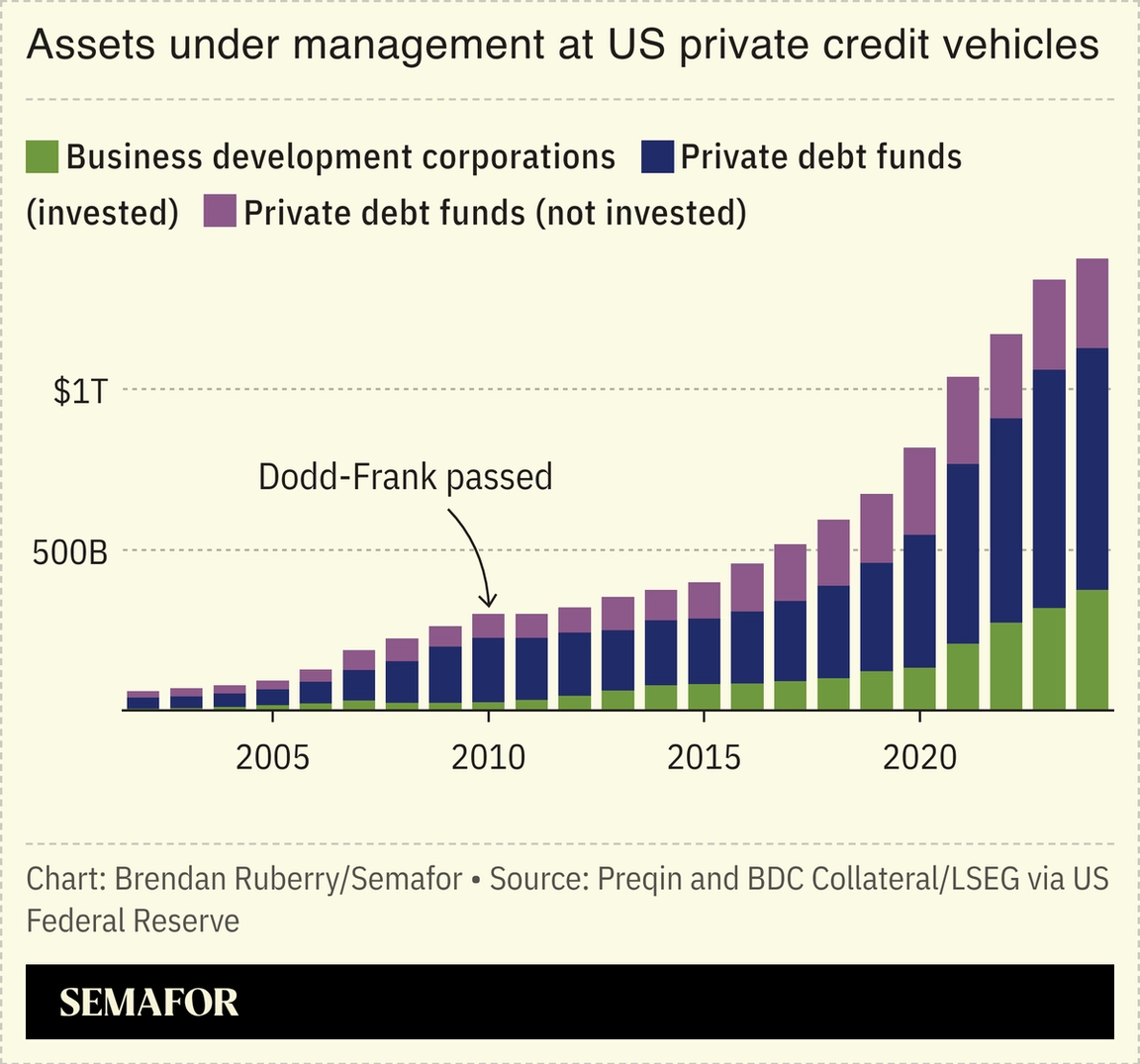 Jitters engulfing the private credit industry may be deepening. Investors in Blackstone’s flagship fund looked to pull 10% of their money this quarter; at Cliffwater’s main lending fund, the figure was 17%. Private credit funds have lent heavily to the software industry — under threat from AI — and many investors also sought to cash out funds earlier in the year. Still, some financiers don’t see a systemic crisis brewing. “This economy is much stronger than the narrative suggests,” Goldman Sachs’ president told Semafor in April. But warnings of a “long-delayed reckoning” for direct lenders are simmering, Bloomberg reported. “I’m not saying they’re going to be wiped out,” one investor said, but “something’s got to give.” |
|
DeepSeek nears $7B haul in first raise |
 Florence Lo/Reuters Florence Lo/ReutersChinese AI phenom DeepSeek is closing in on a $7.4 billion funding round, at around a $52 billion valuation, in one of the country’s largest startup raises. Tech giant Tencent and battery pioneer CATL are reportedly among the investors in the maiden fundraise, along with a state-backed AI investment fund. DeepSeek and other Chinese startups are increasingly looking to take on Silicon Valley, using cheaper costs as their main selling point. A corporate spending tracker showed more US firms are making direct payments to DeepSeek. The startup recently made a 75% discount on its flagship AI model permanent, “a disruptive assault on the capital-heavy business models of Silicon Valley’s frontier labs,” a veteran US tech journalist wrote. |
|
Data center energy challenges mount |
 Shelby Tauber/Reuters Shelby Tauber/ReutersBallooning electricity demand from AI data centers in the US is pushing companies and regulators to consider unorthodox — and aggressive — solutions. Federal officials have suggested breaking up the country’s largest electric grid operator over rising power bills and its failure to keep pace with demand; one regulator said she has “great appetite for aggression” when such challenges endanger the US’ lead in the AI race. In Big Tech’s latest move to power data centers, Google this week struck a first-of-its-kind deal with a “virtual power plant” startup, in which Google will finance a program for parts of the country’s grid that will pay households and businesses to curb their consumption at certain times, freeing up 100 megawatts of power. |
|
Hezbollah rejects Israel ceasefire |
 Stringer/Reuters Stringer/ReutersHezbollah rejected a ceasefire in Lebanon on Thursday shortly after it was announced, denting hopes for peace in the region. Israel pounded southern Lebanon with strikes just before the truce — which was brokered by the US following Israel-Lebanon talks a day earlier — took effect, leading to a “grimly familiar” reality on the ground, The New York Times wrote. A Beirut-based Carnegie expert called it a “performative ceasefire” with “all the packaging for a great declaration, but no commitment.” The fighting threatens to further imperil the US’ talks with Iran, which has pegged a peace deal to a ceasefire in Lebanon. |
|
Nations race to protect undersea cables |
 Rogan Ward/Reuters Rogan Ward/ReutersAustralia, the UK, and the US agreed new measures to protect undersea cables and pipelines from sabotage, including the deployment of autonomous submarine drones. Marine cables carry more than 95% of the world’s intercontinental telecommunications data and ever more electricity. Australia’s defense minister said these “arteries of modern civilization” are being attacked at “historically unprecedented” rates, and the three nations pledged to improve reconnaissance and anti-submarine warfare. Iran, meanwhile, has suggested charging tolls on the data passing through cables off its shores, the author of a book on the undersea network noted; cables in the Strait of Hormuz carry about 20% of global data flow, giving Tehran another point of leverage over Washington. |
|
 On June 18 in Abu Dhabi, Semafor will convene The Gulf’s Golden Age Interrupted to examine how the region can sustain its economic momentum amid renewed conflict and geopolitical uncertainty. The Gulf has emerged as a global crossroads for energy, capital, technology, and talent, generating growth amidst decades of regional instability. As new tensions reshape markets and test economic resilience, Semafor editors will host on-the-record conversations with leaders in finance and technology at the Abu Dhabi debut of Semafor Gulf Live, exploring how the region can navigate this moment and reinforce its position as a critical global hub for capital, innovation, and energy. |
|
Spanish soccer team bets against itself |
 Albert Gea/Reuters Albert Gea/ReutersA Spanish soccer team on the brink of being relegated — potentially costing it millions of dollars — hedged its risk on Kalshi, Semafor reported, in the latest sign of prediction markets moving beyond their retail roots. Kalshi and Polymarket are “more valuable as platforms to match institutional risk than vibes-based casinos,” Semafor’s Liz Hoffman wrote: A New York bar owner who promised free drinks for a Knicks victory on Wednesday won $8,000 wagering on the basketball game, covering nearly the entire tab. Even so, retail bettors, and primarily sports wagers, still dominate the platforms, the Financial Times noted, which are estimated to handle $1 trillion in total volume by 2030. CNBC reported Thursday that Kalshi was developing Bloomberg-style terminals for its retail users. |
|
Mathematicians zero in on AI risk |
Hundreds of mathematicians signed a declaration calling for the use of AI in math to be restricted. The academics are alarmed by “plausible but unreliable (or even incorrect)” AI-generated papers potentially flooding the literature, but they may also be unnerved by AI models’ recent success in resolving several longstanding math conjectures: They warned that AI will “disproportionately affect students and early-career mathematicians.” The quantum computing scientist Scott Aaronson warned that we may be in “the possibly last days of human relevance” in math — and other fields — and unless there’s some “magic human ingredient” that AIs lack, then mathematicians’ roles will be reduced to “deciding which questions we find interesting and then understanding AI models’ answers to those questions.” |
|
|


