
|
 |
When AI Reads the Docs: What SimpliSafe’s Update Instructions Reveal About AI-Readiness
The instructions make sense to humans because we fill in missing context automatically; unlike AI systems that cannot, so they guess
|

| |||||||||||||||


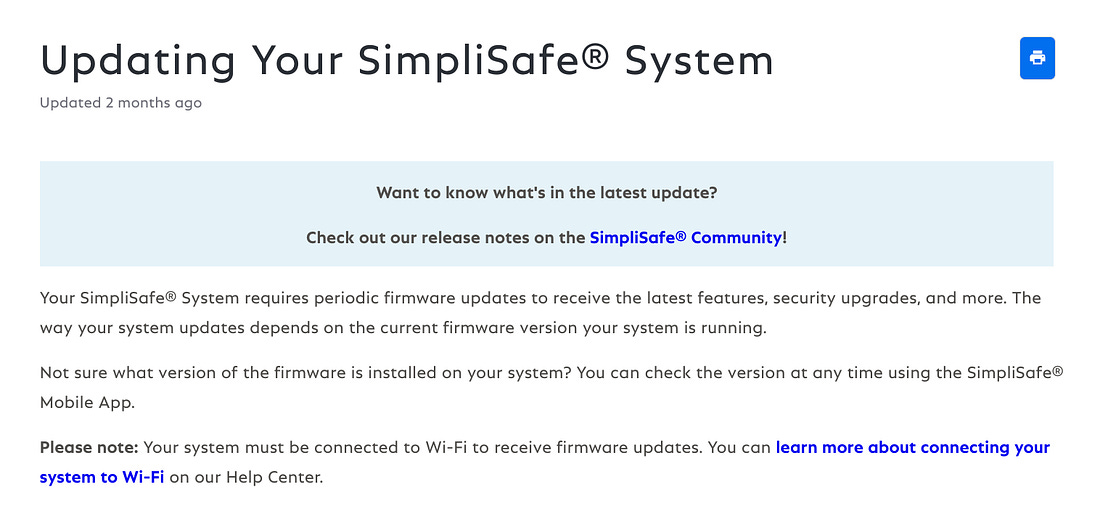
I recently reviewed a support topic published by SimpliSafe that attempts to explain how customers can update their home security system firmware. At first glance, the topic seems perfectly reasonable. The writing is clear and concise. A human reader can probably complete the update process without much trouble.
That’s what makes the example a useful teaching aid for tech writers looking to make the tech docs content easier for AI answer engines to process.
 |
The topic highlights a growing problem in tech docs — content that works adequately for humans can still be highly ambiguous when AIs consume it.
Humans are remarkably good at filling in missing context. We infer relationships automatically, and we assume causality. We understand implied actors and unstated conditions because we’ve spent our entire lives navigating incomplete communication.
AI systems don’t actually “understand” any of those relationships. In lieu of understanding, they infer them probabilistically. That distinction matters.
The SimpliSafe topic contains several examples where operational context is implied instead of modeled explicitly. Those gaps create opportunities for retrieval errors, procedural confusion, and AI hallucinations.
The original topic is here: SimpliSafe: Updating Your SimpliSafe System
I evaluated the topic using TRACE, a framework I’ve been developing to identify contextual signals AI systems need in order to generate reliable answers.
TRACE looks for:
Tasks
Roles
Actors
Conditions
Events
The goal isn’t to make documentation sound robotic. It’s to reduce ambiguity by making operational context explicit enough that AI systems don’t have to guess.
Here’s where the topic begins to break down.
