(Li Zhipeng/Getty Images) |
|
|
|
The BBC is now the world’s most visited news site, a feat it achieved by… collapsing a little less than its competition? As 37 of the world’s 50 most visited news sites saw their reach shrink, the BBC’s 1.9% decline in traffic from last year was enough to move it to the top of the rankings. Check out the full list.
The S&P 500 and Nasdaq 100 fell sharply as chip stocks and AI giants plunged, while the Russell 2000 closed higher. Losses were concentrated in tech and energy, the only two sectors to decline yesterday.
|
|
|
|
- The blueprint would connect data centers across the country into a unified computing network while prioritizing domestic suppliers such as Huawei for much of the underlying technology.
- State-owned telecom giants, including China Mobile and China Telecom, would operate much of the infrastructure, per the report.
- The proposal, still under discussion, would mark one of China’s most aggressive efforts yet to build an AI infrastructure stack largely independent of US technology.
|
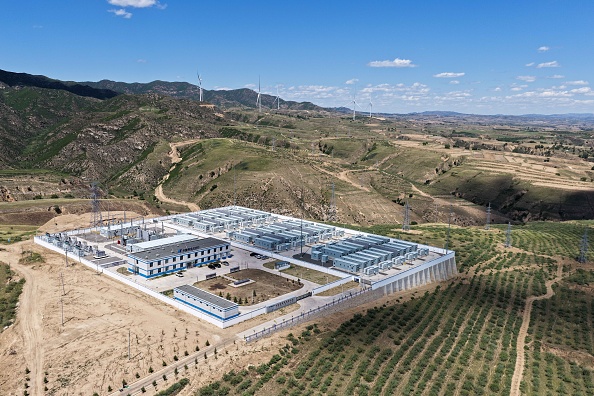
China’s latest push suggests Beijing has increasingly treated computing power as a strategic national resource, similar to electricity or transportation infrastructure. The latest blueprint would push that strategy further by connecting fragmented regional data centers into a national computing network. |
|
|
|
A Chinese planning document from the Ministry of Industry and Information Technology targets 2028 for connecting major computing hubs into a unified national system. Much of that infrastructure is expected to be concentrated in regions such as Inner Mongolia, Ningxia, and Gansu, where abundant land and relatively inexpensive power can support energy-intensive AI workloads. The Chinese documents also highlight the scale of China’s AI ambitions: the country now has more than 6,200 AI companies and an AI industry worth more than $176.9 billion (1.2 trillion yuan), official data shows.
|
|
|
|
- For years, tech companies solved usability problems by simply building more apps. The result is a bloated, siloed grid of colorful squares (or clear ones, if you’re really into Apple’s Liquid Glass feature).
-
Today, the user has become the “human API” — the manual labor required to make these separate, isolated software programs talk to one another.
-
Our phones have more processing power than ever, but little connectivity, since the basic user interface hasn’t fundamentally evolved since the original iPhone dropped in 2007.
-
At its 2026 Worldwide Developers Conference, Apple signaled it finally wants to fix this. By dropping the iOS 27 developer beta on day 1 — rather than in drips and drabs months later like in 2024 — Apple is attempting a massive rescue mission for the overloaded smartphone.
|
However, we don’t actually know yet what’s working inside this initial developer beta. If WWDC 2024 taught us anything, it’s to remain highly skeptical of Apple’s stage demos. Two years ago, the tech giant promised a revolution with Apple Intelligence, only to deliver a sluggish, watered-down rollout of betas that missed its initial launch and lacked flagship features like on-screen awareness. There is a very real chance this early beta is a framework of future promises rather than a functional assistant.
|
|
|
|
A voice assistant isn’t helpful if it can only search Apple Mail or drop pins on Apple Maps. For Siri to actually save us from the app grid, it has to work seamlessly with the software we actually use: Spotify, Google Maps, Uber, Slack, and WhatsApp. Apple, of course, cannot write the code for these third-party platforms. It needs developers to build the bridges — integrating App Intents and APIs so Siri can “see” and “act” inside their apps.
By shipping the iOS 27 beta to developers immediately, Apple is laying the foundation they need to build these integrations before the fall consumer launch. It’s an admission of a hard truth: Apple — with the help of Google, of course — could build the smartest AI models in Cupertino, but if Siri remains trapped in Apple’s proprietary apps, this ambitious new UX fails on arrival. |
|
|
|
Claude Fable 5 will cost twice as much as Claude Opus 4.8, Anthropic’s current flagship model. The company also released Claude Mythos 5, but only for trusted partners for testing. This comes at a crucial moment for the company, as it recently filed for an IPO and closed a funding round valuing it at $965 billion.
|
|
|
|
|