Hello!
I’ve got some exciting news for you in today’s newsletter. I am pleased to announce the launch of the Reuters Climate Monitor.
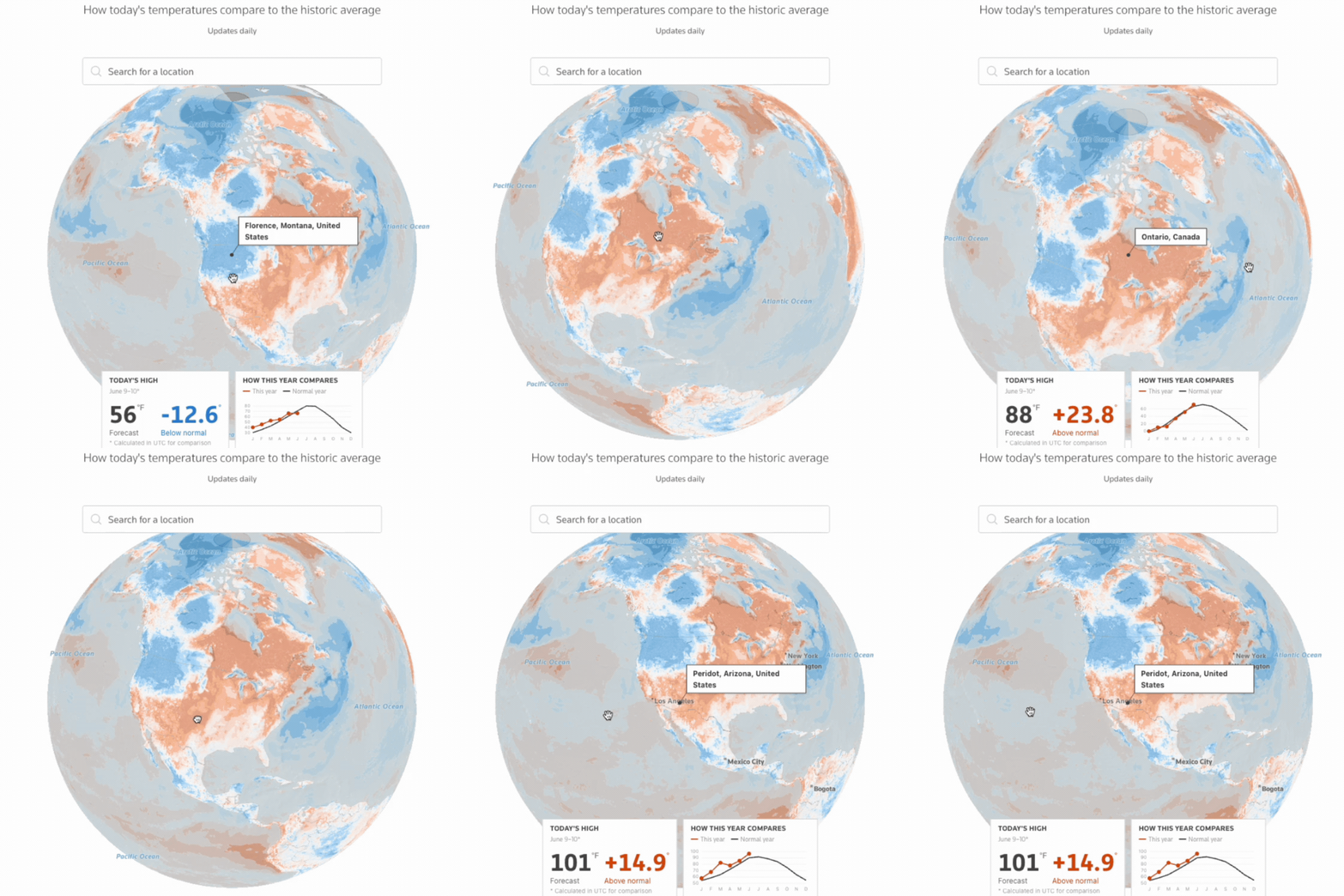
What is it? It’s a simple but powerful tool, created by our News Application Editor Ben Welsh, that brings immediate climate context to daily weather events around the world.
The monitor sets today’s temperatures against a historical baseline from 1961 to 1990, allowing people to see at a glance whether conditions are running hotter or colder than what was once considered normal.
Click here to play around with it, search any country, any day, and see how today’s weather compares with the past through a clear, intuitive interface powered by trusted data from the European Centre for Medium-Range Weather Forecasts.
I’d love to hear your thoughts on the tool. So, send me your feedback, what you learned, what surprised you and any interesting insights you have. I’m all ears! |
|
|
A screengrab showing the Reuters Climate Monitor in action. REUTERS/Rawan Yaghi |
Climate Monitor and the World Cup |
While conditions for individual matches cannot be predicted this far ahead, sports scientists say there are clear weather-related risks facing a summer World Cup spanning Canada, Mexico and the United States. I wanted to play around with the monitoring tool to find out the weather during today’s World Cup kick-off.
The average high worldwide is forecast to be 18.4 degrees Celsius (65.2 degrees Fahrenheit), which is 1.0 C above the normal high for June 11 from 1961 to 1990. The first game is in Mexico City, Mexico, between the host country and South Africa. Today’s temperature in Mexico City is 2.6 C lower than previous years.
However, seasonal forecasts indicate above-normal temperatures across large parts of the United States, while moisture flowing north from the Gulf of Mexico could fuel thunderstorms and severe weather during the opening weeks of the tournament. For example, in Los Angeles, California, the Reuters Climate Monitor shows that today is 3.3 C higher than previous years. |
|
|
|
Now we’ve got a bit of context of the weather before the games, I wanted to turn our attention to how this might affect the players.
Chris Minson, a physiology professor and co-director of the Exercise and Environmental Physiology Labs at the University of Oregon, said elite players generate enormous internal heat even before the weather is considered. "Seventy-five percent of all the energy that we utilize during exercise gets converted to heat," Minson told Reuters. "Only about 25% goes to actually doing the exercise." In hot, sunny or humid conditions, the body's normal cooling system begins to struggle. Humidity is a particular concern, since sweat cools the body only when it evaporates. Climate change has increased the likelihood of temperatures high enough to affect player performance at 97 of the 104 tournament matches, according to new research from Climate Central. Ryan Calsbeek, a biological sciences professor at Dartmouth College who studies how body type affects athletic performance in different climates, said heat and humidity could influence not only player welfare but also the pace and style of matches. "Higher temperature, higher humidity is likely to slow games down," he said. "When athletes have to perform for a very long time, they're just not going to be able to balance the explosive power of their fast-twitch efforts with the more aerobic long-term efforts of a 90-plus-minute game in the heat and humidity."
FIFA has said every match at the World Cup will include a three-minute hydration break in each half, while scheduling decisions have taken into account factors including average temperatures, travel, rest days, medical planning and cooling infrastructure.
Click here for the full Reuters story to learn more about what venues are doing to help fans in the heat. |
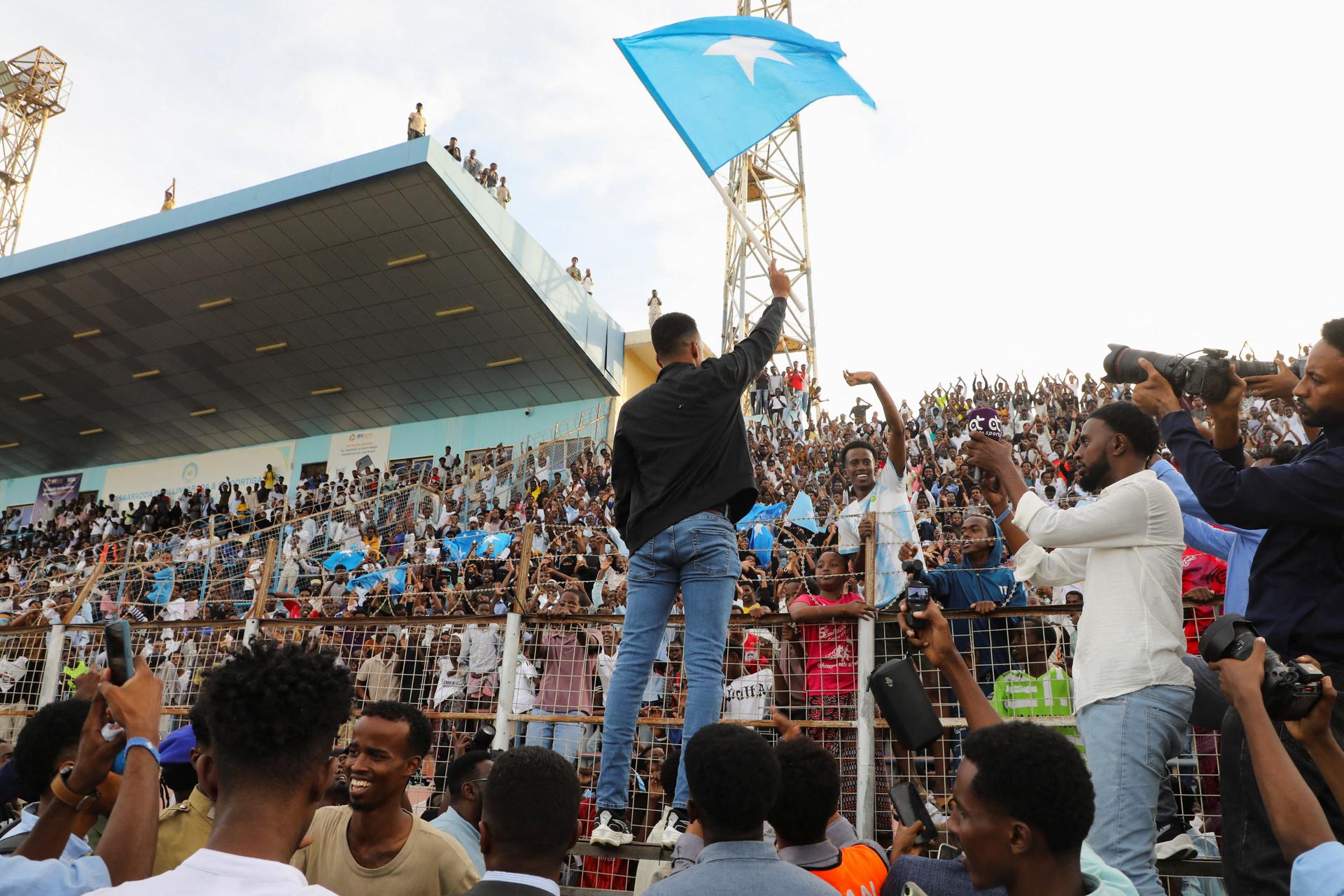
Somali referee Omar Abdulkadir Artan, expected to officiate matches but denied entry to U.S., waves the Somalia flag. Mogadishu stadium, Mogadishu, Somalia. REUTERS/Feisal Omar |
-
Somali referee: Click here to watch the moment when Somali soccer referee Omar Abdulkadir Artan returned home to a hero's welcome on Wednesday after being barred from entering the United States for the World Cup. He described the decision as a matter of "fate" and urged his fellow Somalis not to lose heart over it.
-
Northern Ireland riots: The family of a man who lost an eye in a knife attack appealed for calm after the incident triggered a wave of anti-immigrant violence in Belfast overnight. Masked men burned families out of their homes and torched vehicles. British Prime Minister Keir Starmer and politicians in Northern Ireland condemned the violence that had targeted ethnic minorities.
-
Albania resort protest: Thousands of people took to the streets of Albania's capital Tirana this week over the development of a luxury resort planned by U.S. President Donald Trump's son-in-law Jared Kushner near a protected wetland. On Wednesday, protesters held signs marked with the message "Albania is not for sale" and chanted "New Albania" outside Prime Minister Edi Rama's office.
-
Cuba's seniors: Cuba's government has struggled under punishing U.S. economic sanctions to deliver on Fidel Castro’s promise to provide subsidized food, healthcare, education and other services. Now the country’s seniors face even harsher conditions after the Trump administration’s move in late January to cut off the island’s fuel supply. Click here for the full story.
-
U.S. civil rights rollbacks: The U.S. Transportation Department said it is rescinding part of its civil rights regulations that prohibit conduct that has an unintended "disparate" impact. Curbing so-called disparate impact liability, often cited in employment-related cases, removes a tool the government has used for decades against discrimination in housing, education, lending and other areas.
-
Thomson Reuters resolution: Friend of the newsletter and Reuters U.S. sustainable business correspondent Ross Kerber writes about our own parent company where a shareholder resolution calling on Thomson Reuters to review the human rights implications of its work with U.S. immigration authorities won only about 3% support at the firm's annual meeting on Wednesday. Click here to read the full story.
|
|
|
|
Sadaf Shah, operations director at U.S.-based climate tech firm M2D, shares his thoughts on extreme heat affecting the World Cup: “Hosting matches in extreme summer heat across three countries creates very real risks for players pushing their bodies to the limit, for fans in stadiums with limited shade and, as we've seen, no reusable water bottles.
“These aren't minor logistical oversights. They reflect a deeper failure to plan for the climate conditions we're actually living in. “The social impact is just as significant. Host communities bear the brunt of the carbon footprint of the flights, the infrastructure, and the energy demands of running 16 stadiums simultaneously, while having limited say in how that impact is managed or offset.
“Sustainability can't just be a headline commitment; it has to show up in the decisions that actually affect people. “The tools exist for measuring emissions, identifying reduction opportunities, and building credible offset strategies. What this tournament is missing is the accountability to use them.” |
|
|
|
Sustainable Switch was edited by Andrew Heavens. |
|
|
|
| |
|
|
|
Sustainable Switch is sent three times a week. Think your friend or colleague should know about us? Forward this newsletter to them. They can also sign up here.
Want to stop receiving this email? Unsubscribe here. To manage which newsletters you're signed up for, click | | | |
|
|
|