| | Anthropic staff meet White House officials, UK is banning social media for under-16s, and pufferfish͏ ͏ ͏ ͏ ͏ ͏ |
| |  ATHENS ATHENS | ABU DHABI |  TAIPEI CITY TAIPEI CITY |
 | Flagship |  |
| |
|
The World Today | 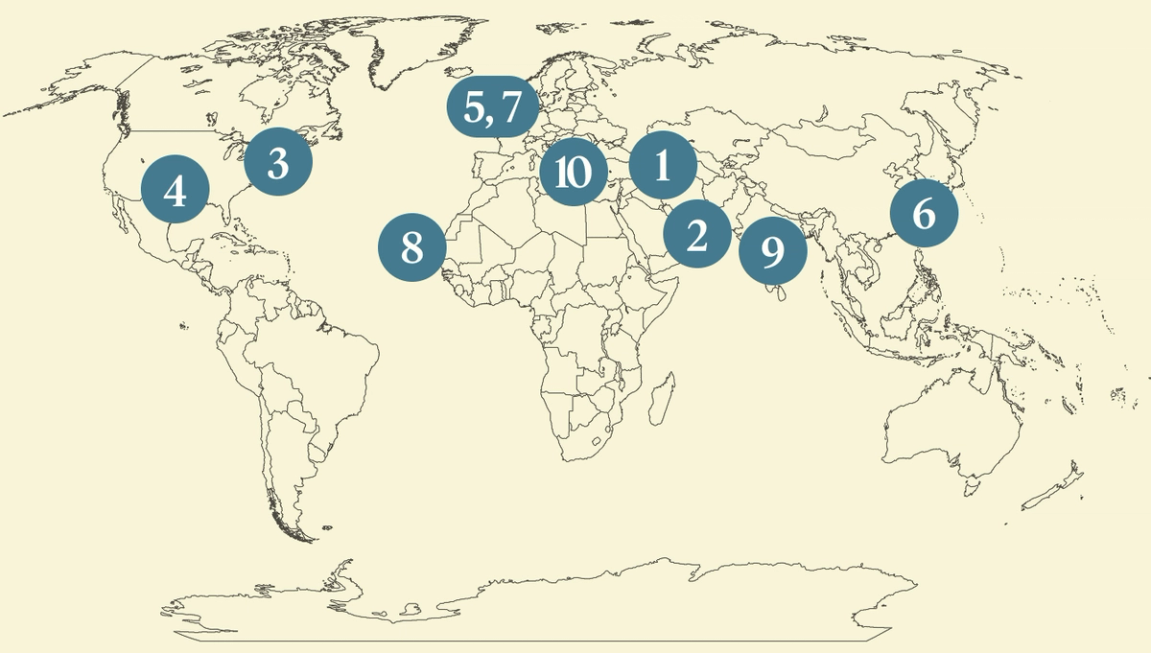 - Oil falls on Iran deal
- Gulf challenges remain
- Anthropic meets WH
- SpaceX extends gains
- Arrests in Starmer attacks
- Taiwan’s drone ambitions
- UK social media ban
- Cape Verde ties with Spain
- Global rice production doubles
- Greece’s pufferfish invasion
 ‘A refreshing new take on fatherhood.’ |
|
US-Iran deal relieves energy markets |
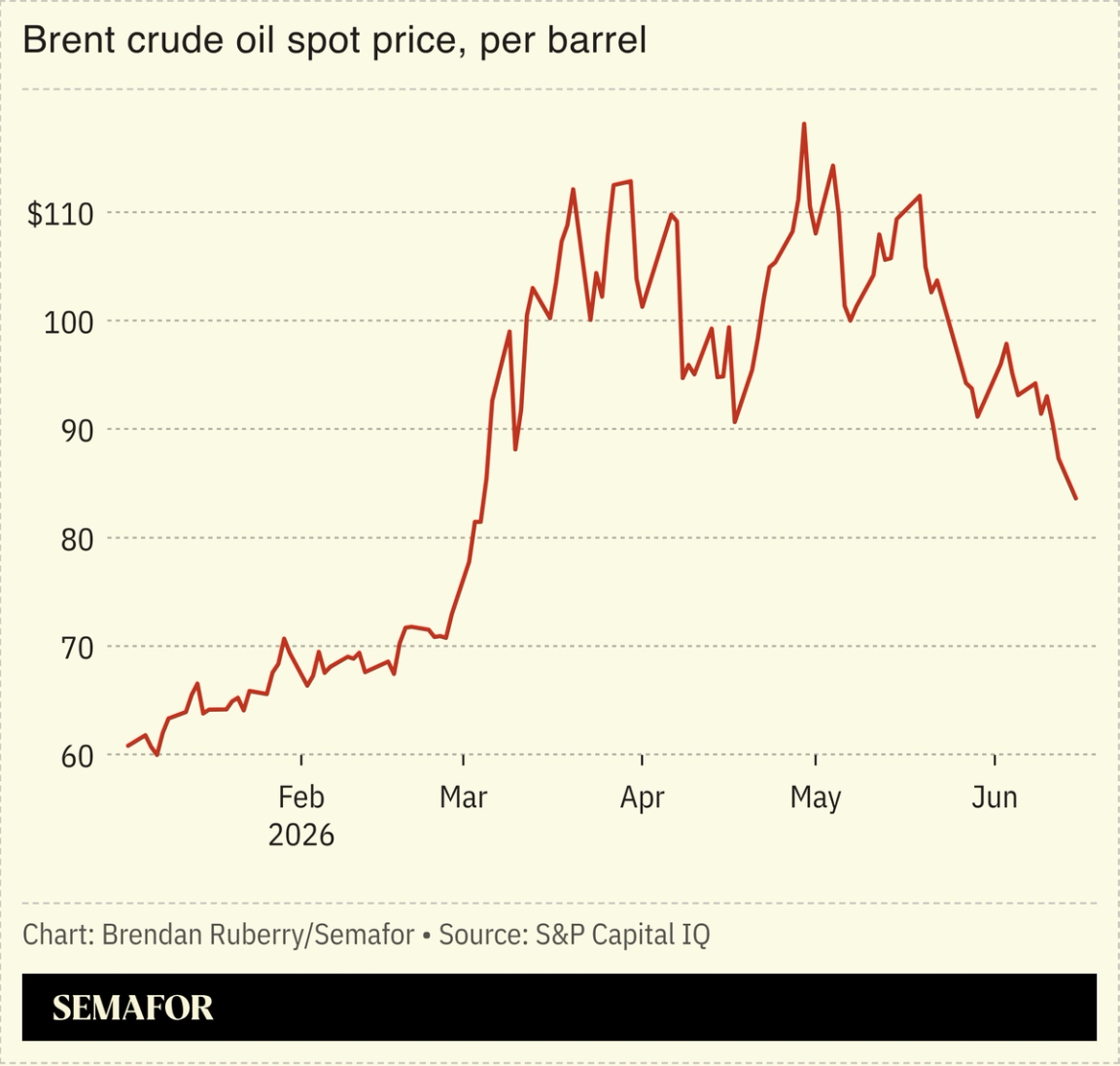 The US-Iran deal to reopen the Strait of Hormuz eased energy markets, bringing oil prices to a three-month low on Monday, but analysts warned that restoring global fuel supplies would take far longer. US President Donald Trump insisted the waterway will reopen toll-free on Friday, but shipping companies, insurers, oil producers, Washington’s European allies, and even members of Trump’s administration remain cautious: Details of the agreement aren’t public, with Washington and Tehran offering conflicting accounts on the toll and timelines. Doubts over the deal’s durability may give pause to shipowners and test the willingness of the Gulf’s energy producers to bring their infrastructure back online. “It’s going to take time for people to feel comfortable,” an energy analyst said. |
|
The Gulf’s postwar challenges |
 Damage from Iranian drone strike, in Bahrain. Stringer/Reuters Damage from Iranian drone strike, in Bahrain. Stringer/ReutersFresh off inking an Iran deal, US President Donald Trump announced that he would move on to ending the war in Ukraine, even as Washington’s Middle Eastern allies prepare for a long strategic retrenchment. Trump on Monday said the ceasefire agreement with Tehran would result in “a lot of great things” in the Middle East. But the region has emerged from more than three months of war with the “balance of power broadly unchanged, Iran politically emboldened, and Gulf confidence in US protection deeply shaken,” Reuters wrote. Gulf states now face a defiant Islamic Republic and the risks of further instability arising from deepening sectarian tensions — “challenge[s] that will persist even if a US-Iranian peace prevails,” Semafor’s Mohammed Sergie wrote. |
|
Anthropic to meet WH officials |
 Bhawika Chhabra/Reuters Bhawika Chhabra/ReutersAnthropic staff were set to meet senior White House officials Monday after the US government restricted access to the firm’s most advanced AI models. The Trump administration blocked foreign nationals’ use of Fable and Mythos, citing security concerns: The models are highly cyber-capable, and Anthropic only released Mythos to select organizations to plug security vulnerabilities. But the move comes against a backdrop of enmity, after the Pentagon branded Anthropic a “supply chain risk” over the latter’s refusal to allow its models to be used in fully autonomous weapons. Ironically, the US government’s restrictions could help cyberattackers; open-source models are increasingly powerful, and since hackers tend to use those, limiting frontier AI access will hurt institutions’ ability to build defenses, an open-source AI platform argued. |
|
SpaceX extends record-breaking debut |
 Joe Skipper/Reuters Joe Skipper/ReutersSpaceX shares rose 6% in early trading Monday, extending an already record-breaking stock market debut, suggesting that investor appetite for marquee tech names is still strong despite concerns of a bubble. The space giant is yet to turn a profit, but its revenues have grown exponentially and its Starlink arm dominates the space broadband market, while it is expanding into AI infrastructure as demand increases. One investor warned this month that equity markets are showing signs of a bubble comparable to 2000 or 1929, but others argue that the upward movement is driven by earnings rather than froth. Lenders, at least, are still buying the boom: Nvidia drew $85 billion in orders for a $25 billion bond issuance. |
|
Russia likely culprit in UK arson attacks |
 Carlos Jasso/Pool via Reuters Carlos Jasso/Pool via ReutersRussia was behind arson attacks on UK Prime Minister Keir Starmer’s properties, the BBC reported. Two men were convicted Monday, and the BBC’s investigation found evidence that a young Russian diplomat had recruited the pair. Moscow regularly recruits young men of various nationalities — the Starmer arsonists were Ukrainian-born — as proxies in its shadowy hybrid warfare campaigns, Reuters reported. More than 1,100 Ukrainians, a fifth of them minors, have been accused of committing arson, terrorism, or sabotage, apparently Russian-backed, since 2022. In Britain, the tactic is partly a response to necessity, because the government expelled 600 Russian operatives, including 400 suspected spies, after the 2018 poisoning of a former Russian double-agent. Moscow also backs cyber-warfare campaigns and sabotage of undersea cables. |
|
Taipei taps US firms in drone push |
 Ben Blanchard/Reuters Ben Blanchard/ReutersTaiwan’s drone ambitions are getting a boost from the private sector despite a massive budgetary setback. A US dronemaker is partnering with a Taiwanese tech firm to build scalable systems for the country’s military, as the rush to augment autonomous defense capabilities intensifies on both sides of the strait. China dominates the global drone supply chain, spurring Taiwan to build a domestic ecosystem, with the island’s exports to Europe surging in the last two years. But the industry suffered a serious blow when legislators culled the entire drone production program from its recent budget. Meanwhile, in a rare overseas exhibition, one of China’s largest defense contractors demonstrated its drone manufacturing process, in a potential play for Middle Eastern buyers, SCMP reported. |
|
UK to ban social media for under-16s |
 Chris J. Ratcliffe/Reuters Chris J. Ratcliffe/ReutersThe UK announced a social-media ban for under-16s, a move that follows other countries but clashes with the government’s other priorities. The ban will include Instagram, TikTok, and other platforms as well as YouTube but not messaging apps like WhatsApp. The move is popular, with polls finding 74% support, although the evidence for both the mental health impacts of social media and the efficacy of bans is disputed. But the British government is also passing legislation allowing 16-year-olds to vote. “You… ultimately have to decide whether 16-year-olds are sovereign adults,” a Financial Times columnist wrote, and either they should have access to the same information environment as other voters or “you need to move away from votes at 16.” |
|
 Siphiwe Sibeko/Reuters Siphiwe Sibeko/ReutersTwo minnows’ results in the men’s soccer World Cup painted contrasting pictures of the newly expanded tournament’s health. The World Cup now involves 48 nations, up from 32, raising worries of more games no one cares about or grim mismatches like Germany’s 7-1 clobbering of tiny Curaçao. But only-slightly-bigger Cape Verde held favorites Spain to a hard-fought draw on Monday, a romantic outcome that FIFA will consider vindication of the expansion. Whether it’s a good decision or not, the expansion is driven by FIFA’s incentives, two soccer analysts argued on The Double Pivot podcast: Soccer’s governing body is a democracy of “[constituent nations’] corrupt sportocrats,” and offering the World Cup’s riches to ever more participants is a vote-buying tool. |
|
Global rice production doubles |
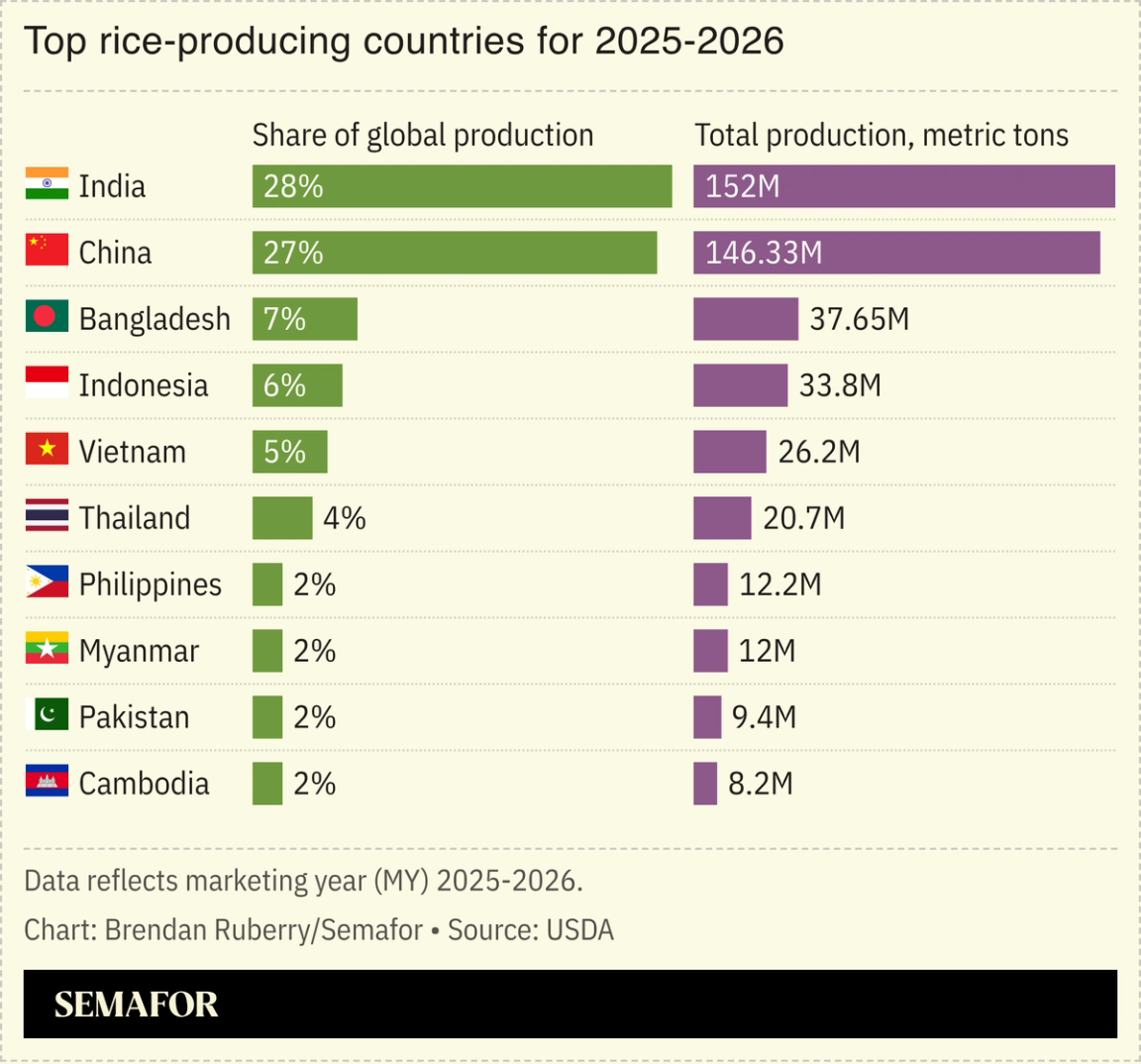 Global rice production has more than doubled in 50 years, despite — and to some extent because of — climate change. Rice is the staple dietary calorie source for half the world’s population. Much of the huge increase, from 296 million tonnes in 1961 to 750 million in 2015, is driven by an expansion of cultivated area, plus heavier fertilizer use. But while warming has reduced yields by 7%, new research estimated, rising CO₂ concentrations have boosted them by 30% by giving plants more growth material. Concerns that humanity would run out of food have so far proved false: While the world population has doubled since 1974, calories per capita have risen 25%. But rice yield growth is slowing, the research found. |
|
|