(Jay Janner/Getty Images) |
|
|
|
Turning a beloved board game into a movie can go well, like “Jumanji,” or badly, like “Battleship,” but so far, the making of the “Monopoly” movie has struggled to even pass “go.” More than a decade after Lionsgate first rolled the dice on the project, the latest turn in the game has two different screenwriting pairs competing to pen a winning take. If it actually gets made, the massive popularity of the IP could give it a box office boost.
The S&P 500, Nasdaq 100, and Russell 2000 climbed higher yesterday on news that the US and Iran have reached a deal to reopen the Strait of Hormuz and end hostilities. Oil prices sank on the news. Technology was the best-performing sector as the peace deal reignited enthusiasm for the AI trade, and all Magnificent 7 stocks rose. |
|
|
|
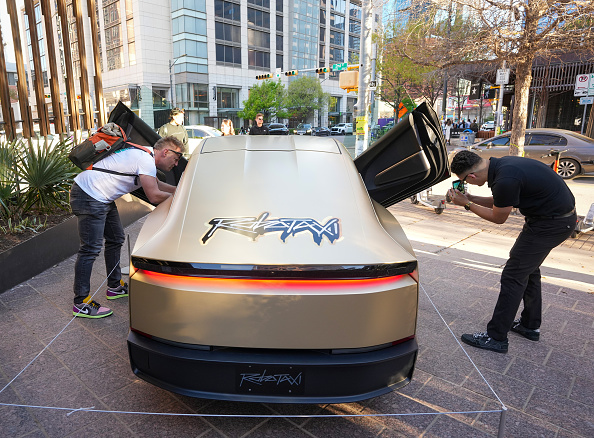
If you live near Giga Texas — or have come across drone footage of it online — you’ve seen the buildup: rows of gleaming Tesla Cybercabs piling up in outbound lots. Or you’ve seen Tesla employees in the driver’s seat on social media or the streets of Austin.
|
- Some appear to have steering wheels and some don’t. One Facebook user recently reported seeing one parked with a driver inside at an Austin Supercharger.
-
But they aren’t picking anyone up. At least not yet. It seems to be Tesla, not regulators, pumping the brakes. Tesla already holds state authorization for 69 unsupervised Robotaxis and is actively running its small driverless ride-hailing service in Texas using Model Ys.
- But for whatever reason, Tesla hasn’t yet self-certified any of those purpose-built Cybercabs, which went into low-volume production in April, for its fleet.
|
Tesla, of course, famously doesn’t respond to reporters’ questions. |
|
|
|
It’s unclear why they’re not on the road yet — it could be software training needs, it could be that the cars are so new that they’re still in the testing phase, or it could be a number of other factors. Right now, Tesla is confident enough to be piling up the hardware. It just isn’t confident enough to let passengers inside. |
|
|
|
Want the inside look on the stats, data, and insights going on in sports? Looking for the numbers behind the biggest stories in the World Cup? Interested in prediction markets and how to make money there? Check out Snacks’ newsletter Scoreboard.
For instance, in yesterday’s Scoreboard, we dove into who’s gaining and who’s losing in the World Cup after a huge weekend of soccer. The chance that the United States makes it to the round of 16 jumped by 17% to hit 63%, Australia’s shot at making it there jumped by 18%, and both Sweden (next game June 20 against the Netherlands) and South Korea (next game June 18 against Mexico) saw their chances at making it to the round of 16 jump by 14%.
On the other side of the coin, Türkiye and Paraguay all had disastrous starts that tanked their chances of making it into the round of 16 by double digits. The US faces Australia and Türkiye plays Paraguay in a must-win game for both in just a few days.
|
- Anthropic said it received a Friday night order from the Trump administration to suspend access to the models for any foreign national (anywhere in the world) — a group that included some Anthropic employees. In response, the company turned off access to everyone.
-
Last week, the company released its much-anticipated Claude Fable 5 model to the public (and its restricted version, Claude Mythos 5, which is still being tested with trusted partners).
-
Anthropic said in a blog post announcing the action that officials cited national security concerns with the new models, while offering few specific details.
-
The post said that the government gave the company “verbal evidence of a potential narrow, non-universal jailbreak” of the public Fable 5 model. A jailbreak is a means by which users can evade restrictions built into the code to unlock prohibited functionality.
|
|
|
|
Fears of these first Mythos-class models being misused are running high, after Anthropic warned the cybersecurity world in May that the advanced cyber capabilities of Mythos have rapidly discovered thousands of vulnerabilities in ubiquitous software, leading to the decision to restrict the full version of the model to a close group of trusted partners for testing.
Axios reported that Anthropic technical staff have flown to Washington to meet with White House officials to resolve the issue. The Wall Street Journal is reporting that the Trump administration’s decision to take action against Anthropic was prompted by discussions that Amazon CEO Andy Jassy had with officials, including Treasury Secretary Scott Bessent.
|
|
|
|
Commiserations (or cry reacts?) to chronically online British teens: the UK will officially enact a social media ban for children under the age of 16, using the same model for the restrictions as Australia did — but how successful has that case study been in practice?
See the data |
|
|
|
|