| | In this edition, why Anthropic’s feud with the White House is really not necessary, and Meta’s AI st͏ ͏ ͏ ͏ ͏ ͏ |
| |  | Technology |  |
| |
|
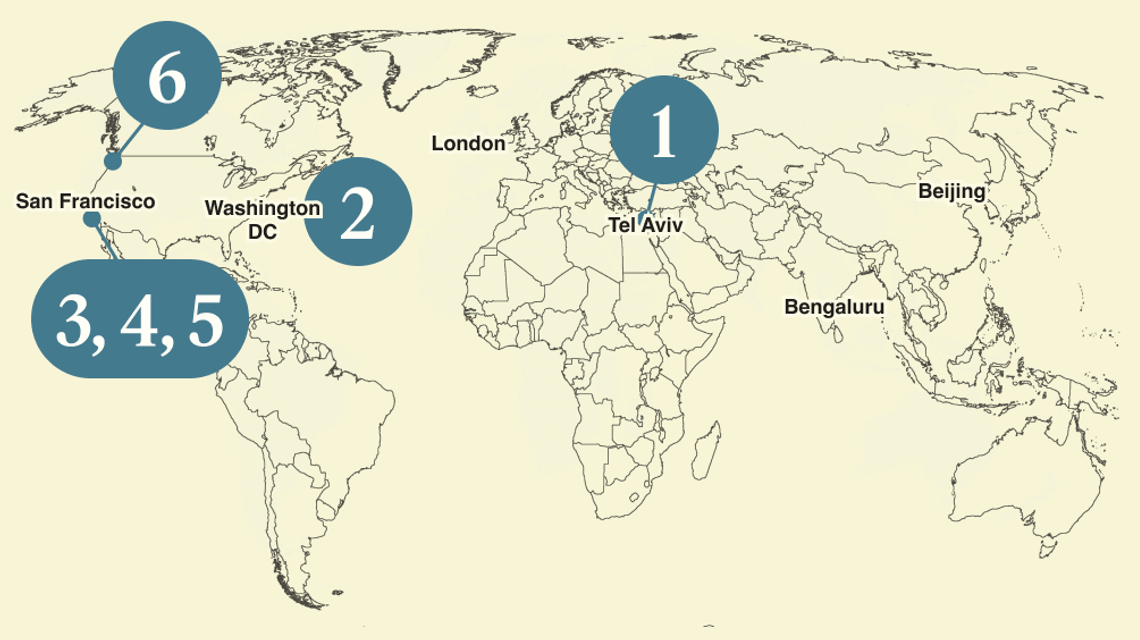 - Agent or human?
- Weighing AI stakes
- Meta’s unclear strategy
- SpaceX-Cursor play
- Claude unveil
- Learning loops
 Why the perennial feud between Anthropic and the White House isn’t necessary, and how satellites use AI. |
|
 Anthropic has, once again, found its future in the crosshairs of the Trump administration. None of this is necessary. The thing most people don’t realize is that Anthropic isn’t fundamentally opposed to the current administration’s economic goals. It isn’t the “woke” or anti-capitalist caricature that the administration has publicly attacked. It’s a startup on the precipice of a $1 trillion IPO that wants to make money and share (at least part of) the spoils of the AI economic boom. What the company has miscalculated is how it’s communicated with the Trump administration — and the general public — about its business. Take CEO Dario Amodei’s comments that AI could wipe out half of entry-level white collar jobs and spike unemployment — grand proclamations that some in the administration took as stoking fear over the technology, rather than framing its business as a force of economic growth in a country that has the chance to lead the world on AI development. Or the public dust-up with the Pentagon, that eventually erupted, about the theoretical use of its models in mass surveillance of US citizens, something the military doesn’t actually have the legal authority to do. Over-torqued discourse also seems to be at the center of last week’s spat with the US government over Mythos and Fable 5, which led to export controls on some of the company’s most sophisticated models. By touting its rigorous safety and testing protocols to a fault when it released Fable, the company projected a sense of locked-down security that then surprised the US government when the model was inevitably jailbroken. In all of these instances, a compromise for uniformity was there for the taking. But Anthropic’s decisions to fight these battles set the company up for conflict. A year from now, Anthropic may have the last laugh. It will likely be a successful public company with soaring revenue, while the Trump administration finishes out a potentially lame-duck term. But the AI lab won’t have taken the easiest path to get there. Smart companies typically try to make the differences between them and the government seem small and insignificant. Anthropic has only made those differences seem bigger. |
|
The tech behind agentic commerce |
 Bruna Casas/Reuters Bruna Casas/ReutersIt’s getting harder to tell the agents apart from the humans. For cybersecurity companies, identifying a digital agent crawling a website used to be enough evidence of malicious activity. Now, digital agents are representing human users and making purchases online, prompting sellers to reconfigure their businesses to better serve agents that read descriptions of products rather than look at photos to decide what to buy. Companies like Israel-based CHEQ — which serves customers such as Dell, Heineken, and the University of Virginia — have developed platforms attempting to solve these problems for companies, CEO Guy Tytunovich told Semafor. CHEQ’s platform can figure out whether a visitor is a bot or agent and identify what their intent is by looking at data like how they click through the website and from what device. Then, brands can cater the website experience to them in real time. (Humans see colors, buttons, and product photos, while agents see large blocks of text or are able to ask the company’s own agents for specific information via chat.) Agents are expected to handle up to $5 trillion in retail transactions by 2030, and companies that aren’t able to figure out the difference between agents and humans could miss out on sales and expose themselves to cybersecurity risks. — Rachyl Jones |
|
Trump officials have weighed AI stake structures |
 Evelyn Hockstein/Reuters Evelyn Hockstein/ReutersSenior Trump administration officials weighed how to structure potential government equity stakes in major AI companies before the US placed export controls on Anthropic’s AI models. Two top Cabinet members had discussed different ideas, people familiar with the talks told Semafor: Treasury Secretary Scott Bessent favored using equity in AI firms to seed Trump Accounts, while Commerce Secretary Howard Lutnick’s preference was that any equity be directed to a type of US sovereign wealth fund. Talks about the possible AI stakes are still in the early stages, and it isn’t clear how such allocations could be executed. A meeting with industry CEOs that President Donald Trump previewed earlier this month has not taken place. It’s unclear where the Trump administration could ultimately land on the idea that remains unpopular for most of the industry beyond OpenAI, which first pitched it last year. Executives at firms like Microsoft and Meta have turned a cold shoulder to the concept in the last week alone. — Eleanor Mueller |
|
What is Meta’s AI strategy? |
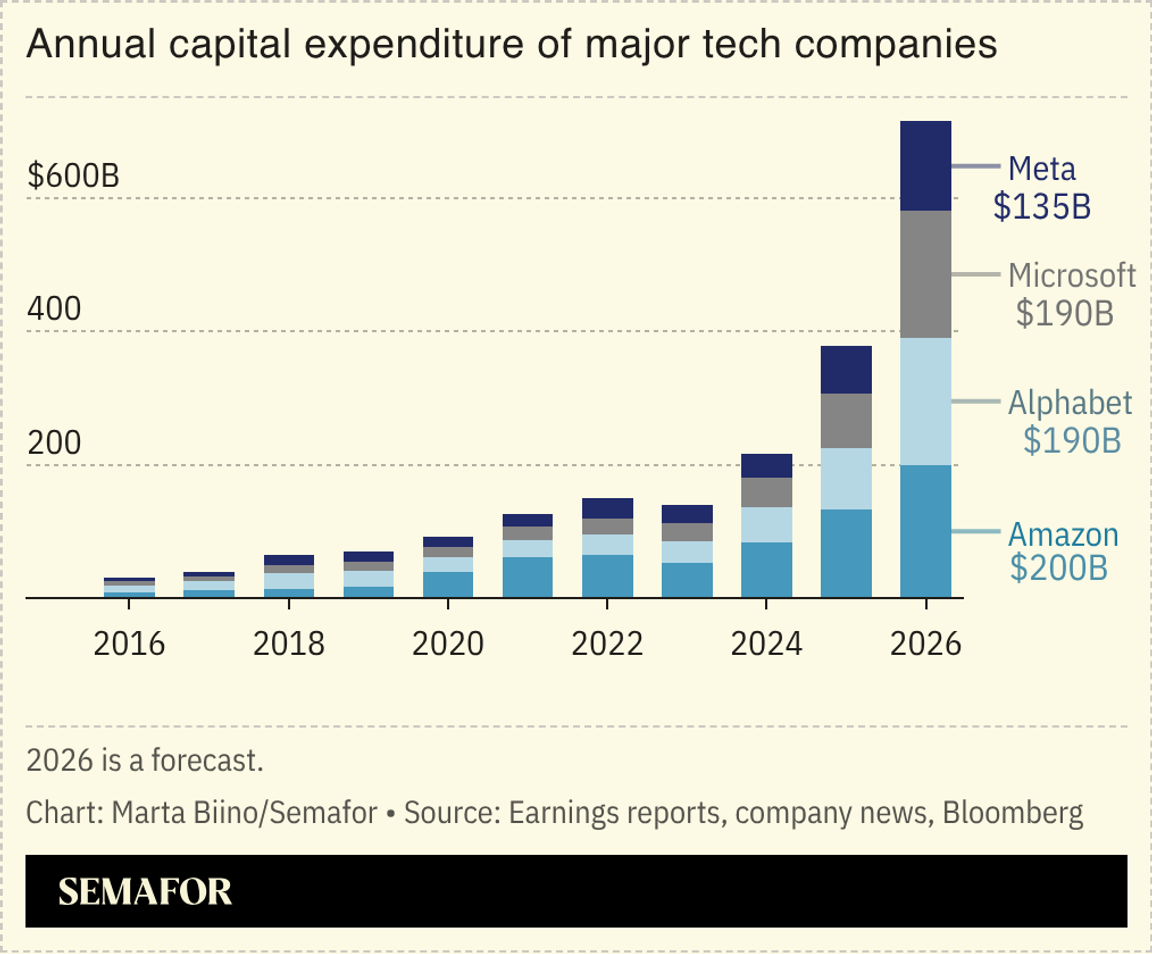 Meta CTO Andrew “Boz” Bosworth’s apology to staff Monday for the company’s massive layoffs and AI missteps may be a first move to addressing sapped morale but it belies a bigger problem: its AI strategy still doesn’t seem to make sense. The company is borrowing like mad to build massive data centers to train AI models that are unlikely to ever catch up to the frontier labs. Meta doesn’t have the kind of enterprise businesses that Anthropic or OpenAI have built, which require a huge number of tokens. Nor does it seem like it wants to become a cloud services provider like AWS, Google, or Microsoft. Meta may have found some traction with its hardware strategy — one that even Apple has had difficulty emulating — but it can’t do much with top-of-the-line frontier models. Even with its billions of Instagram, WhatsApp, and Facebook users, when you roll out AI to that many people, you have to use hyper-efficient models to control cost. Pursuing more than that could be a costly distraction. — Reed Albergotti |
|
SpaceX wins big with Cursor |
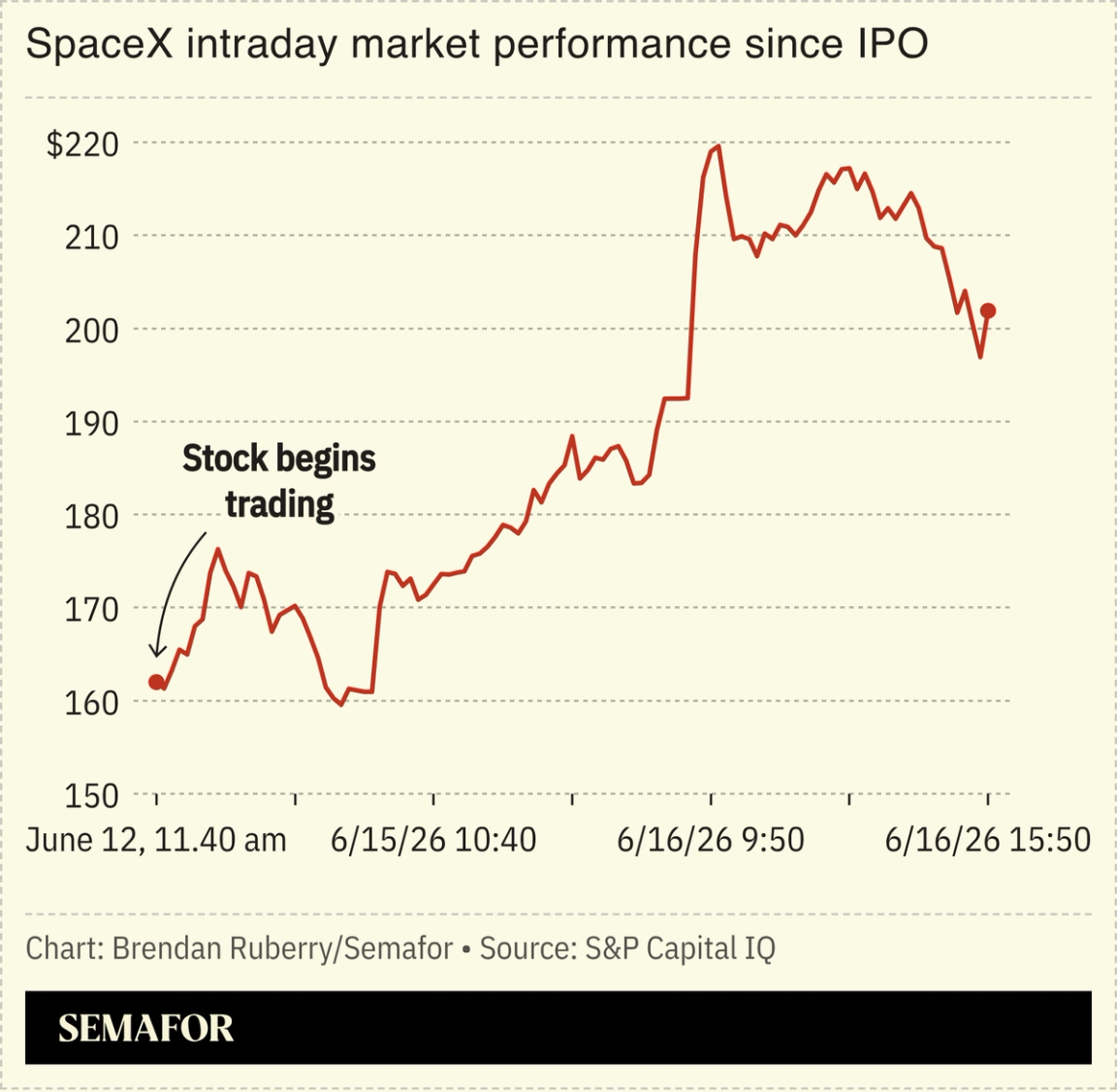 Elon Musk’s $60 billion acquisition of Cursor is a huge win for its AI business. It also leaves a big open question for Anthropic, which counted Cursor as one of its biggest customers. Musk’s Grok models have historically underperformed their counterparts on coding tasks, but Cursor’s vast swaths of data will help SpaceX mount formidable competition to Anthropic and OpenAI. Currently, Cursor charges coders monthly subscription fees to use its software, which offers models created by companies like OpenAI and Anthropic (which, in turn, get paid for the compute customers are using). But Claude Code’s increasing prices provide an opening for Musk’s Grok, which can position itself as a cheaper and efficient alternative. And with Cursor’s own proprietary models running on SpaceX’s compute resources, the company may be able to capture both the revenue from subscriptions and from users choosing Grok and Cursor models. It’s likely xAI will want to develop Cursor into a full-blown harness that competes with Codex, Claude Cowork, and Google’s Antigravity. Developing Grok frontier models alongside that harness will create even more efficiency and capability. Even if customers continue to choose Anthropic’s models, SpaceX sees upside from the rent the Claude-maker pays to use Musk’s Colossus data center. — Rachyl Jones |
|
Research pulls back curtain on Claude |
 Anthropic exec Alex Albert at a Code with Claude event. Courtesy of Anthropic. Anthropic exec Alex Albert at a Code with Claude event. Courtesy of Anthropic.Anybody who’s been playing around with AI this year in any meaningful way will have noticed that the “models” have taken a back seat to the “orchestration layer,” the non-AI operational tasks that allow the technology to function in the real world (If this were a fancy restaurant, the AI model would be the Michelin star chef while the orchestration would be all the wait staff keeping the restaurant running.) The real power of AI models comes when they are harnessed by an elaborate piece of software that lets users interact with the technology, whether it’s Codex, Claude Cowork, or OpenClaw. “Only about 1.6% of Claude Code’s codebase constitutes AI decision logic, with the remaining 98.4% being operational infrastructure,” a little-noticed research paper from April explains. In fact, the AI model itself is sort of cordoned off from anything important. For that, old-fashioned, deterministic computer code handles everything. These still aren’t really consumer products — yet. For that to happen, we need vastly more complex software to handle everything that comes after the AI. Consumers don’t want to think about things like security or access control. They want it all to just work. Of course, you still need a very good AI model to get great results. But as time goes on, the AI models themselves become less important than all the infrastructure being built around them. — Reed Albergotti |
|
Owning the fruit of the loops |
 Manuel Orbegozo/Reuters Manuel Orbegozo/ReutersCompounding capital may be hard but it’s straightforward — invest a dollar so it turns into more dollars, then do it again. Compounding knowledge is more complex. People leave, culture erodes, the playbook changes faster than management can rewrite it, and so the edge slips to newcomers. Satya Nadella thinks AI will change that. “The future of the firm is the ability to compound that learning,” the Microsoft CEO wrote in a buzzy X post over the weekend (Sixty-four million views and counting, for what qualifies these days as long-form, I guess). His argument is that if companies own the fruits of their “learning loops” that incorporate this institutional knowledge into their systems, rather than into best-practices manuals that nobody reads anyway, they can finally compound intelligence the way humans do. AI models, of course, want to capture that compounding for themselves. Nadella is talking his book — Microsoft’s homegrown AI models still aren’t state of the art and, in the middle of a messy uncoupling from OpenAI, it is positioning itself as the enabler of the learning loop, at least until its own models reach the top of the leaderboards. But if he’s right, expect the spoils of AI to look different from the last technological change it usually gets compared to: The internet punished pioneers like Netscape, AltaVista, AOL, and MySpace, while rewarding fast followers. If intelligence compounds as Nadella predicts, this time there will be a real first-mover advantage that didn’t exist in the internet era. — Liz Hoffman |
|
 On Thursday, June 25 at Google Beach in Cannes, Semafor Editor-in-Chief Ben Smith and Media Editor Max Tani will sit down with Alex Cooper, host of Call Her Daddy and founder of Unwell, for a special live taping of Mixed Signals. The conversation will examine the radical changes in media right now through the lens of one of the industry’s most influential creators and entrepreneurs. June 25 | Cannes | Request Invite |
|
|


