| | In this edition: Dems chart a post-Biden foreign policy, gut-check polling on America 250, and campa͏ ͏ ͏ ͏ ͏ ͏ |
| |  JACKSON, GA JACKSON, GA |  TULSA, OK TULSA, OK | WASHINGTON, DC |
 | Americana |  |
| |
|
 - The SEC primaries
- DC’s new guard
- Murphy’s laws
- Go New York go
- Poll Watch
|
|
 GRAND LEDGE, Mich. — On his way to the Yankee Doodle Day parade, Democrat Matt Maasdam tried to explain why his party had lost Michigan’s 8th Congressional District. Sen. Elissa Slotkin, a former CIA analyst, had won the seat three times on the strength of her national security experience, serving presidents of both parties. But even as she ascended to the Senate, Rep. Tom Barrett picked it up for the GOP by touting his experience fighting in Iraq and Afghanistan while President Donald Trump carried the district on pledges to end wars in Ukraine and Israel. “People voted for no foreign wars and lower prices,” said Maasdam, a Navy SEAL turned candidate who has carried the nuclear football for then-President Barack Obama. But when Trump and Barrett took office, he added, “they got the opposite” of what Republicans were selling, as the US upped defense spending while choosing new wars. Now Maasdam is trying to stand for a break from Trump — but not a return to the world before 2016: “Restoring things to the way they were, I don’t think that’s necessarily the goal.” To retake the House, Democrats will need to succeed in districts like his, where they had a breakthrough in 2018 with national security-focused candidates only to backslide in 2024. This year’s crop of Democratic candidates with security experience is both more war-weary and confident than their 2018 and 2006 predecessors, though. They talk about America’s place in the world with no hand-wringing about looking weak; they opposed the Iran war from the jump. More daringly, today’s Democrats don’t talk about restoring the pre-Trump order of the world — or, as Joe Biden once did, making MAGA an “aberration” in history. In fact, they don’t want to hear much from Biden’s team at all. “I want us to admit that the Biden administration made some pretty big mistakes,” Sen. Chris Murphy, D-Conn., told me recently, describing the former president’s call for a return to the old ways as fundamentally unsuited to the electorate Trump managed to capture. |
|
MAGA tallies its wins and losses in the South |
 Rep. Mike Collins. Alyssa Pointer/Reuters Rep. Mike Collins. Alyssa Pointer/ReutersTrump got his endorsed candidates through Senate and House primaries on Tuesday, while Georgia Republicans rejected a presidentially endorsed candidate for governor in favor of healthcare executive Rick Jackson. Rep. Mike Collins won the GOP’s nomination to challenge Democratic Sen. Jon Ossoff. In his victory speech, he emphasized that he had business experience (“Jon Ossoff doesn’t”) and that he’d helped pass the Laken Riley Act immigration law; his supporters cheered when he said it led to more than 20,000 deportations. One reason for his win, not mentioned onstage: His opponent had confirmed that Trump fairly lost Georgia in 2020, getting the president off the sidelines for an endorsement. But in Georgia, Lt. Gov. Burt Jones couldn’t ride his Trump support to victory, even while easily winning votes cast on Election Day. And outside the region in Oklahoma, Trump-endorsed ex-legislator Mike Mazzei will head to an August runoff against state Attorney General Gentner Drummond. Gubernatorial primaries have been a weak spot in Trump’s record this cycle. Next week, South Carolina Lt. Gov. Pamela Evette is an underdog in her runoff, despite the president’s support. Also in Oklahoma, Rep. Kevin Hern easily won the GOP nomination to replace now-Homeland Security Secretary Markwayne Mullin in the Senate. Back in Alabama, Rep. Barry Moore beat Navy SEAL Jared Hudson in the Senate primary, with the latter only carrying Birmingham and its exurbs. (Moore got help from the crypto PAC Fairshake, which spent more than $10 million on him between the primary and the runoff.) |
|
The capital shifts further left, elevating a Trump foe |
 Leah Millis/Reuters Leah Millis/ReutersVoters in Washington, DC look likely to nominate Janeese Lewis George for mayor, a victory for the city’s left wing and its chapter of Democratic Socialists for America. “Tonight, DC made its demand,” Lewis George told supporters, quoting Frederick Douglass. “Tonight is for the postal worker on the early route; the nurse coming off a double; the teacher buying classroom supplies out of her pocket; the child care worker who loves our babies all day but still can’t make ends meet.” Lewis George was the latest Democrat to benefit when the president attacked her — specifically, when asked what he’d do if a socialist won in DC. “Maybe we take back Washington, run it on the federal basis,” he told reporters last week. Congressional control of the city becomes far less likely if Republicans lose the House in November. But the expected defeat of Kenyan McDuffie, a more moderate candidate who promised some continuity with outgoing Mayor Muriel Bowser, saw Democrats supporting Lewis George’s pledge to build more housing and pay for more services, despite the city’s DOGE-driven economic downturn since 2025. |
|
 Elizabeth Frantz/Reuters Elizabeth Frantz/Reuters“Crisis of the Common Good,” the new book from Sen. Chris Murphy, D-Conn., is the most interesting one written by a Democrat after Kamala Harris’ defeat. Murphy isn’t concerned with the party’s 2024 electoral strategy, which obviously failed. He believes that it needs a new “economic nationalism,” stopping short of socialism, while adapting to the changes that two Trump administrations have wrought. He ends with specific ideas for the party and recommends a constitutional amendment that would limit money in campaigns. In a discussion with me, he didn’t outline a straight, clear path there, but contended that the party needs to pick bigger fights to reestablish its brand. “If we focus all of our energy just on Trump’s corruption and don’t admit that the whole system is corrupt, I don’t think we’re credible messengers,” Murphy told me. |
|
Mamdani’s latest ad harnesses Knick fever |
 Zohran Kwame Mamdani/X Zohran Kwame Mamdani/XThe best-timed political spot of the year may be “This is the Team,” a joint effort between New York City’s three left-wing congressional candidates and their most important endorser, Mayor Zohran Mamdani. It started running when the Knicks made the NBA finals. At worst, had the Knicks lost, the sight of Brad Lander, Claire Valdez, and Darializa Avila Chevalier passing a basketball as they talked about their agenda would have come off as bittersweet. But the team went all the way, and the ad is now shot through with good feelings about New York. The Progressive Unity Fund, one of the pop-up PACs supporting the city’s Democratic incumbents, goes after Avila Chevalier for now-deleted tweets where she insulted Harris and Biden, morphing footage from the original Mamdani ad to show the candidate passing a basketball to Trump. It’s a sign that incumbents have to work around Mamdani’s popularity, not just ignore him, as he keeps cutting ads for his picks. In “Claire is the Progressive We Can Trust,” Mamdani appears to politely interrupt Valdez so he can brag about her record. In “Cara,” he pops up at the end of Avila Chevalier’s pitch to endorse her in Spanish. |
|
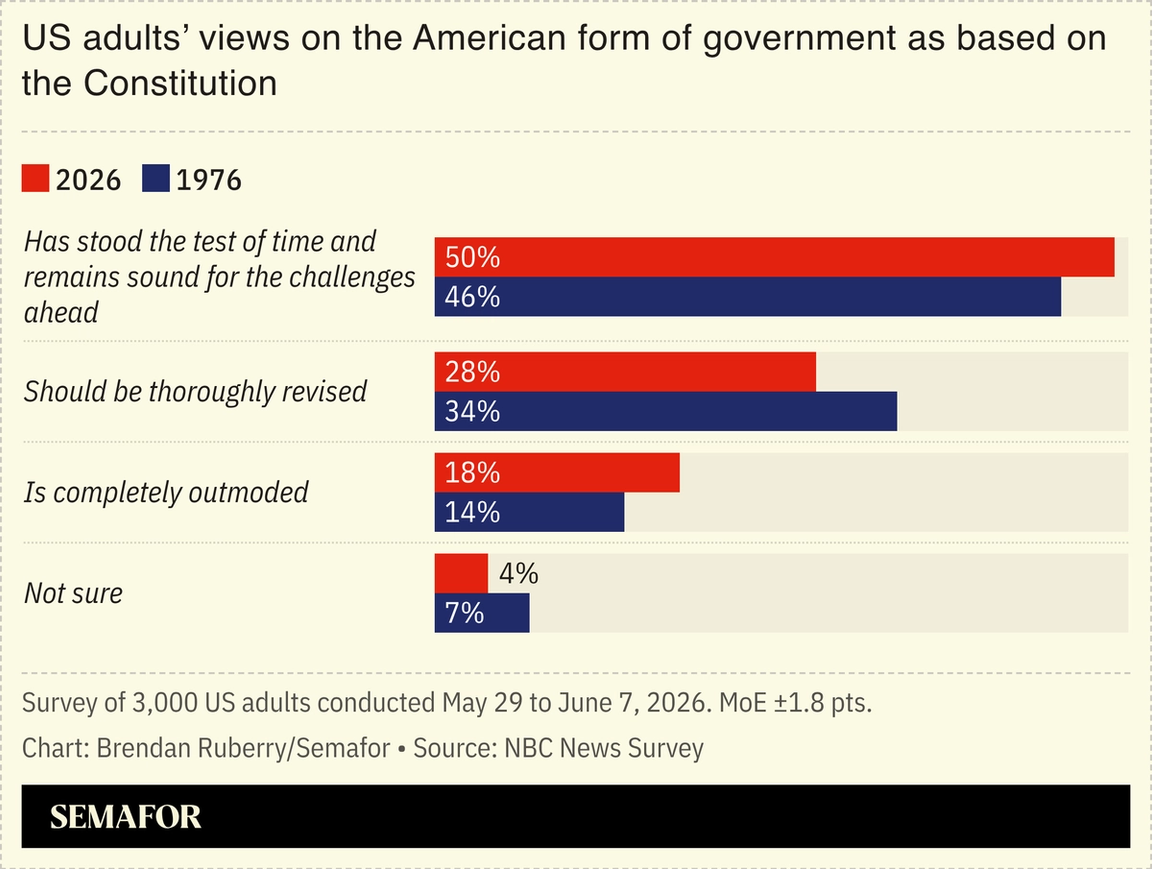 An emerging theme in Democratic politics is that the Constitution may not “work” anymore — i.e., that the country wants change that its founding rules don’t allow. Pete Buttigieg gets heads nodding when he talks about expanding “a rogue Supreme Court” with new justices. Most Democrats support some sort of amendment to reverse the Citizens United decision, challenging how the court interpreted the First Amendment. Those discussions are continuing during the nation’s 250th birthday celebrations, with Republicans accusing Democrats of lacking patriotism if they challenge how the country’s being run. The country doesn’t quite agree with Democrats, but we’re also not seeing a surge of patriotism and defense for the Constitution alongside the national birthday. Half of Americans see no need to change “our form of government,” a climb from the post-Watergate birthday of 1976, but half of them do want some sort of constitutional revision. A smaller share of those people, mostly Democrats, want to consider “a new form of government.” |
|
 On Thursday, June 25 at Google Beach in Cannes, Semafor Editor-in-Chief Ben Smith and Media Editor Max Tani will sit down with Alex Cooper, host of Call Her Daddy and founder of Unwell, for a special live taping of Mixed Signals. The conversation will examine the radical changes in media right now through the lens of one of the industry’s most influential creators and entrepreneurs. |
|
 Elizabeth Frantz/Reuters Elizabeth Frantz/ReutersGraham Platner’s story is so new, so intriguing, and so easy to click on that the media spotlight has ignored GOP Sen. Susan Collins. Enter Jim Newell, who’s written a comprehensive story about the Collins record and her ability to win reelection while Mainers vote against other Republicans. There’s rich detail about the specific ways she brings money back home, and some evidence that Platner’s arguments have already been unsuccessfully deployed against her — albeit in different media environments, when more voters read local newspapers and not everything was nationalized. |
|
 “One of the vices that animated me — looking back, probably since the earliest days of my life — was the arrogant desire to rise above others,” writes JD Vance in his second memoir. “Communion” came from a 2017 book contract, before Vance ran for office. It became a guide to, and defense of, his Christianity — one that he sees as critical, with the West growing more distant from church and having fewer babies. “If the Titanic is going down, I’d rather be on board than hop on a lifeboat,” he writes about his commitment to the Catholic Church. There’ll be takes about the book from people who only see excerpts, but it’s an unusual, revealing combination of three stories at once: A political memoir, a Netflix-ready telling of his life with Usha, and an elucidation of the future he wants to build if he keeps winning. |
|
|


