
|
Who’s with W. Kamau Bell?
Inside the comedian’s newest podcast deal, clipping discussions, newsletter growth, and the guest he’s always wanted to book
| ||||||||||||


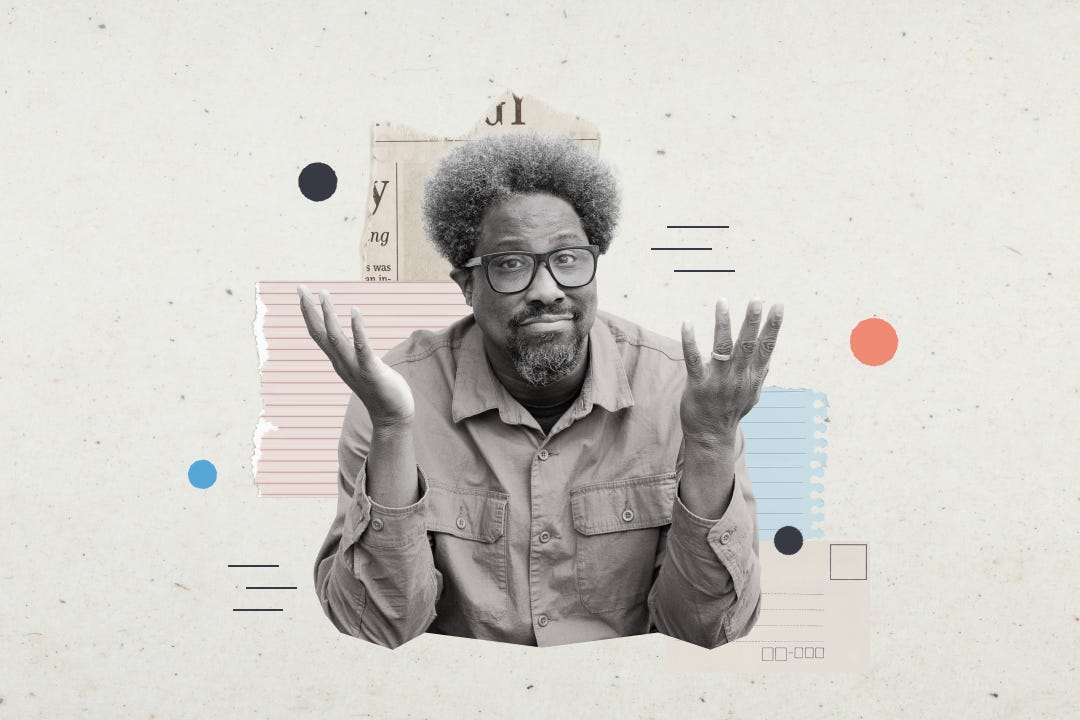 |
W. Kamau Bell has lived many different lives as a host and comedian: one of them centered on the singular conviction that Denzel Washington Is the Greatest Actor of All Time Period, another in service of an institution (the ACLU’s At Liberty), another at the helm of several documentaries and seven seasons anchoring CNN’s prime-time Sunday night slot with his show United Shades of America. He’s now launched Who’s With Me?, a new podcast based on and distributed through his Substack publication of the same name, which he’s grown from an email list of 20,000 to nearly 140,000 subscribers since joining the platform in 2024. The show is not another celebrity podcast, he says, but features a guest list of people he can actually text to invite on: Delroy Lindo, Robert Reich, Ted Danson, Daveed Diggs, Misty Copeland, and more. Made in partnership with Malcom Gladwell’s Pushkin Industries, it’s also a venture he’s owned from day one. We sat down with Kamau to find out how season one is going, ask him about his “white whale” guest, and talk about what it means to own his own work in an industry that’s still trying to decide who it’s for.
You kicked off episode one of the new show by saying, “This is me investing in myself and trying to bet on myself, because the industry is not betting on people like me anymore.” What did you mean by that?
I had one of the great runs in the history of show business. I had seven seasons of a television show at CNN with United Shades of America. That puts me in the showbiz hall of fame. I sort of was aware as it was happening that this was rarefied air that I was in. And then when the show went away, I thought I had plans for my next chapter with another show like that, but the industry sort of turned on those shows. After the murder of George Floyd, there was all this clamor in the industry for “We need to talk to more Black creators and empower them.” In one of those conversations, I got my documentary, 1000% Me: Growing Up Mixed. That came out of a conversation with HBO about “What would you like to work on?” And actually, the project was their idea. And so I got something out of that clamor. A lot of Black creators got the meetings and got things greenlit but didn’t actually get projects. By the time it was time to make the projects, the clamor had gone down.
Ava DuVernay, who is one of the most great and acclaimed directors of our time, is right here with me on Substack too. I think one of the reasons she did it is because she’s like, “I need to get my own voice out there.” And she had to independently raise money for her last movie that was based on a New York Times bestselling book. I still have three children and an 89-year-old mom and a wife, and I need to make sure we’re all eating every day or as often as we want to. So that’s the big story, and that’s happening all through the industry. I’d had all this life in podcasting, as you said, but I never really had what I would define as my own podcast, where I get to do whatever I want to do every week and follow my own nose.
What did that mean for booking guests for the show?
Most are people that I can reach out to directly. So that, I think, on its face means [the show] is different from most of these quote-unquote celebrity-led podcasts. I’m really proud of the fact that so far it is people I’m either in direct contact with or people where I’m like, “Oh, I’ve always wanted to be in direct contact with that person.” I think about Marc Maron’s podcast [WTF with Marc Maron], which if you’re a comedian is the blueprint. It was very clear at some point Marc went from “These are comedians who I have grudges with that I need to solve” to “This is the A-list celebrity whose movie’s out, and now my podcast is one of the cool stops in town.” Right? And I don’t think there’s anything wrong with that, but I think that I want to at least establish the groundwork of not starting there. I want to start personal.
Do you feel like having a built-in subscriber base who already knows your voice gives you the ability to skip the usual swings for A-list guests?
I mean, I definitely think that… like, if Sydney Sweeney called me...
Would you say yes?
Here’s what I would say: Do you actually know who I am? It’s important to me that the people I sit down with have some sense of who I am, because I’m not an entertainment interviewer, I’m not a celebrity stopper. And if you’re not willing to investigate and do the work, I don’t think I really need to talk to you. Now, my publicist might say differently.
Do you have a white whale guest?
Yes. My white whale guest has been the same white whale guest since I’ve started talking to people professionally. It’s Zack de la Rocha from Rage Against the Machine.
Have you tried to get him?
No, I’ve never sent a thing to Zack de la Rocha. I just got it confirmed about a year ago that he knows who I am, and I was very excited about that because I just think he’s probably in the mountains of Mexico with the revolution or rapping in his house on tracks we’ll never hear. But I’d say I’m big on not trying to make things happen not in their time.
I think there’s also a need for me to sit down with Denzel Washington at some point. I got invited to his AFI tribute years ago and I met him, and he knew who I was. United Shades of America was such a big deal. If you were of a certain age and at that point a CNN watcher, you saw me at some point. And 9:00 on a Sunday, which is when it aired, was a prime time for people to just turn on their TV and go, “Oh, what’s this about?” I just met Jodie Foster recently, and I was blown away that she knew who I was. That 9 p.m. on Sunday on CNN really did a lot of work for me with a certain demographic of people.
Do you feel like you’re still getting in front of new audiences?
I feel like part of the reason that it’s important to stay active on social media is because you never know when your clip is going to get in front of a new audience. So you never know when someone’s going to be scrolling on their phone and go, “Oh, who’s that guy?” People are also regularly going, “Oh, that’s where you are.” “You disappeared. You stopped being on Sunday nights on CNN, and I thought you dropped off the face of the earth.” So I think it’s important to stay in some of these social media spaces, because you never know when you’ll not even find a new audience, but find your old audience.
What’s the clipping strategy for the show?
Chris Rock taught me this years ago. He said, “More people see the trailer than see the movie.” So I’m very aware that on some level you want the clips to convert people to listeners of the podcast, but you’re also aware that a lot of these are just only going to be taken in as content on their own. And so there’s a little bit of pressure to make sure that it actually works on its own so if they never see the podcast, they got something out of it. But even with my clip recently with Ted Danson—we were promoting the Ted Danson episode, and he does this major apology for blackface—I was very aware, and me and the producers were like, “We don’t want to put up a two-minute clip of him apologizing for blackface on the internet ’cause that’s just going to work against all of us.” People are going to argue with that clip in the comments, when [in the episode] he talked for, like, 15 minutes. So what we did is we basically put together a teaser. Like, him sort of going, “Hey, can we talk about that?” And he’s like, “We can. Let’s do it.” I mean, it was done better than that. As a way to go, people will know what this is, or they won’t. But it makes you have to go find the thing. And also for me, he did such a generous thing by apologizing. I didn’t want to weaponize it against him by turning it into a two-minute clip that was going to take out all the nuance.
Has anyone clipped it independently and commented on it?
There have been some clips, yeah, like... TMZ clipped it, which was sort of hilarious. But the thing about it is that even when you go clip it, I’m finding it’s so clear that he’s earnest, that you have to be a real asshole to turn it into something that it’s not.
How did the deal with Pushkin Industries come to be?
So there’s a guy who works at Pushkin who fans of my Denzel Washington podcast will know under the moniker of Black Judgment. I’ve known Justin Richmond since he was a recording engineer at U.C. Berkeley, and he just happened to be assigned to our podcast because I was recording the Denzel podcast at U.C. Berkeley. Justin reached out to me and said, “Hey, if you ever want to get into podcasting again, Pushkin might be interested.” So that’s why the Pushkin thing started. I, of course, knew of Malcolm Gladwell. I read his books. I “blinked,” I “thunked,” I did all the things. So then I had a meeting with them. The biggest thing that is important in any deal, especially at this point in my career, is my joke is no new friends, unless those friends really can let you know that they know who you are. So it’s like I said earlier about Sydney Sweeney wanting to do the podcast. I am not the kind of product—and I think in showbiz we have to think of ourselves as products sometimes—that you can just throw me on anything and it’s going to work. I’ve met with a bunch of different podcast companies, had some good meetings, but I really kept coming back [to Pushkin].
Do you own the show?
It’s funny, I went in going, “I hope they can pay me for this,” and then after the way the industry fell apart, I was like, “Oh, I think I need to own all of it.” Which means I have to pay for this. And so we have a relationship and a partnership, but the ownership of the podcast is mine. I just sort of feel like it’s important to bet on myself, especially at this point in my career and at this point in the history of this industry, and at this point in the history of this country. Like, I can’t be giving away pieces of myself knowing where everything is headed. Not to say that I wouldn’t do that under the right circumstances, but it was just really important to me. Sometimes you accidentally end up owning things because nobody thinks it’s valuable. And then sometimes—like the Denzel podcast I didn’t own, and sometimes I was like, “It is crazy that I don’t own that.” ’Cause nobody else would’ve come up with that idea. Or I didn’t own it. I do now. But to me it’s like, I can’t go through that again, especially when every now and again now that podcasts are being sort of... you’re seeing them on Netflix and Hulu and whatever, and people are getting paid for exclusive deals. And I’m not saying I want to do that, but I want to have the option that if that happens, it benefits my family the most.
How does Substack fit into the ownership piece?
I brought in my audience and then built an audience that was way bigger than the people I brought into Substack. And I was just like, “Oh.” I had an email list, but suddenly the email list was doing something. The regular practice of writing on Substack became a thing that I really enjoyed, and the fact that some people were giving me $5 a month for it gave me the incentive to be up till 2 in the morning sometimes, like, “I gotta get this out.” When I finally decided I’m going to do the podcast, I was like, “Well, I have to name it Who’s With Me,” ’cause the Substack has become such a core part of my creative identity, and I only want to build on that. And I’ve already planted a flag on this Who’s With Me concept on Substack. Instead of coming up with nine different names for things, I think this thing has a longer tail than I realized when we came up with that name. So yeah, for me, the Substack is why the podcast is named Who’s With Me, because I had built this community of people with Who’s With Me, and the podcast is now growing out of that.
You’re distributing the show through Substack—uploading each episode and sending it out to other listening platforms. Why did you set it up this way?
I find it’s great because it creates a natural hub for the podcast. Yes, you can go get it on all these other platforms, but I like the regularity and the ease of saying that if you join me here, then you’ll know when the podcast is coming up. Becau