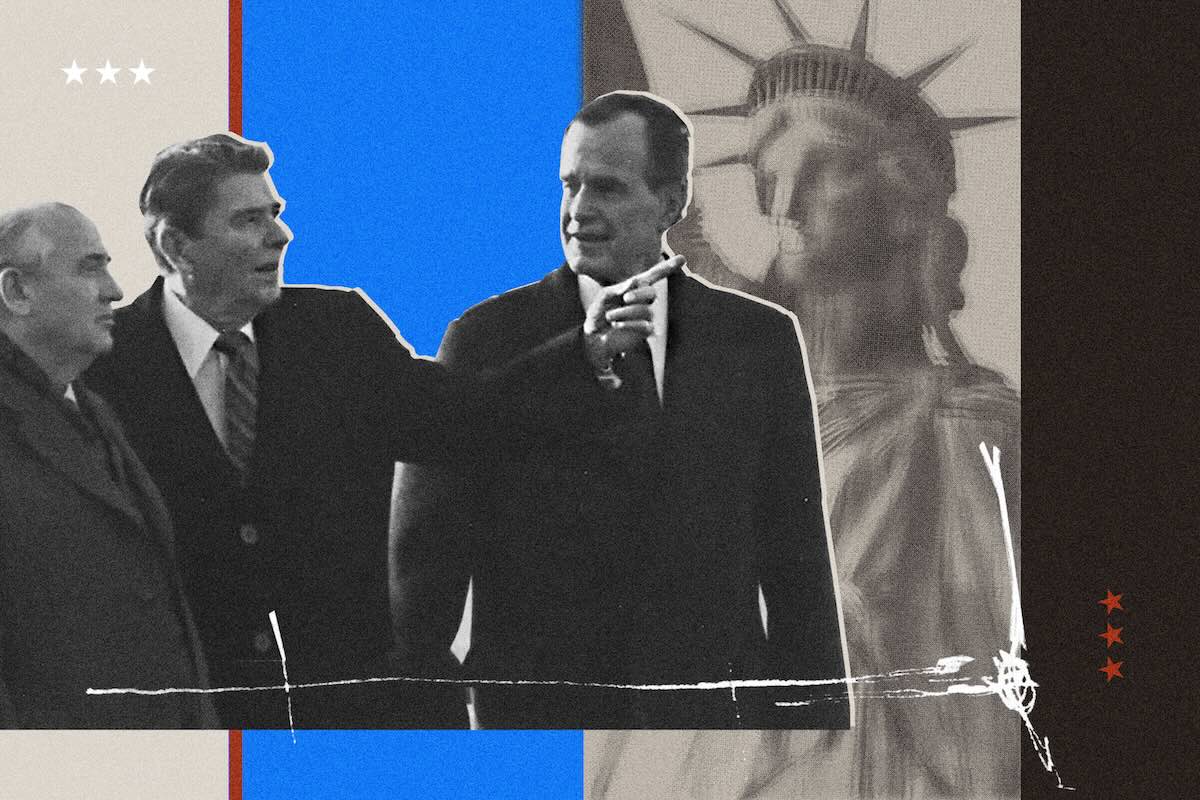
Every Sunday this summer, we’re sharing essays from the Foreign Affairs archives that examine American statecraft and power and the history that shapes both. Next up is “Foreign Policy and the American Character,” a 1983 essay by the historian Arthur Schlesinger, Jr., on how the “contradiction and paradox” at the heart of the United States’ identity has influenced the way the country approaches the world.
Since the United States’ founding, there has been a “tension in the American soul between an addiction to experiment and a susceptibility to ideology,” Schlesinger wrote. As a result, “two strains have competed for the control of American foreign policy: one empirical, the other dogmatic.” Many of the country’s founders, for instance, wished to stay out of European affairs, reasoning that foreign entanglements could jeopardize the “risky and doubtful experiment” of American democracy—but they also “hoped that the American experiment would in time redeem the world.”
The balance between pragmatism and philosophy shifted over the decades, Schlesinger argued. When the United States reengaged with global politics at the end of the nineteenth century, “it did so with an exalted conviction of its destiny as a redeemer nation.” The growth of American power in the twentieth century only “confirmed the messianism of those who believed in America’s divine appointment,” Schlesinger wrote. “And the fact that there were a couple of real monsters roaming the world encouraged a fearful tendency to look everywhere for new monsters to destroy.”
|