
|
Meta’s Path To AI Relevance, According To Meta CTO Andrew Bosworth
Bosworth on what went wrong with Llama 4, Zuckerberg’s AI “founder mode,” and why he thinks the model alone isn't enough to win.
|
| |||||||||||||||


 |
Meta CTO Andrew Bosworth says the big monolithic model era is over, and the battle over AI product has just begun.
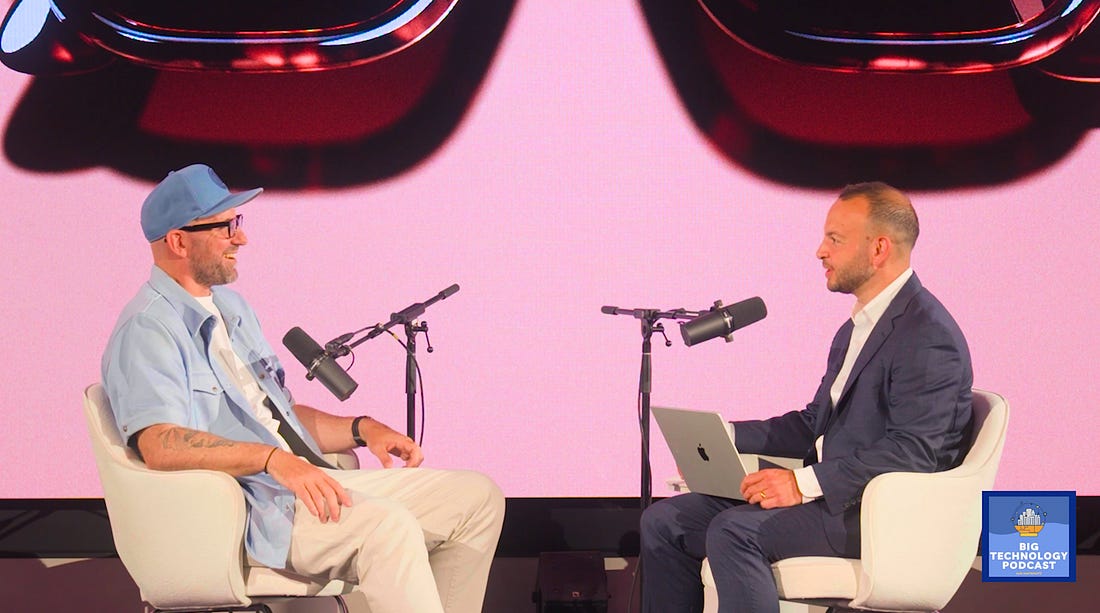
In an extended interview on Big Technology Podcast this week, Bosworth claimed that while frontier AI models are valuable, the way they’re implemented will create the most value.
“There’s a strategic construct of having a model, and having it be a truly state-of-the-art one, that’s super important. But having that alone doesn’t mean you win,” Bosworth said. “There are a bunch of pieces you have to connect it to: product, distribution, and the consumer experience. It’s the collection of all four that I think is our advantage relative to competitors, most of whom — whether it’s Apple, Anthropic, OpenAI, Google — only have one of those pieces.”
Meta has struggled to build its own frontier model, and it’s now renting models from some of those competitors, Bosworth said, in service of building “personal superintelligence.” The company also just released a new model today, Muse Spark 1.1, that it says is competitive on leading benchmarks at a lower cost than its rivals.
In our conversation, we cover Meta’s pursuit of the frontier, its latest wearable hardware, and the cultural challenges of meeting this AI moment. You can read the full Q&A below, edited lightly for length and clarity, or listen on Apple Podcasts, Spotify, or your podcast app of choice.
Alex Kantrowitz: Building a great AI model, in theory, takes a ton of compute and great researchers. Meta has both, but the leading model hasn’t shown up yet. What’s going on?
Andrew Bosworth: The only other ingredient I’d add is great data.
There are two stories here. The first is — go back to Llama 1, Llama 2, Llama 3 — we really were at the forefront and advancing things. The Facebook AI Research group goes back a decade or more.
And the real gap, which has been pretty public, was that when we were pulling Llama 4 together, we’d already pulled every stop we had into Llama 3, and unwittingly killed the pipeline.
The way it works is you build a base, you’ve got people pioneering an incremental version of that base, and you’ve got people pathfinding entirely new strategies. Unbeknownst to us at the time — and this speaks to the fact that we weren’t focused enough on it — Llama 3, which was a great model and well received, had pulled forward all the future bets. That meant when it came time for Llama 4, we didn’t have any of the pathfinding the other labs still had going. So now you’re behind on reasoning, behind on mixture of experts, behind on a bunch of the critical technologies that have driven the pace of progress.
That was a pretty public disappointment about a year ago, and it led to Mark shifting from “AI is one of our bets” — which is how we thought of it up to that point, just one of many bets — to “AI is foundational to the entire company.”
This is such a cliché, but I don’t have a better word for it: he went founder mode. He became uniquely focused on getting us all the compute we needed, all the talent we needed, the researchers we signed, who landed about a year ago.
I think Alexandr Wang just hit his one-year Metaversary, and I’ve loved working with him and learned a lot from him already. We’re seeing the fruit of that. If you look at Muse Spark, our latest model, it’s been very well received, and depending on the benchmark, it does really well on the things we care most about, the things we think are unique to our products.
“He goes founder mode. He really did flip into a mode that is like unique and reserved for Mark.”
So you’re absolutely right about where we are in terms of public perception. Model-wise, we’ve built a team I really believe in. We’ve got the compute and the data we need, so I’m confident we’re going to be where we need to be.
The Product Is the Value
I’ll add a second piece I think is strategically important: models are available — you can go rent a model, use Anthropic’s, use OpenAI’s, use Google’s. They’re great models, you can go get them. That’s pretty great. But the real value we’re going to create in the world is the product. The vision we have for personal superintelligence is one we’re uniquely suited to deliver. It’s not just that we have data — we actually have a better chance of understanding you, what you’re trying to do, and who you are in the world than almost anybody else does. So having the model is one piece — you want that strategically, so you’re not dependent on somebody else — but you mostly want to control your own destiny.
The model itself isn’t the value. I think we’re going to get to a world very soon where consumers don’t care which model they’re using — they don’t care if it’s 4.7 or 4.8, the same way you don’t care whether you’re using Oracle or a SQL database. You just want the functionality to work well. That’s the standard we’re all going to be held to. Today the discussion is about models, which suggests to me that we’re a little under-indexed on the user side of it — on how humans are actually going to benefit. That’s the story we need to tell, in addition to showing the technical work — we need to demonstrate the value to consumers
So the brute-force theory doesn’t hold anymore. To build frontier intelligence, you need more than compute, data, and researchers. You need techniques like mixture of experts and reasoning on top of the base pre-train. That’s what Meta’s working through now?
It’s not just that. The era of the monolithic model kind of died around the Llama 3 launch — the idea that there’s one model, you test how smart it is, and that’s how good it’ll be at everything.
We’re now in a world where these harnesses — Claude Code, Codex, whatever it is — are shopping underneath to lots of different models depending on the task. If you’re using Gemini, it’ll farm image-generation tasks out to Nano Banana.
We’ve moved past the world where one model rules everything.
We’ve moved past the world where one model rules everything. What you want is a very expensive, exquisitely intelligent model that you can distill down in interesting ways, and use only when necessary — because it’s expensive to run — with cheaper, faster, lower-latency models for tasks that don’t need genius-level intellect.
I really believe in scaling laws — you’ll see continued growth as compute scales up, raw model intelligence scales up — but human tasks don’t have infinite intelligence demands. A lot of human tasks can be done with conventional levels of intelligence. So there’s going to be a stratification. It’s not “what’s the one model that rules them all,” it’s “what’s the collection of models that come together to solve these problems with the right balance of performance, price, and value.”
The interview continues below…