|
|
|
|
|
|
|
|
|
The Home of the Week is a renovated 1860s barn that doubles as a concert venue. Arkin Moment/Supplied
|
|
|
|
|
This week: The high premium buyers will pay to live near top schools, and Halifax’s housing growing pains threaten its big moment. Plus, data on mom-and-pop investors might surprise you, and one property worth a look. |
|
|
|
|
|
|
|
|
|
|
How much more parents are paying to live near top-rated schools |
|
|
|
|
|
|
|
|
How high a premium would you pay to live near a school that could give your child an edge? For parents – and even couples just thinking of having kids – it’s quite a lot.
Realtors say buyers are increasingly willing to max out their budgets for smaller, older homes that are in their desired school catchment. And as Mariya Postelnyak reports, some are adding tens or hundreds of thousands to their purchase prices for a place on the right side of the street. |
|
|
|
|
The school zone tax is real, and Mariya’s data analysis shows just how high it can be. Living near the 30 top-rated schools in the GTA adds a median premium of $60,000 to $70,000 more – or 5 to 7 per cent of the price of a detached home. That premium is even higher in B.C. – up to a median of 10.5 per cent added. It makes a lot of sense, Mariya told me, because average student outcomes and the very idea of a “starter home” are both declining. “It puts added pressure on homebuyers who are simply floating the idea of having kids in the future to find the right home right away," she said. |
|
|
|
|
And while she was shocked by the number of homebuyers looking at school scores without any kids to speak of, something else in the data struck her too. “What surprised me the most is that, at least in the GTA, the ritziest neighbourhoods often carried not just middling but often some of the lowest school scores,” Mariya told me. Take a look at her deep dive into the data and
how much you might pay to live near the best schools here. |
|
|
|
|
|
|
|
|
|
|
Individual investors own about 10% of Ontario and B.C.’s housing stock, study finds |
|
|
|
|
|
|
|
|
|
New insights on the share of housing owned by mom-and-pop investors might surprise you. JONATHAN HAYWARD/The Canadian Press
|
|
|
|
|
Remember the real-estate frenzy of 2021, when investors made up about 20 per cent of home sales and were blamed for driving up prices? It feels lightyears away, but now we know a little more about the size and type of the buyers – and Statistics Canada’s numbers might surprise you. |
|
|
|
|
Small-scale investors with up to five properties owned 8.9 per cent of Ontario’s housing market (in terms of assessed property value) in 2022, and those with more than five held 1.3 per cent, according to a study by the Canadian Housing Statistics Program.
In B.C., the numbers were 9.6 per cent for small-scale and 1.9 per cent for medium. When you zoom in on rental stocks, the rates shoot up in both provinces: small-scale investors held 52.6 per cent in Ontario and 49.4 in B.C. |
|
|
|
|
You might be saying, sure, but what about commercial investors? This is where it gets interesting. These mom-and-pop investors held more property value – and rental stock– in Canada’s two most expensive housing markets than businesses and large investors combined at the time. But, as Rachelle Younglai reports, the numbers don’t reflect the recent inroads large investors are making into the purpose-built rental space. Read Rachelle’s full story about the study. |
|
|
|
|
This week’s lowest fixed and variable mortgage rates in Canada |
|
|
|
|
|
|
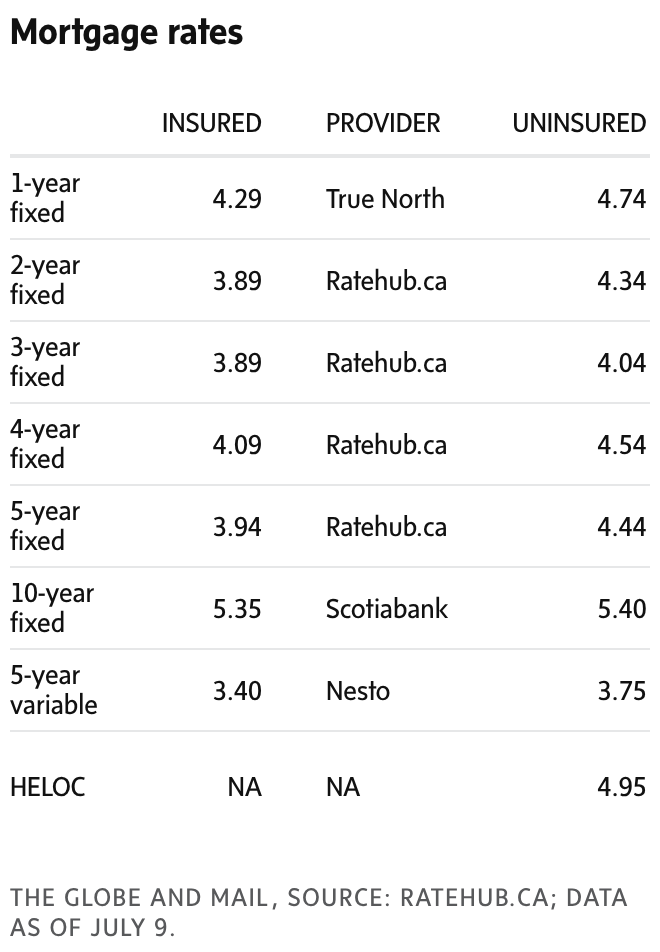
Rates shown are the lowest available for each term/type and category (insured vs. uninsured) as of market close on Thursday, July 9. |
|
|
|
|
|
|
|
|
|
|
Halifax’s housing growing pains threaten to derail the city’s big moment |
|
|
|
|
|
|
|
|
|
Halifax has been touted as Canada's next defence city, but can housing and infrastructure keep up? Darren Calabrese/The Globe and Mail
|
|
|
|
|
If you or your friends moved to Halifax during the pandemic, you weren’t alone. A wave of remote workers seeking affordable housing fuelled massive population growth in the city, with hopes for economic development to follow. But the growth spurt has also brought its own problems
: major roads choked with traffic, housing shortages, and water and power grids buckling under the increased demand, to name a few. |
|
|
|
|
Now, all those issues are coming to a head just as Halifax hopes to capitalize on a generational opportunity: a surge of federal military spending local politicians say will make it Canada’s defence city. Chris Wilson-Smith went to Halifax, where local authorities are racing against time to update and build out the civic infrastructure needed before the chance slips through their fingers. |
|
|
|
|
What he found is a city coming face-to-face with the promise and peril of growth. Rising home prices, businesses desperate to meet the moment unable to hire staff because of the housing shortages, and developers also finding it hard to hire and house people to actually build the 30,000 homes needed by 2030. Read Chris’s deep-dive
for more about the Halifax’s fight to rise to the occasion and what it means for cities across Canada |
|
|
|
|
|
|
|
|
|
|
Scenic wall murals to up the drama in your decor |
|
|
|
|
|
|
|
|
|
In Cape Fear, pastoral landscapes in the Atlanta home of Anna Bowden (Amy Adams) offer a lesson in creating mood and atmosphere at home. Apple Tv/Supplied
|
|
|