| | In today’s edition: Baghdad strikes energy deals with the US, a UAE casino faces delays, and Dubai’s͏ ͏ ͏ ͏ ͏ ͏ |
| |  | Gulf |  |
| |
|
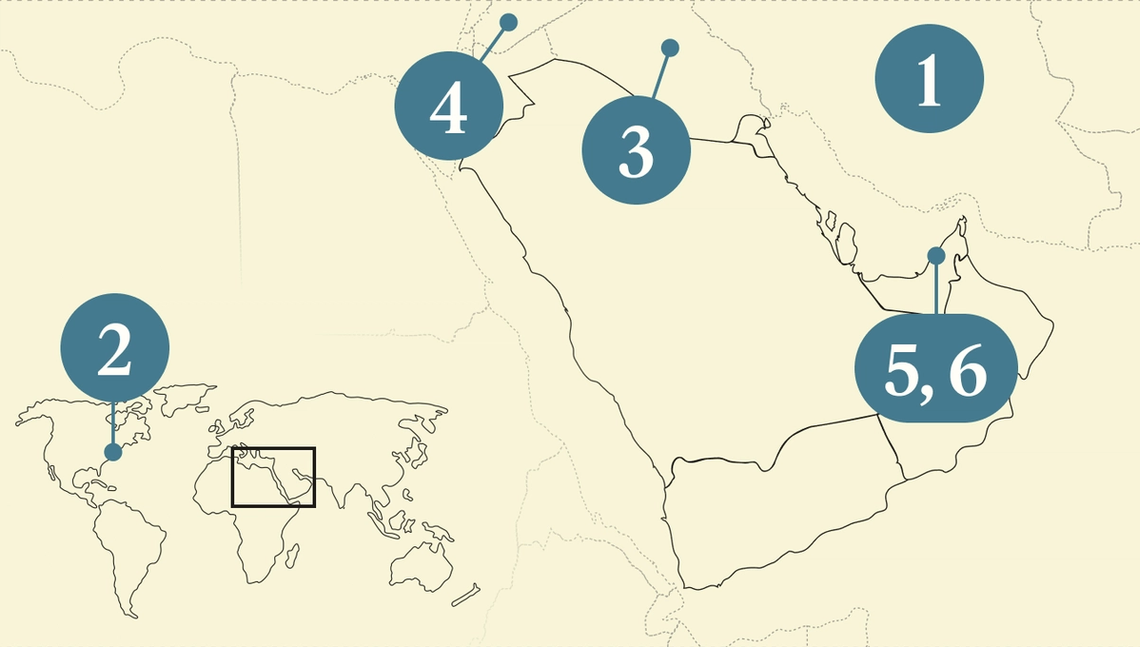 - Iran’s diplomatic signals
- Hormuz remaps energy
- US strikes Iraq deals
- Alabbar’s $20B Syria bet
- War cools RAK boom
- Dubai’s real estate outlook
 How Oct. 7 broke an unlikely friendship. |
|
Iran hints at diplomatic opening |
 Stringer/Reuters Stringer/ReutersThe US and Iran continue to trade strikes, but there are at least some signs diplomacy could be given another chance. Pakistan has not given up on its role as mediator, and a dual US-Iranian citizen, Dena Karari, was freed by Tehran, a move welcomed by US President Donald Trump as a “gesture of goodwill.” An Iranian government spokesman said on Wednesday the Islamic Republic had no plans to resume talks, but later in the day the country’s chief negotiator said that discussions do not mean compromise, but are a way to protect national interests. On the war front, the US hit an Iranian army barracks, struck an oil tanker headed for Iran’s Kharg Island, and bombed Greater Tunb — one of three Iranian-controlled islands near the Strait of Hormuz claimed by the UAE. Trump was reportedly briefed on options that included sending ground forces to seize islands. Iran fired at Bahrain, Jordan, and Kuwait, while threatening to hit infrastructure around the Gulf, and warning that control of the strait was an “invincible red line.” |
|
Energy security in a ‘low-trust world’ |
 The Aspen Institute/YouTube The Aspen Institute/YouTubeNearly five months after traffic through the Strait of Hormuz was first disrupted, the biggest impact hasn’t been on oil prices but on how countries think about energy security. Crude prices have remained lower than many expected, thanks to large prewar inventories, the release of emergency reserves, Saudi and UAE pipeline diversions, and higher output from producers elsewhere in the world, according to Fatih Birol, executive director of the International Energy Agency. But those measures are temporary, he warned. With inventories falling and ships under fire in Hormuz, “it’s too optimistic to believe that the global economy is off the hook,” he told the Aspen Security Forum. Countries recognize that the “global energy map is being redrawn” and are prioritizing supplies from what they perceive to be more reliable producers, which “will increase the cost of energy in a low-trust world,” he said. Another shift may be China’s role. Former US energy security official Meghan O’Sullivan noted that China’s 4 million-barrel-a-day reduction in demand since the war began helped cushion the supply shock. While there are questions about how long that can be sustained, it raises the prospect that Beijing could now be a “swing consumer,” with “geopolitical influence along the lines that Saudi Arabia has had in the past” as the market’s swing producer. — Mohammed Sergie |
|
Semafor Exclusive Iraqi dealmaking in post-Hormuz world |
 Trump meets with Iraqi PM Ali al-Zaidi in Washington. Evan Vucci/Reuters. Trump meets with Iraqi PM Ali al-Zaidi in Washington. Evan Vucci/Reuters.The US and Iraq are slated to announce $60 billion in commercial agreements at a US Chamber of Commerce summit Friday, according to a conference agenda seen by Semafor. The visit by Iraq’s prime minister comes as Washington works to reduce Iran’s influence and leverage over Iraq and the wider Gulf region. Central to that strategy is a plan to rebuild the Kirkuk-Baniyas pipeline, which would carry Iraqi crude to Syria’s Mediterranean coast, bypassing the Strait of Hormuz. Gulf states are also weighing a land transit corridor through Iraq and Syria, with Abu Dhabi’s AD Ports Group in talks with Syrian customs officials over border crossings and free zones. “There are going to be a lot of deals,” US President Donald Trump said, arguing Iraq had “tremendous potential because of their oil.” Trump also suggested that the US no longer needed a military footprint in the country, saying the relationship should instead center on economic partnership. — Lauren Morganbesser and Ed Clowes |
|
 Mahmoud Hassano/Reuters Mahmoud Hassano/ReutersDubai developer Mohamed Alabbar is planning housing and tourism developments in Syria worth at least $20 billion, including homes, resorts, and schools in Damascus and the coastal city of Latakia. The proposed projects — part of a wave of Gulf capital being poured into Syria’s reconstruction — align with a broader effort to keep the country out of Iran’s orbit. For UAE property developers that were facing a slowing home market even before the Iran war, Syria also represents an international growth opportunity. Alabbar’s Syria ventures will be run through his Abu Dhabi-based firm Eagle Hills, which has close ties to the emirate’s ruling family, rather than via Dubai-based Emaar. Syrian President Ahmed al-Sharaa calls him periodically to check on progress, Alabbar told Bloomberg, adding that he isn’t deterred by the risk: “We’ve had incidents, we’ve had bombings, but I’m from the Middle East … I know the game.” |
|
Ras Al Khaimah stalls ahead of Wynn |
 A rendering of the planned Wynn resort on Al Marjan island. Courtesy of Wynn. A rendering of the planned Wynn resort on Al Marjan island. Courtesy of Wynn.Ras Al Khaimah built for a property boom around a casino, but the casino is running late. The low-profile emirate, best known for its ceramics, has been reinventing itself around Wynn Resorts’ $5.1 billion Al Marjan Island resort, which will house the Gulf’s first legal casino. However, the Iran war has caused logistics problems and undermined the tourism sector, prompting Wynn to delay the resort’s planned spring 2027 opening by a “modest,” if unspecified, amount. The emirate’s wider real estate market is also slowing. Developers have launched more projects than there are buyers, AGBI reported. Prices have started to ease, though they remain near four times their 2021 level. If the casino plans do move ahead, the UAE gambling market could be worth $3 billion to $5 billion a year, about 1% of national output. — Manal Albarakati |
|
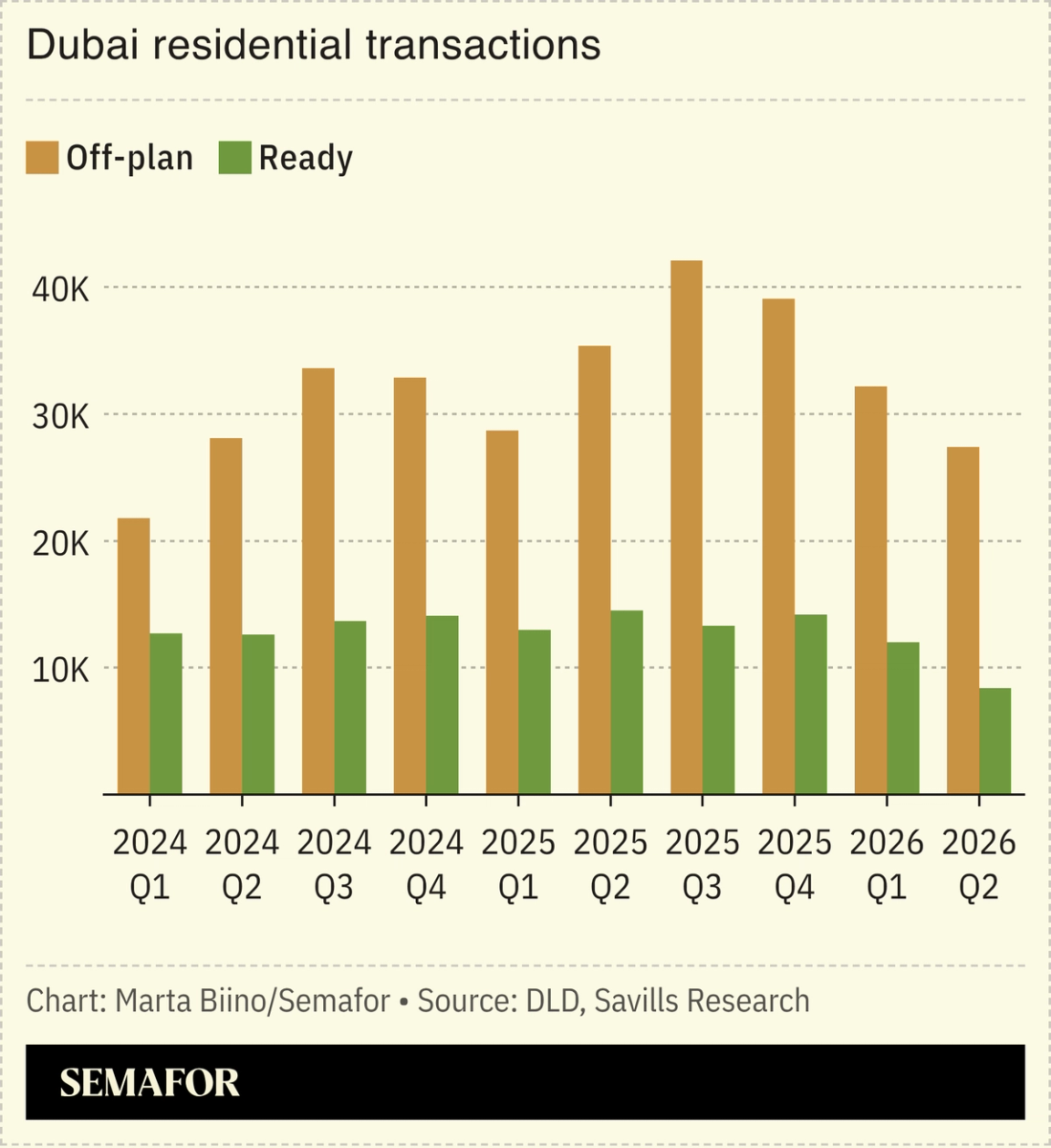 The ultra-wealthy are pulling back from Dubai real estate amid the Iran war, bringing a sharp pause to the years-long rush that made the city one of the hottest property markets in the world. Home sales above 10 million dirhams ($2.7 million) fell 54% in the second quarter compared to the first, to 864 transactions, according to real-estate brokerage Savills. Dubai’s status as a tax-free haven with flexible long-term residency visas has drawn buyers from China, Europe, India, and Russia in recent years, turning the emirate into one of the fastest-growing cities for millionaires. Now, buyers are pulling back across the board, cooling on new and secondary sales, as well as off-plan purchases still years from completion. Developers are slowing down, too, announcing far fewer projects and longer timelines. Projects once expected to be done in three years could now take four, according to Savills. — Kelsey Warner |
|
 DefenseCrypto- UK neobank Revolut won preliminary approval from Dubai’s crypto regulator VARA to offer digital-asset trading in the UAE, nearing the final step in allowing customers to buy, sell, and hold crypto through its app.
Ports- The former chairman and CEO of Dubai’s DP World, Sultan Ahmed Bin Sulayem, has popped up in Malaysia as the new head of MMC Port Holdings, the country’s largest port operator. The Emirati billionaire left DP World in February amid scrutiny over his ties to convicted sex offender Jeffrey Epstein. — Reuters
Stocks- SpaceX shares dipped below the company’s IPO price for the first time on Wednesday, erasing paper gains that investors including many Gulf funds had recorded. Sovereign funds including Saudi Arabia’s Public Investment Fund, Kuwait Investment Authority, and Qatar Investment Authority all reportedly placed orders for billions of dollars of shares in the IPO. — Enterprise Saudi
|
|
 Destroyed houses in Gaza. Mahmoud Al-Basos/Reuters. Destroyed houses in Gaza. Mahmoud Al-Basos/Reuters.The Oct. 7, 2023 Hamas attack and Israel’s response unleashed a chain of events that is still reshaping the Middle East. They also destroyed a close friendship between Israeli tech entrepreneur Eyal Waldman and Palestinian businessman Bashar Masri. Bloomberg’s Ethan Bronner tells the story of their friendship — from skiing in the Alps to trips on yachts and business deals — and its collapse, with Waldman accusing Masri of being complicit in the Hamas assault on Israel in which the Israeli tycoon’s daughter was murdered. Their fractured relationship encapsulates the hardening of Israeli and Palestinian views, making broader Arab-Israeli normalization more difficult. |
|
|


