
|


 |
My elderly rabbit Giggles has unfortunately been quite sick the past two days (he’s recovering now), so I haven’t had as much time to write. Instead I thought I would repost a book review I did two years ago. I’ll be back with more original content tomorrow!
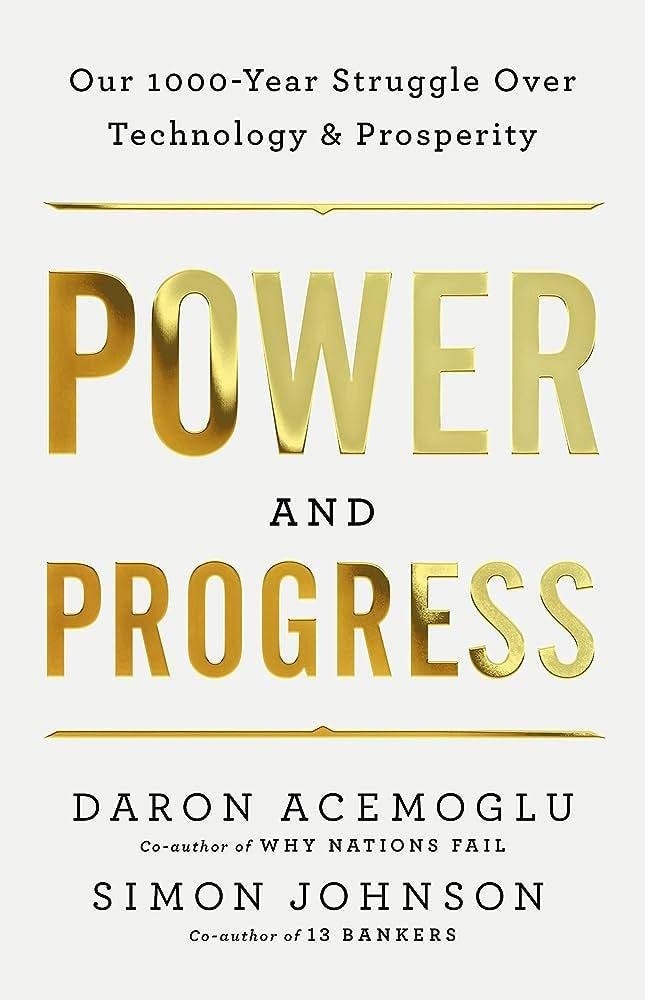
In my post yesterday about the “We Must Act Now” statement, I noted that Daron Acemoglu successfully got the writers to alter some key language in exchange for his signature — most likely, adding the “steering” idea that I took issue with. Technological “steering” is the central policy recommendation of Acemoglu’s 2023 book Power and Progress, with Simon Johnson.
As it happens, I wrote a review of Power and Progress, back in 2024. In fact, it was by far the longest book review I’ve ever written.¹ I actually read the book cover to cover in detail, marking passages and looking up sources as I went; this took a very long time, and it was very frustrating, since I had serious objections to nearly every part of the book. I took out that frustration by writing a very long and highly critical review.²
So anyway, here’s that review for you to enjoy. Hopefully it gets a few people to think a little harder about the AI-related ideas that Acemoglu has been promoting throughout the econ world, and why it would be a big mistake to make those ideas the default position of the economics profession on the AI issue.
“Do not be fooled by the monumental technological achievements of humankind.” — Acemoglu and Johnson
It’s hardly surprising that Power and Progress made it onto practically every list of the most important business books of 2023. First, there’s the unrivaled pedigree of the authors themselves. To call Daron Acemoglu a powerhouse in the world of economics would be a ludicrous understatement:
 |
Acemoglu is also the main proponent of the institutional explanation for national development, through his famous book Why Nations Fail and its sequel, The Narrow Corridor (both with James Robinson). If you hear me talk about “inclusive institutions” and “extractive institutions”, I’m channeling Acemoglu.
Simon Johnson, meanwhile, is the author of some of my favorite popular books about economic policy, especially Jump-Starting America (with Jonathan Gruber) and 13 Bankers (with James Kwak). When I write more about the need to spend more on science and to restrain the excesses of the finance industry, I’m channeling Johnson.
The second reason this book was destined to garner attention is that it brings together two extremely timely strains of thought: 1) the widespread distrust of tech companies that has grown in American society over the last few years, and 2) the wave of anxiety over AI-driven automation. Power and Progress weaves those two anxieties into a more-or-less coherent whole — a sum of all technological fears, if you will. And it seems to have been spectacularly well-timed, since its release coincided closely with the coming of ChatGPT and other generative AI.
But given all of those powerful tailwinds, I have to say I’m kind of surprised at how little of a splash Power and Progress seems to have made. This is anecdotal of course, but in the 9 months since it came out, I’m not sure I’ve once heard someone reference the book or any idea in it. The authors clearly intended it to be a handbook for people who are scared about AI putting humans out of a job, the way Thomas Piketty’s Capital in the Twenty-First Century became a handbook for people worried about inequality, or Robert Gordon’s The Rise and Fall of American Growth became a handbook for people concerned about technological stagnation. But I don’t think it did.
Why not? One reason might be that the timing wasn’t as favorable as it might appear. Contrary to Acemoglu and Johnson’s assertion (on p.24 of the hardcover edition) that we live in an age of “blind techno-optimism”, the internet is absolutely chock-full of arguments and warnings about the downsides of AI. Concerns over the risk of rogue Artificial General Intelligence resulted in a boardroom coup attempt that almost drove Sam Altman out of OpenAI. Worries that AI wouldn’t uphold diversity led Google to implement some pretty hilarious countermeasures. Fears of mass surveillance, deepfakes, etc. are widespread. And of course the idea that AI is going to lead to mass unemployment is absolutely ubiquitous — so much so that practically every San Francisco tech event I go to features discussions about exactly this subject. Yes, even dance parties.
In other words, Power and Progress may have come out a little too late to make a big splash, and instead ended up just being one more voice shouting in the chorus.
On top of that, though, I have to say that this book…well, I just don’t think it’s very good. I winced while I wrote that sentence, because Simon Johnson is a personal friend, and Acemoglu is a celebrated genius, and because both of them have written such good books in the past. This is the first broadly negative book review I’ve written since 2014, and I’m a lot less combative of a blogger than I was a decade ago. I did not want to pan this book, especially because I think the topic is a good and important one, and I think the authors are brilliant people whose hearts are in the right place.
But I just don’t think the way this book was written ends up supporting the conclusions it draws. The historical examples it cites simply don’t support a narrative of out-of-touch technologists inventing the wrong sorts of technologies and hurting workers in the process. The book embraces a highly questionable definition of “power” in which persuasion in an open democratic society is painted as a threat. It often seems to assume its conclusions about the impacts of specific technologies, and it tells a jumbled and confusing story about the role of productivity growth. And its central claim — that society can push entrepreneurs to steer innovation in a direction that augments humans instead of replacing them — is not well-supported.
All in all, Power and Progress just fails to convince.
The basic idea
Power and Progress is of the “magisterial sweeping tome” class of econ book, like Capital in the Twenty-First Century, The Rise and Fall of American Growth, or Brad DeLong’s Slouching Toward Utopia. Much of the book is a history of technological innovation in general. As such, it tends to ramble; the authors often seem to get so caught up in the telling of this history that they neglect to tie each event to their central theses. In fact, those are often the most fun and fascinating parts of the book. But if I were to boil down Power and Progress to a set of core ideas, it would be:
Technological innovation’s impact on human welfare depends crucially on social choices about how those innovations are used.
Those choices are determined by the relations of power in a society, and in recent decades our choices have been steered in a negative direction by the power of tech company founders and venture capitalists.
The type of technologies that society invents can be chosen so as to distribute benefits more widely, by avoiding technologies that replace workers and inventing technologies that complement workers.
It’s the last of these that t